First Seen
2023-05-10T21:03:38+00:00
simple-description (llama3.2-vision_11b)
The meme is an image of a character from the animated series "Star Wars" (specifically, a young version of Anakin Skywalker) wearing a graduation cap and holding a diploma. The character is sitting at a desk with a stack of books and a cup of coffee, and there is a caption below the image that reads "When you finally get that PhD in Sith Studies".
detailed-analysis (gemma3-27b-vision)
Okay, here's an analysis of the image broken down into sections as requested, focusing on the theoretical approaches that apply.
Visual Description
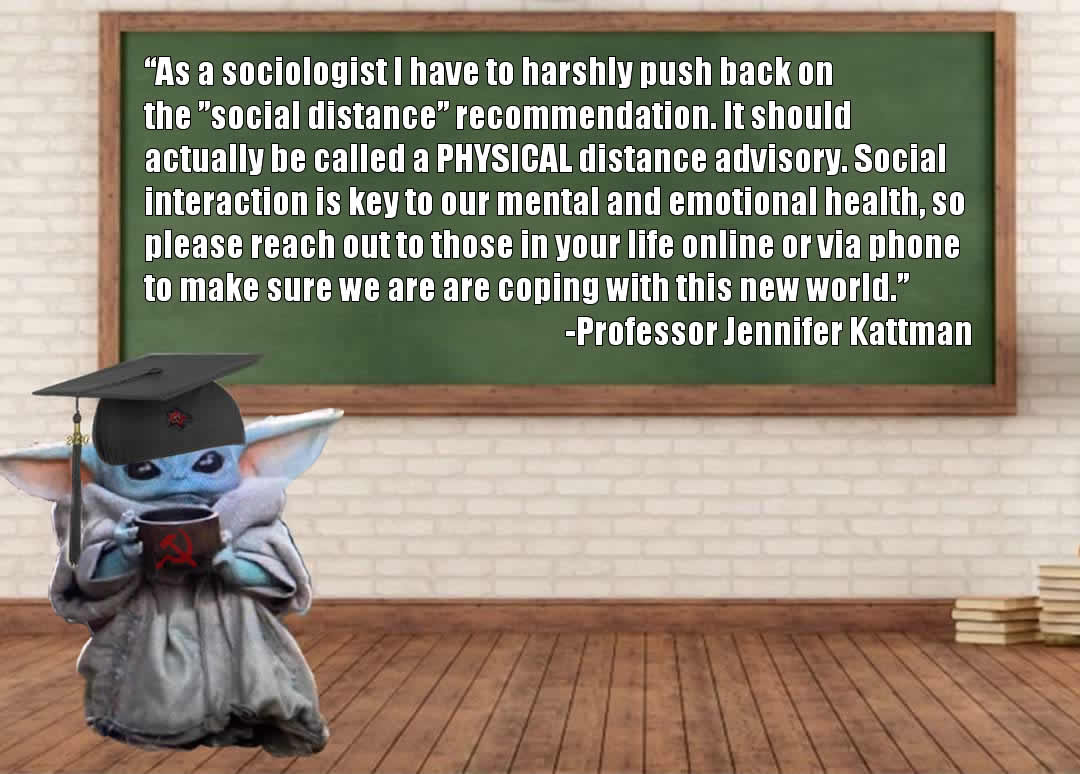
The image features "Baby Yoda" (Grogu) from the Disney+ series The Mandalorian. He is depicted sitting at a school desk in what appears to be a classroom, though it is minimalistic. Grogu is dressed in a graduation cap and gown, making him resemble a graduate. Behind him is a chalkboard with text in white, reading: "As a sociologist I harshly push back on the ‘social distance’ recommendation. It should actually be called PHYSICAL distance advisory. Social interaction is key to our mental and emotional health, so please reach out to those in your life online or via phone to make sure we are coping with this new world.” The text is credited to "Professor Jennifer Kattman." The room appears empty and somewhat sterile, and there are blurred books in the background.
Foucauldian Genealogical Discourse Analysis
This image, and the quote on the chalkboard, is very fertile ground for a Foucauldian analysis.
- Discourse & Power: The core of Foucault’s work centers around how discourse (ways of talking, thinking, and representing) constructs reality and is intimately tied to power. The quote actively challenges the dominant discourse of "social distancing" that arose during the COVID-19 pandemic. The professor isn’t simply disagreeing with a public health recommendation; she's arguing that the language itself is problematic, framing distance as something inherently social rather than physical. By re-framing the term, she attempts to alter the power relations embedded within the discourse.
- Genealogy: We can trace the genealogy of "social distancing" – how this term gained prominence, the authorities that promoted it, and how it became normalized as a way to manage the pandemic. The professor's statement is a direct challenge to this historical process, arguing that the term has unintended consequences because it pathologizes connection.
- Biopower: Foucault’s concept of biopower—the ways in which power operates on life itself—is also relevant. The initial intention of “social distancing” was to protect life, yet the professor argues that excessive emphasis on distance undermines mental and emotional well-being—another aspect of life. The image with a baby Yoda in the context of school indicates a focus on the life of the future generations, which highlights the concern with the detrimental effects of the imposed "social distancing".
The use of a symbolic character like "Baby Yoda" in this context can be seen as a strategy to make the argument more palatable or engaging, softening the critique of a potentially controversial stance.
Critical Theory
The image and quote resonate strongly with the tenets of Critical Theory, particularly the Frankfurt School’s emphasis on critique of ideology and the need to challenge dominant narratives.
- Ideology Critique: The quote is a clear critique of what the professor sees as an ideology embedded within the “social distancing” recommendation. She believes that the term reinforces an isolating and potentially harmful worldview, obscuring the fundamental human need for connection.
- Reason & Enlightenment: A key aspect of the Enlightenment and subsequent Critical Theory is the potential for reason to be used to both liberate and oppress. The professor, as an academic, is employing her reasoned critique to challenge what she perceives as a problematic application of reason (the idea that distance can solve all problems).
- The Role of the Intellectual: Critical theorists believe intellectuals have a responsibility to critique power structures and offer alternative ways of understanding the world. The professor’s statement and the context of it being presented on a chalkboard in a classroom position her as an intellectual fulfilling this role.
Postmodernism
Postmodern elements are present, though perhaps subtly:
- Deconstruction of Language: The professor’s insistence on the term “physical distance” rather than “social distance” is an act of deconstruction—challenging the assumed meaning of a term and revealing the underlying power dynamics it embodies.
- Rejection of Grand Narratives: The emphasis on individual wellbeing and the need for connection could be seen as a rejection of a "grand narrative" that prioritizes public health metrics over human connection.
- Playfulness & Irony: The use of the “Baby Yoda” character, while serving a symbolic purpose, also injects an element of playfulness and irony into what is otherwise a serious critique. The character's presence disrupts the expected tone of an academic statement, inviting a more nuanced engagement with the message.
Note: Marxist Conflict Theory and Queer Feminist Intersectional Analysis don't have strong, direct applications to the image in this case. While we could stretch connections, they feel forced. There are no clear power dynamics based on class struggle or explicit issues of gender, sexuality, and intersectional identity present within the image or the quoted statement.
Let me know if you'd like me to expand on any particular aspect of this analysis!
simple-description (llama3.2-vision)
This meme is an image of a character from the Star Wars franchise, Grogu (also known as Baby Yoda), sitting in a classroom. The character is wearing a graduation cap and holding a cup of coffee. The text on the image reads: "As a sociologist I have to advise against the 'social distance' recommendation. It should be called a 'physical distance' advisory. Social interaction is key to our mental and emotional health, so please reach out to those in your life online or by phone to make sure we're all doing okay during this time."
tesseract-ocr
“AS a sociologist | have to harshly push backon the “social distance” recommendation. Itshould actually be called a PHYSICAL distance advisory. Social interaction is key to our mental and emotional health, so please reach outto those in your life online or via phone to)make sure we are are coping with this new world.” -Professor Jennifer Kattman se = a —— ‘ rd We = aN