First Seen
2023-05-10T21:03:38+00:00
simple-description (llama3.2-vision_11b)
This meme features a screenshot from the animated TV series "Avatar: The Last Airbender" with the character Iroh, a wise and spiritual mentor, speaking about the nature of wisdom. The image is captioned "Iroh: 'I don't get wisdom, I get tired'" and is often used humorously to express the feeling of being exhausted from trying to understand complex concepts.
detailed-analysis (gemma3-27b-vision)
Okay, let's break down this image from Avatar: The Last Airbender through several theoretical lenses.
Visual Description
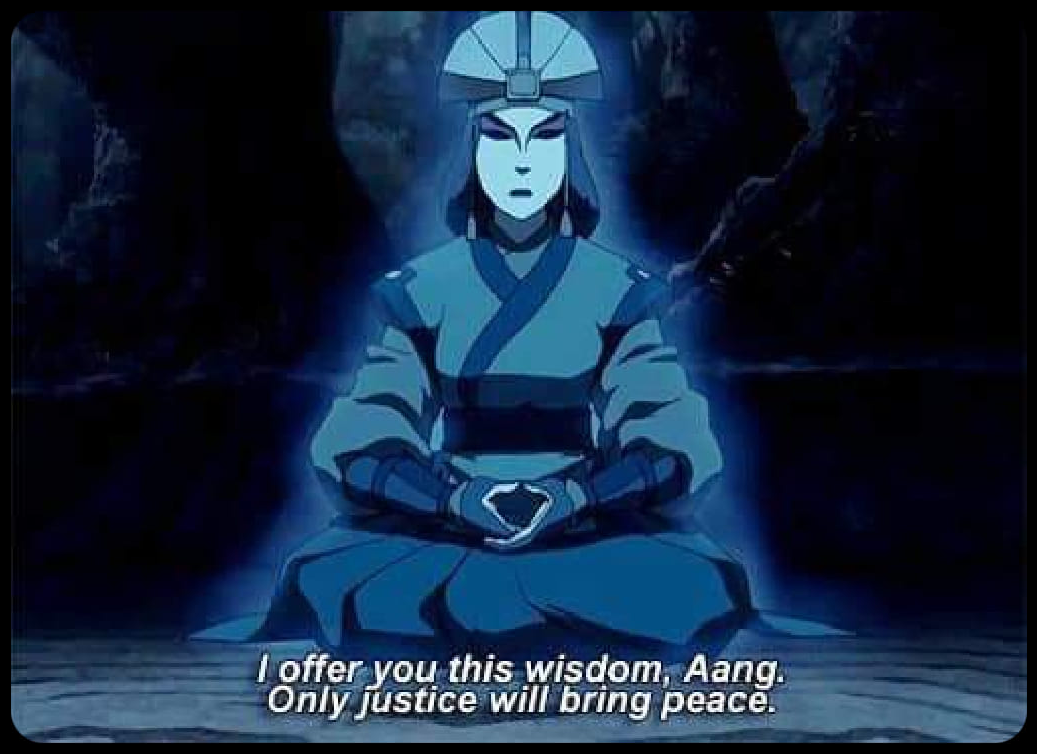
The image depicts a figure, presumably a spirit or a past Avatar, meditating in a darkened, cave-like space. The figure appears to be a man of East Asian origin with a shaved head and a distinctive, angular headdress. He is clad in layered blue robes and has hands clasped in a meditative pose, with a faintly glowing energy radiating from them. The overall aesthetic is one of somber authority and spiritual power. The lighting is dramatic, highlighting the figure and casting the background into shadows. Beneath the image, text reads, "I offer you this wisdom, Aang. Only justice will bring peace." The composition centers the figure, emphasizing his role as a source of guidance and his central message.
Foucauldian Genealogical Discourse Analysis
This image and the accompanying statement are rife with discourses of power, knowledge, and justice. Foucault would be interested in how the very concept of “justice” is constructed and used as a mechanism of power.
- Discourse of Justice: The statement itself isn't a neutral expression of morality. It's a discursive assertion that links "peace" not to harmony or simply the absence of conflict, but to justice. This requires defining what constitutes "justice" within the Avatar universe, and that definition is potentially tied to existing power structures. Is it retribution, restoration, or a rebalancing of societal forces?
- Genealogy of “Justice”: A genealogical investigation could trace the historical development of the idea of "justice" within the Avatar world. Who historically defined justice? What institutions (e.g., courts, the Fire Nation royalty, spiritual leaders) have enforced it? How has this definition changed over time? The form of dress, body language and even the color blue hint at the Water Tribe and could imply the speaker’s history and biases.
- Power/Knowledge: The figure is positioned as an authority – one who offers wisdom, implying a position of knowledge and power. This power stems from his perceived access to deeper truths. Foucault would argue that knowledge isn't neutral; it's intertwined with power. The figure’s very ability to speak the truth about justice, and to be heard by Aang, is an exercise of power.
Critical Theory
Applying a critical theory lens (drawing on Frankfurt School thinkers like Adorno and Horkheimer) we can consider how the statement "Only justice will bring peace" functions as an ideology.
- Ideological Function: The statement presents a seemingly simple solution – justice as the path to peace – but obscures the complexities involved in achieving it. This can act as a hegemonic force – making it appear that a particular understanding of justice is natural and inevitable.
- Reason and Enlightenment: The statement taps into Enlightenment ideals of reason and justice. However, a critical theorist would ask whose reason and whose justice are being privileged? The visual presentation (the meditative pose, the solemn expression) evokes a sense of transcendental truth, potentially masking underlying social and political interests.
- Domination and Control: The assertion could be seen as a way to legitimize social control. If peace is contingent on justice, then any actions taken in the name of "justice" (even if coercive or violent) can be justified as necessary for maintaining order.
Marxist Conflict Theory
From a Marxist perspective, the image and statement are indicative of class struggle and power dynamics.
- Social Relations of Production: Within the Avatar universe, there are clear inequalities (e.g., the Fire Nation’s imperialistic ambition, the suppression of bending arts in certain communities). “Justice” in this context likely relates to addressing these fundamental imbalances in power.
- Superstructure & Ideology: The statement "Only justice will bring peace" can be seen as part of the ideological superstructure, serving to reinforce or challenge existing power relations. Is it a call for revolution and redistribution of resources, or a justification for maintaining the status quo under the guise of fairness?
- Class Consciousness: Aang, as the Avatar, is uniquely positioned to understand the suffering of all nations. This statement could be a catalyst for Aang to develop greater class consciousness, recognizing the root causes of conflict as stemming from economic and social exploitation. The figure's role is as a source of knowledge and therefore, he implicitly participates in the ideology.
Postmodernism
A postmodern lens would deconstruct the statement and challenge any claims to universal truth.
- Deconstruction of "Justice": Postmodern thought, particularly that of Derrida, would question the very meaning of "justice." Justice isn't a fixed concept; it's a social construct that varies across cultures, historical periods, and individuals.
- Rejection of Metanarratives: The statement implies a metanarrative – a grand, overarching story about how to achieve peace. Postmodernism rejects such metanarratives, arguing that they are inherently oppressive and exclude alternative perspectives.
- Subjectivity & Relativism: Postmodernism emphasizes the subjectivity of experience. What one person perceives as "justice" may be different from another’s. The image itself is a representation of an idea, not a transparent window onto truth. This invites us to consider the perspective of the figure, Aang, and the unseen forces shaping their understanding of justice.
Queer Feminist Intersectional Analysis
While the image doesn't explicitly address gender or sexuality, an intersectional feminist analysis can still illuminate power dynamics and consider marginalized perspectives.
- Silencing & Marginalization: A feminist lens encourages us to ask: whose voices are missing from this conversation about justice and peace? Are the experiences of women, non-binary individuals, or those with marginalized social positions being considered? The image only shows one figure and Aang and could be a sign of male dominance.
- Power & Representation: How is power being exercised through the very act of speaking about justice? Who has the authority to define it, and who is excluded from the conversation? The figure, as an authority, is potentially perpetuating patriarchal or other oppressive structures.
- Interlocking Systems of Oppression: An intersectional analysis would recognize that justice cannot be achieved in isolation from other forms of oppression (e.g., racism, classism, ableism). True justice requires dismantling all systems of power that perpetuate inequality. It can also apply to the bending arts where certain styles were encouraged over others.
I hope this detailed breakdown is helpful! Let me know if you'd like me to explore any of these theoretical frameworks in more depth, or if you'd like me to apply other lenses to the image.
simple-description (llama3.2-vision)
This meme features a screenshot from the animated TV series "Avatar: The Last Airbender" with the character Iroh, who is a wise and spiritual leader. The image shows Iroh in a meditative pose, with a calm and peaceful expression on his face. The text overlayed on the image reads: "I offer you wisdom, Aang. Only justice will bring peace."
tesseract-ocr
a 4 ny yy : \ | : V3 a =| 4 } [> al ’ i r ¥ het | , Tay Fi \ Y ——— ’ iG Cy = _ - ee AlN m MEL (ol steele: em — eI TES et 7 5 ai Tey sel =~ a — . : a i —