First Seen
2023-05-10T21:03:38+00:00
simple-description (llama3.2-vision_11b)
The meme features a photo of a child playing with a toy, but with a twist: the child is dressed as a Nazi soldier and is holding a toy gun. The image is captioned "When you finally understand the true meaning of 'OC'". The meme is a humorous commentary on the internet culture of "Original Content" (OC) and how it can be misinterpreted or distorted by users.
detailed-analysis (gemma3-27b-vision)
Okay, here's an analysis of the image broken down into the requested sections, focusing on the visible elements and drawing upon the specified theoretical frameworks. I will only include sections where the theory applies significantly to an analysis of the image.
Visual Description
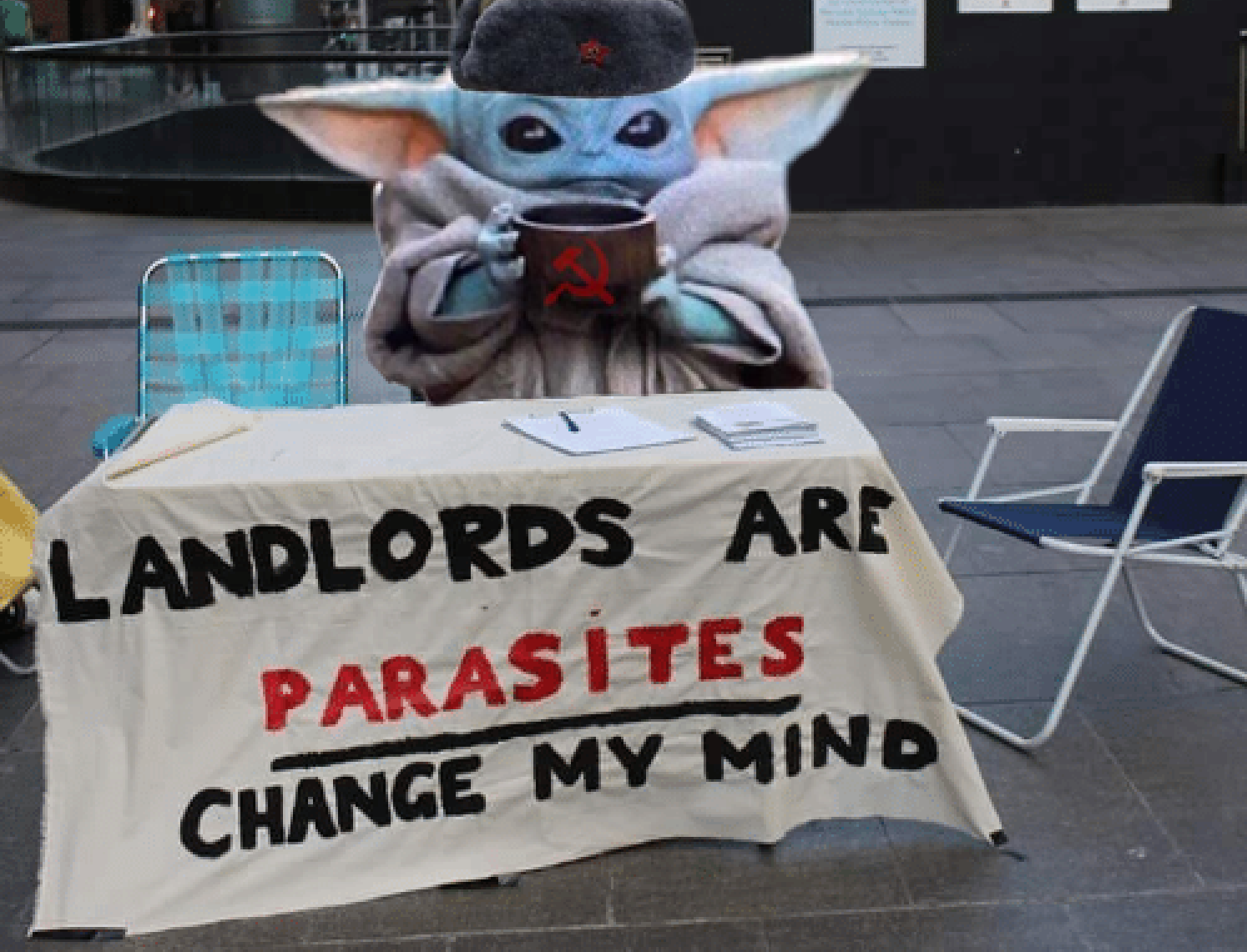
The image shows a life-sized, soft sculpture (likely fabric) representation of “Baby Yoda” (Grogu) from the Disney+ series The Mandalorian. Baby Yoda is seated at a small table, holding a mug as if drinking from it. In front of Baby Yoda is a banner that reads, in large, red lettering, "LANDLORDS ARE PARASITES CHANGE MY MIND." The backdrop appears to be a public outdoor space (sidewalk, possibly in front of a business), and there's a blue plastic folding chair to the right. The lighting is natural, indicating the photo was taken outdoors during the day. The overall aesthetic is somewhat homemade and deliberately provocative, combining pop culture with political messaging.
Marxist Conflict Theory
This image is strongly rooted in Marxist conflict theory. The central statement – “Landlords are Parasites” – directly aligns with Marxist critiques of capitalism.
- Class Struggle: The statement positions landlords as the exploiting class, benefiting from the labor and needs of others (tenants) without contributing productive labor themselves. This creates inherent class conflict. The "parasite" metaphor highlights the idea that landlords extract wealth (rent) without generating equivalent value, thus harming the working class.
- Mode of Production & Relations of Production: Rent, within this framework, is seen as surplus value extracted from those who need housing. The relationship between tenant and landlord is inherently unequal – one controls a vital resource (housing), while the other is dependent on access to it.
- False Consciousness & Ideology: The use of “Baby Yoda” is a fascinating element. Baby Yoda is a universally beloved pop culture figure, designed to evoke feelings of comfort and positivity. By pairing this beloved image with a strongly anti-capitalist message, the creator attempts to subvert the dominant ideology. It's a strategy to make a potentially alienating or confrontational message more approachable and invite engagement.
- Call to Action/Change: The phrase "Change My Mind" is a direct invitation to debate and contest the prevailing power structures. It implies that this is not simply a statement of opinion, but a challenge to the status quo.
Foucauldian Genealogical Discourse Analysis
While Marxist analysis provides a strong structural reading, a Foucauldian approach highlights the discourse surrounding housing and property ownership, and how this image attempts to disrupt that discourse.
- Power/Knowledge: Foucault would argue that the idea of "landlord" and "tenant" aren't neutral categories but are constituted through power relations. Laws, social norms, and economic practices define these roles and legitimize the extraction of rent. The image directly challenges these norms.
- Genealogy of Concepts: A genealogical analysis would trace the historical development of the concept of “property ownership” and how it came to be normalized. It would look at how discourses of individual rights, free markets, and economic efficiency have been used to justify the accumulation of wealth in the hands of landlords.
- Disrupting the Discourse: The image attempts to interrupt the normalized discourse. It's a provocative gesture that aims to force viewers to question their assumptions about housing, property, and the relationship between landlords and tenants. The stark language (“parasites”) is deliberately confrontational, breaking with the more polite and sanitized language typically used in discussions of housing.
- Subjectivity and Normalization: Foucault's work examines how power shapes subjectivity. The image attempts to disrupt the normalization of the landlord/tenant relationship, inviting viewers to see landlords not as legitimate owners but as exploiters.
Postmodernism
A postmodern reading focuses on the image's mixing of signs and its playful subversion of meaning.
- Pastiche & Intertextuality: The image deliberately combines elements from different cultural contexts—a popular media character (Baby Yoda) with a radical political statement. This juxtaposition is a hallmark of postmodern pastiche. It’s a mashup that disrupts conventional meaning.
- Deconstruction of Signifiers: The image challenges the signifier "landlord". It deconstructs the generally accepted positive connotations associated with property ownership and reframes it as parasitic.
- Playfulness & Irony: The use of Baby Yoda is inherently playful. It creates a cognitive dissonance between the cute, innocent image and the serious political message. This irony is a common feature of postmodern art.
- Questioning Metanarratives: Postmodernism rejects grand narratives (like the idea of progress or the inherent goodness of capitalism). The image undermines the dominant narrative that justifies private property and rent as essential components of a functioning economy.
Critical Theory
A Critical Theory lens examines the image as a critique of broader societal power structures and the perpetuation of inequality.
- Ideology Critique: The image functions as an explicit critique of the ideology that supports the landlord-tenant relationship. It reveals how this relationship perpetuates economic inequality and social injustice.
- Emancipation: The "Change My Mind" element hints at the goal of emancipation – freeing people from oppressive structures. It is a call for a re-evaluation of societal norms and a move towards a more just and equitable system.
- Power Dynamics: The image underscores the imbalance of power between landlords and tenants, and calls attention to the ways in which landlords exercise control over a basic necessity (housing).
Note: A Queer Feminist Intersectional Analysis would be difficult to apply without further context. While the image touches on economic inequality, which disproportionately affects marginalized groups, it doesn't explicitly address issues of gender, sexuality, or intersectionality. Without further information about the creator or the specific context of the image, it would be speculative to apply this lens.
Let me know if you'd like me to elaborate on any of these sections or explore other theoretical perspectives.
simple-description (llama3.2-vision)
This meme is a humorous image of the character Baby Yoda from the Star Wars series sitting at a desk with a sign that reads "Landlords are parasites. Change my mind." The image is likely a commentary on the struggles of being a tenant and the frustrations that come with dealing with landlords.
tesseract-ocr
ee / eS ae — P om — . ‘ of t Fr “my LANDLORDS ARE =—/a - » AR AS 5 TE Ss LS CHANGE MY MIND