First Seen
2023-05-10T21:03:38+00:00
simple-description (llama3.2-vision_11b)
The meme is a humorous image of a woman with a shocked expression, captioned "I can explain why my husband left me for a younger woman". The meme is a play on the stereotype that older women are more attractive to younger men, and the caption is a sarcastic commentary on the societal expectations of women's aging and attractiveness.
detailed-analysis (gemma3-27b-vision)
Okay, let's break down this meme through the lenses you've provided. This is a complex image, ripe for interpretation, and not all categories will apply equally or at all. I'll prioritize those where the meme strongly resonates with the theoretical framework.
Please note: This is an interpretive analysis. Many interpretations are possible, and this is just one reading. The inherent darkly humorous and slightly disturbing nature of the meme requires acknowledging its potentially triggering content.
Visual Description
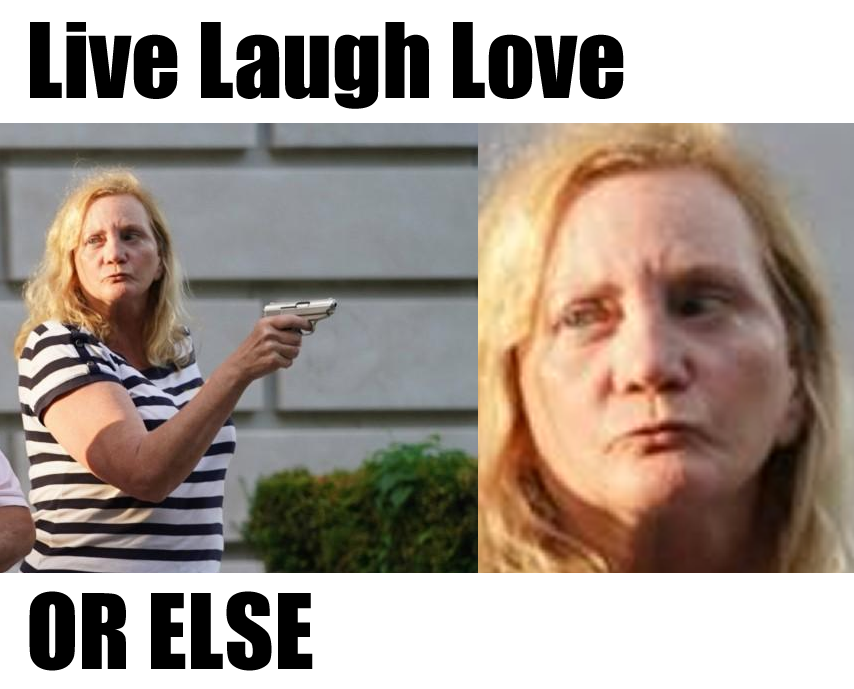
The meme is a two-panel image. The top panel depicts a woman (identified as Karen, a widely recognized internet archetype) in a striped shirt aiming a handgun at the viewer. The backdrop appears to be a suburban house, implying a domestic setting. Her expression is serious and somewhat aggressive.
The bottom panel is an extreme close-up of the same woman, looking directly at the viewer. Her face is contorted, eyes narrowed, and brow furrowed, exuding a threatening and unsettling gaze.
The text "Live Laugh Love OR ELSE" is overlaid on the image. "Live Laugh Love" is a common inspirational phrase, often associated with domestic décor and a certain type of suburban lifestyle. "OR ELSE" is placed below, dramatically contradicting the preceding sentiment and implying a threat.
Foucauldian Genealogical Discourse Analysis
This meme can be read through a Foucauldian lens by examining the power dynamics at play in the construction of "Karen" and the discourse surrounding self-help/positive thinking ("Live Laugh Love").
- Discourse: The "Live Laugh Love" phrase represents a discourse of domesticity, happiness, and surface-level positivity. It’s a societal expectation, a script for how women (particularly suburban homemakers) are supposed to behave and present themselves. The “Karen” archetype, conversely, represents the breakdown of that script – the woman who rejects or actively disrupts this expected behavior.
- Power/Knowledge: The meme suggests the power dynamics inherent in this discourse. The threat ("OR ELSE") reveals the underlying coercion within the "Live Laugh Love" ideology. If one doesn't adhere to the expected norm of perpetual happiness, the meme implies, there will be consequences (represented by the gun). This challenges the notion that this discourse is simply "positive" or "harmless."
- Genealogy: Examining the historical roots of "Live Laugh Love" (tied to early 20th-century self-help movements and evolving marketing practices) can reveal how it became a pervasive cultural norm. Simultaneously, the "Karen" archetype has a genealogy tied to complaints about entitlement, privilege, and aggressive assertion of perceived rights.
- Disciplinary Power: The meme, by juxtaposing these two elements, subverts the disciplinary power of the "Live Laugh Love" ideology. It exposes the absurdity of expecting constant happiness and the potential for rage and resentment that can build up under such pressure.
Critical Theory
The meme fits into Critical Theory by highlighting the hypocrisy and inherent contradictions within dominant cultural norms and expectations.
- Ideology: “Live Laugh Love” is a clear example of ideology – a set of beliefs and values that mask underlying power structures. It presents a simplistic and unrealistic view of life, obscuring the complexities of human experience.
- False Consciousness: The meme suggests that the pursuit of this ideal can be a form of “false consciousness,” preventing individuals from recognizing and addressing the genuine sources of their dissatisfaction or unhappiness.
- Domination: The “OR ELSE” element reveals how this ideology can be used as a tool of domination, enforcing conformity and suppressing dissent.
- Deconstruction: The meme performs a sort of deconstructive act, tearing down the seemingly benign façade of “Live Laugh Love” to expose the violence and threat that may lie beneath. It highlights the disconnect between the idealized image and the potential for real-world conflict.
Postmodernism
This meme plays with postmodern themes of irony, parody, and the breakdown of grand narratives.
- Meta-Narrative Critique: The "Live Laugh Love" phrase represents a meta-narrative - a totalizing story about how life should be lived. The meme subverts this narrative by introducing a violent and absurd element, shattering the illusion of a coherent and harmonious lifestyle.
- Simulacra & Simulation: The "Live Laugh Love" aesthetic can be seen as a simulacrum – a copy without an original, representing a superficial and artificial version of happiness. The gun disrupts this simulation, revealing the emptiness beneath the surface.
- Irony & Parody: The meme is fundamentally ironic and parodic. It takes a widely recognized inspirational phrase and twists it into a threat, creating a jarring and unexpected effect.
- Fragmentation: The meme juxtaposes seemingly unrelated images and ideas, creating a fragmented and disorienting experience that reflects the postmodern condition of uncertainty and lack of meaning.
Regarding Marxist Conflict Theory and Queer Feminist Intersectional Analysis:
These lenses don’t fit as strongly as the others. While you could interpret elements of class dynamics (suburban lifestyle as a marker of privilege) or gender performance (the "Karen" archetype often linked to expectations of white, middle-class women), the meme’s core message isn't explicitly about class struggle or systemic oppression. A stretch could be made to see the "Karen" as representing a type of bourgeois entitlement, but this feels less central to the meme's meaning. Similarly, there isn’t enough detail for a solid Queer Feminist Intersectional analysis.
Let me know if you'd like me to elaborate on any of these points or explore other interpretations.
simple-description (llama3.2-vision)
This meme features a photo of a woman with a shocked and confused expression. The text "Live Laugh Love" is written above her, but she's holding a gun and looking angry, implying that her life philosophy is actually "Live, Laugh, Kill". The image is a humorous commentary on the contrast between the usual inspirational phrase and the woman's aggressive demeanor.
tesseract-ocr
Live Laugh Love OREISE