First Seen
2023-05-10T21:03:38+00:00
simple-description (llama3.2-vision_11b)
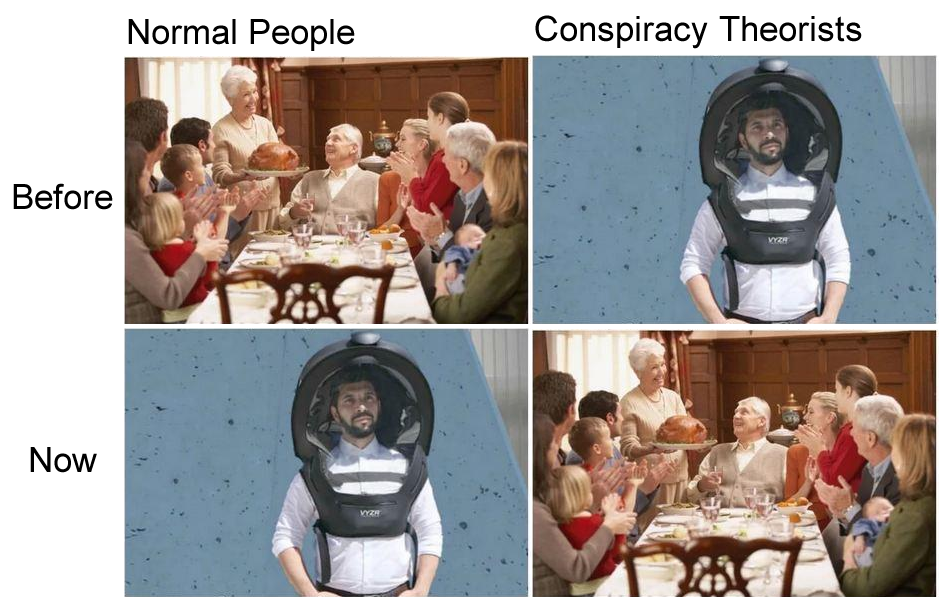
The meme is a humorous comparison between two images, one of a typical person (the "normal" person) and one of a person wearing a virtual reality (VR) headset. The text "I'm not arguing, I'm just explaining why I'm right" appears above the VR image, implying that the person in the VR headset is so convinced of their own correctness that they're not even willing to engage in a discussion.
detailed-analysis (gemma3-27b-vision)
Okay, let's break down this image set using the requested theoretical frameworks. It's a provocative juxtaposition, and lends itself to a lot of interesting interpretation. I will address each section only if it meaningfully applies to the image and themes.
Overall Impression:
The image shows a stark contrast between a "normal" family dinner and a person enclosed in what appears to be a device suggesting sensory deprivation or control. The shift from "before" to "now" implies a transformation or a shift in perspective/experience. This sets the stage for a lot of analysis.
1. Visual Description
- "Before" (Top Row): The left image depicts a large family gathering around a long dining table. There's a sense of warmth and relative abundance. People are engaged in conversation, although not necessarily deep connection. The scene is brightly lit, suggesting a comfortable, idealized domestic space.
- "Before" (Top Right): A man is pictured inside a futuristic, helmet-like device. The device is gray and metallic, with straps and what appears to be technology embedded within. The background is a flat, muted blue. The man's expression is visible and seems slightly concerned.
- "Now" (Bottom Row): The bottom left is the same device. The bottom right is the same family dinner scene.
2. Foucauldian Genealogical Discourse Analysis
This image is very strong in the context of a Foucauldian reading. Foucault focused on the relationship between power, knowledge, and discourse.
- Discipline & Control: The helmet/device is a direct representation of disciplinary power. It physically encloses, potentially restricts senses, and implies external control. The “before” image, while seemingly innocuous, can be read as a normalization of certain social behaviours and expectations around family, and domesticity. The "now" image disrupts that normalization. It suggests the individual has moved away from that expected social behaviour, possibly as a way of exerting agency or trying to understand what drives that system.
- Genealogy of "Normalcy": The "before" image of the family dinner represents what has been constructed as "normal" through centuries of discourse. This "normalcy" isn't natural, but produced through systems of power. The device in the “now” image is a rejection of that construction. It's an attempt to break free from the established order and re-evaluate its foundations.
- Power/Knowledge: The person inside the device likely seeks an alternative "knowledge" or a different way of perceiving reality. Their pursuit of knowledge is intrinsically linked to a rejection of the power structures that created the "normal" that the family dinner represents.
3. Critical Theory
This image lends itself very well to a critical theory interpretation, specifically relating to the Frankfurt School.
- The Culture Industry: The idyllic family dinner scene can be seen as a product of the "culture industry" – the mass production of standardized cultural goods that pacify and control the population. The image suggests a critique of this homogenization. The device represents an attempt to break free from these imposed norms.
- Alienation: The person in the device could be seen as alienated from the traditional social structures represented by the family dinner. They've retreated into a technologically mediated experience in an attempt to find meaning or authenticity.
- Reason and Enlightenment Critique: The image challenges the idea that reason and progress necessarily lead to liberation. The device, while technologically advanced, is also potentially isolating and controlling. This aligns with the critical theory's skepticism towards the uncritical embrace of technological "solutions."
4. Marxist Conflict Theory
This image doesn’t immediately scream Marxist analysis, but there is potential within it.
- Ideology & False Consciousness: The family dinner can be seen as reinforcing dominant ideologies (e.g., the nuclear family as the ideal unit, consumerism, social conformity). The person in the device, however, is potentially disrupting this ideological reproduction. They are questioning the underlying assumptions and power relations that sustain the family structure.
- Class Consciousness: One could interpret the device as a symbol of technological sophistication, potentially available only to certain classes. This creates a division between those who have access to alternative ways of perceiving reality and those who are confined to the dominant ideology.
- Alienation from Labor: (A stretch, but possible.) The person could be seen as alienated from the "labor" of maintaining social relationships and conforming to social norms. The device offers a way to escape that labor.
5. Postmodernism
The image is highly aligned with postmodern thought.
- Deconstruction of Grand Narratives: The image challenges the "grand narrative" of the traditional family and the idea that there is a single, universal "normal" way of life. The device disrupts that narrative and suggests the possibility of multiple, fragmented realities.
- Simulacra & Simulation: The family dinner could be seen as a "simulacrum" – a copy without an original. It's a performance of a domestic ideal that may not reflect genuine connection or meaning. The person in the device is withdrawing from that simulation in search of something more authentic.
- Subjectivity & Fragmentation: The image highlights the fragmentation of the modern subject. The person in the device is withdrawing from social roles and constructing their own subjective reality.
Important Note: The interpretation of an image is always subjective. This analysis presents one possible reading based on these theoretical frameworks. Different perspectives and contexts could yield different interpretations.
Is there anything specific you'd like me to elaborate on or a particular angle you'd like me to explore further?
simple-description (llama3.2-vision)
This meme is a humorous comparison between two types of people. The image shows a person from the "Before" era (representing those who believe in conspiracy theories) and a person from the "Now" era (representing those who don't). The text "In 2-3 sentences, describe this meme for someone who cannot see it" is a prompt, and I'll provide the description.
The meme juxtaposes a person from the "Before" era, who is oblivious to the presence of a surveillance device, with a person from the "Now" era, who is aware of and annoyed by the device. The text "Before: They're watching us" and "Now: They're watching us" are not present in the image, but I assume they are the punchline of the meme. The meme is a humorous commentary on the changing attitudes towards surveillance and the awareness of being watched.
tesseract-ocr
Normal People - Conspiracy Theorists jj j ~~ or Wie 4 y Ps Betore ys gh Dy Yea pga” LJ > | Vy oe cae * Now ) 2. Ia as at get eA ES ArT