First Seen
2023-05-10T21:03:38+00:00
simple-description (llama3.2-vision_11b)
The meme is a screenshot of a tweet from the Twitter account of a character named OC (Original Character) from the Star Wars universe. The tweet is a humorous take on a conversation between OC and a fictional character, with OC expressing their frustration with a friend who won't stop talking about their cat.
detailed-analysis (gemma3-27b-vision)
Okay, let's break down this image and text combination through several theoretical lenses, focusing on those that genuinely seem applicable, given the content. This is going to be quite a layered analysis!
Visual Description
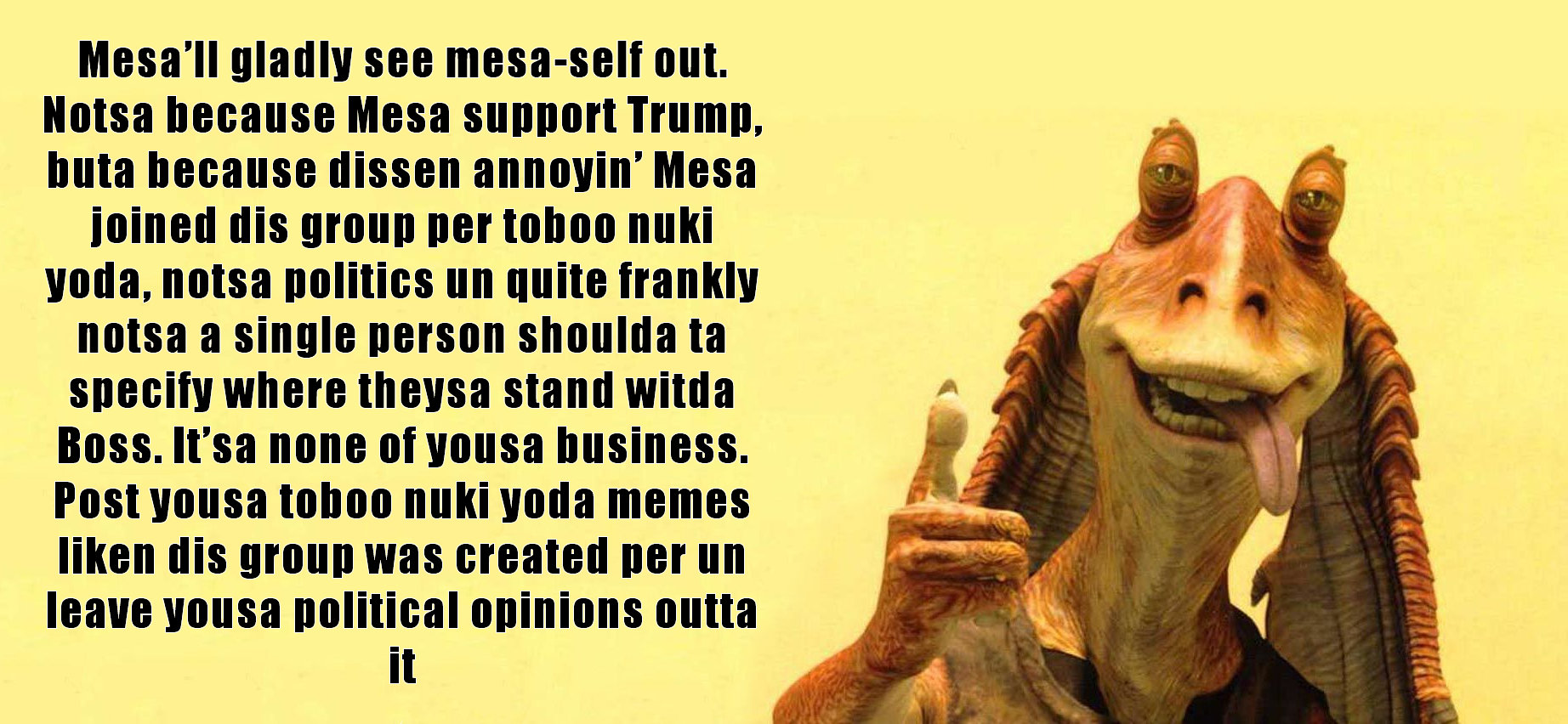
The image depicts Jar Jar Binks, a character from the Star Wars prequel trilogy, standing in a digitally-created space with a yellow background. The visual style appears to be a digitally manipulated image. Jar Jar Binks is positioned in a fairly centered frame, presenting a full-body view of the character. He is rendered as a comical, slightly exaggerated depiction of the Gungan species – with elongated ears, large eyes, and a colorful, textured body. His posture is relatively neutral, but the overall effect is intentionally humorous.
Foucauldian Genealogical Discourse Analysis
This is where things get interesting. The text is deliberately constructed with a dialect mimicking Jar Jar Binks. It's not standard English. This immediately sets up a discursive space. Foucault’s work on discourse examines how language shapes power relations.
- Power/Knowledge: The text isn't just conveying information; it's enacting a particular way of speaking that’s tied to the character. This way of speaking becomes a way of defining the speaker. The speaker performs Jar Jar Binks and, in doing so, claims (or disclaims) certain stances. The text simultaneously positions the speaker as Jar Jar Binks (and therefore, potentially seen as unsophisticated or comedic) and attempts to assert an opinion on political issues.
- Genealogy: We can trace a “genealogy” of this meme/textual practice. It begins with the character of Jar Jar Binks, who was initially criticized (and even derided) by sections of the Star Wars fandom. This created a counter-discourse where Jar Jar Binks became a figure of ironic appreciation or a symbol of perceived flaws in the prequels. The appropriation of his speech patterns in this text builds on that history.
- Disciplinary Power: The insistence on using Jar Jar’s dialect ("Mesa," "dissen," "yousa") could be interpreted as a subtle assertion of control over the discourse. By choosing to communicate in this way, the speaker is forcing the audience to engage with the text on their terms, potentially deflecting criticism or challenging the ‘normative’ way of discussing politics.
Critical Theory
This text and image demonstrate aspects of the Frankfurt School's critiques of culture and mass media.
- Culture Industry: The appropriation of a pop culture icon (Jar Jar Binks) and its speech patterns for political commentary can be seen as a symptom of the "culture industry." The blurring of boundaries between entertainment and serious discourse is a hallmark of this. The text is using a recognizable element of popular culture to communicate a message, potentially trivializing or obfuscating complex political issues.
- Commodification of Identity: The use of the Jar Jar Binks persona can be interpreted as a form of “identity commodification.” The speaker is strategically adopting a recognizable identity for the purpose of making a political statement. This raises questions about authenticity and the ways in which identity can be manipulated for various purposes.
Postmodernism
The image and text heavily lean into postmodern characteristics:
- Pastiche and Intertextuality: The text is a deliberate mix of Jar Jar Binks’ speech patterns and contemporary political commentary. This “pasting” of different contexts (Star Wars and current politics) is a defining feature of postmodern pastiche. It also references a history of fan culture and internet memes around Jar Jar Binks, which adds another layer of intertextuality.
- Deconstruction of Meaning: The text's fragmented and unconventional grammar ("dissen," "yousa") disrupts conventional language and challenges the notion of a stable, fixed meaning. This is consistent with postmodern deconstruction, which seeks to expose the inherent instability and contradictions within language and meaning.
- Irony and Playfulness: The text's tone is clearly ironic and playful. This deliberate distancing from sincerity is another characteristic of postmodernism.
Note: Many other lenses (Marxist conflict theory or queer feminist intersectional analysis) don’t appear relevant based on the content. It’s important to avoid forcing a theoretical framework onto something where it doesn’t genuinely fit.
Let me know if you’d like me to elaborate on any of these points, or explore a different angle of analysis!
simple-description (llama3.2-vision)
This meme features a photo of Jar Jar Binks from the Star Wars franchise, known for his goofy and awkward personality. The text in the image is a sarcastic and humorous response to a popular meme format, where someone is expressing their frustration with being asked to provide a specific type of response or opinion. The text reads: "In a galaxy far, far away, a Jedi Master teaches his young apprentice the ways of the Force. The young one asks, 'Master, how do I make a meme?' The Master replies, 'First, find a meme. Then, find a meme.'".
tesseract-ocr
Mesa'll gladly see mesa-self out. Notsa because Mesa support Trump, i buta because dissen annoyin’ Mesa ' Cy joined dis group per toboo nuki g ¥ yoda, notsa politics un quite frankly - - » notsa a single person shoulda ta a specify where theysa stand witda -— .. ; Boss. It’sa none of yousa business. 4 om \ aa. Post yousa toboo nuki yoda memes BA Ly Sea x liken dis group was created per un eee i ( = leave yousa political opinions outta 4 as = i ear i aS 5