First Seen
2023-05-10T21:03:38+00:00
simple-description (llama3.2-vision_11b)
This meme is a play on the phrase "I can explain it in 2 minutes" and is used to express that something is complicated or confusing. The image features a screenshot of a YouTube video's description, which says "I can explain it in 2 minutes" but is actually just a loop of a cat playing the piano.
detailed-analysis (gemma3-27b-vision)
Okay, let's break down this meme using the requested theoretical frameworks.
Visual Description
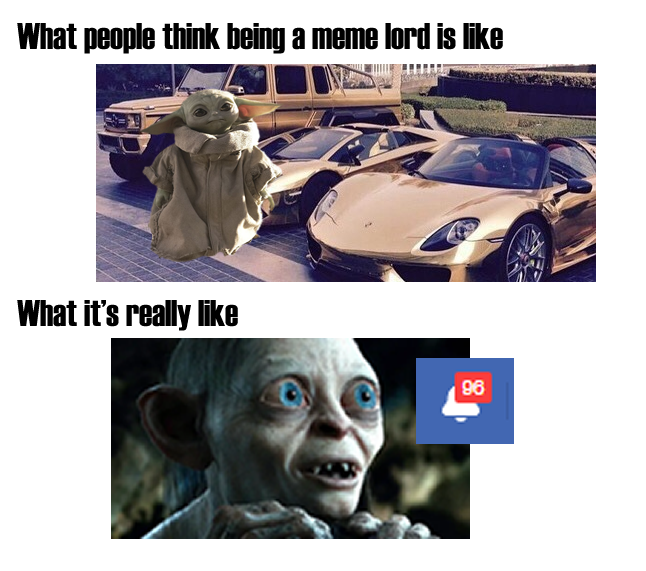
The meme is a comparative "expectation vs. reality" format.
- Top Panel ("What people think being a meme lord is like"): Features "Baby Yoda" (Grogu) from The Mandalorian, standing triumphantly on the hood of a bright yellow Lamborghini, with a black Mercedes SUV parked nearby. It evokes an image of wealth, status, and a "winning" lifestyle. The imagery is associated with luxury, success, and popularity.
- Bottom Panel ("What it's really like"): Displays a close-up of Gollum from The Lord of the Rings, looking intensely fixated on a "96" upvote counter on Reddit. This image portrays obsession, desperation, and a somewhat pathetic seeking of validation.
The juxtaposition creates a comedic effect by contrasting the perceived glamour of "meme lording" with the actual experience of craving online approval.
Foucauldian Genealogical Discourse Analysis
This meme speaks to the discourse of online status and identity. We can trace a genealogy of how being a "meme lord" has come to be constructed as a position of power, influence, and even a form of capital.
- Power/Knowledge: The meme suggests a disconnect between the perception of power associated with being a meme lord (the top image) and the actual mechanics of obtaining that power (the bottom image). The power isn't inherent; it’s constructed through the system of likes/upvotes/shares – a digital panopticon where individuals are incentivized to create content to gain recognition within the algorithmic structure.
- Discipline & Normalization: The constant chase for validation (represented by Gollum's focus on the '96' upvotes) normalizes a form of self-discipline and surveillance. Individuals become their own censors, constantly adjusting content to optimize for engagement and avoid negative feedback.
- Genealogy: Originally, “meme lords” might have been seen as simply creative individuals. The meme suggests that this role has been reconfigured by the logics of social media platforms into a constant pursuit of quantifiable metrics. It shows the historical shift from a potentially authentic expression of creativity to a performance governed by platform algorithms.
Critical Theory
The meme critiques the culture industry (Adorno & Horkheimer) as it applies to online spaces.
- Commodity Fetishism: The 'meme lord' figure isn't valued for their intrinsic creativity or insight. Their value resides in the potential to generate engagement (likes, shares) which can be monetized (through advertising, brand partnerships, etc.). The meme highlights how online status itself becomes a commodity.
- False Consciousness: The top panel represents the illusion of power and success. The 'meme lord' is perceived as a dominant figure, but the bottom panel reveals a more vulnerable, almost desperate reality. The meme suggests that many individuals are trapped in a cycle of seeking validation that doesn't actually provide meaningful fulfillment.
- Mass Culture: It is a commentary on the current state of digital mass culture. The 'meme lord' is presented as a symbol of this culture, the top image being a fantasy constructed by the platform and the bottom image portraying the emptiness of digital recognition.
Marxist Conflict Theory
The meme can be seen as a microcosm of class struggle in the digital realm.
- The Proletariat of Content Creators: The 'meme lord' – especially the one depicted in the bottom panel – represents a content creator striving for recognition within a hierarchical system. The platforms themselves (Reddit, Instagram, etc.) can be seen as the bourgeoisie, controlling the means of distribution and extracting value (data, attention, advertising revenue) from the labor of content creators.
- Alienation: Gollum's obsessive focus on the '96' upvotes embodies alienation – a sense of separation from genuine connection and purpose. The labor of creating content becomes detached from its meaning, reduced to a mere quest for quantifiable metrics.
- Exploitation: The meme suggests that content creators are exploited by the platforms, providing free labor (content creation) that generates profits for the platforms themselves. The pursuit of validation becomes a form of self-exploitation.
Postmodernism
This meme heavily relies on postmodern tropes.
- Irony & Parody: The juxtaposition of the luxurious imagery with the pathetic depiction of Gollum is inherently ironic. It parodies the notion of online success and the inflated egos often associated with it.
- Simulacra & Simulation: The 'meme lord' depicted in the top panel is a simulacrum – a copy without an original. It's a constructed image of success divorced from genuine meaning. The entire online persona is a simulation – a performance designed to elicit a specific response.
- Deconstruction: The meme deconstructs the myth of the powerful 'meme lord', exposing the vulnerability and desperation that lie beneath the surface. It undermines the notion of a stable, authentic online identity.
Queer Feminist Intersectional Analysis
While less immediately apparent, this meme can be read through an intersectional lens:
- Performative Identity: The construction of a "meme lord" persona is a form of performance, often aligning with societal expectations of dominance and success (often masculine coded). The meme reveals how these performances can be hollow and based on external validation.
- Vulnerability & Precarity: The bottom image of Gollum highlights the vulnerability that can accompany the pursuit of online validation. Individuals, particularly marginalized groups, may be especially susceptible to the pressures of social media and the need to perform for acceptance.
- Digital Harassment & Exclusion: The pressure to gain approval can create a hostile environment where individuals are subjected to harassment or exclusion if they don't conform to certain standards. The obsession with metrics can exacerbate these inequalities. (This requires some contextual inference, as the meme doesn’t explicitly depict harassment.)
I hope this detailed breakdown is helpful! Let me know if you'd like me to elaborate on any of these points or explore other theoretical frameworks.
simple-description (llama3.2-vision)
This meme is a humorous comparison between the popular image of a character from a movie or TV show (Lord of the Rings) and a popular social media platform (Twitter). The image shows a character from the Lord of the Rings, Gollum, with a Twitter notification icon. The text above the image reads "What people think being a meme lord is like" and the text below reads "What it's really like". The meme is poking fun at the idea that being a meme lord is glamorous and exciting, but in reality, it's just a never-ending stream of notifications.
tesseract-ocr
What people think being a lord is like 72 OG. ae Sy , ZY Sore What it’s really like ;