First Seen
2023-05-10T21:03:38+00:00
simple-description (llama3.2-vision_11b)
The meme features a still image of the character BB-8 from the Star Wars franchise, with a caption that reads "When you're lowkey happy but also lowkey sad". The image is meant to convey a sense of mixed emotions, where the character is expressing a subtle but complex emotional state.
detailed-analysis (gemma3-27b-vision)
Okay, here's an analysis of the image, broken down into the requested sections, addressing those theories where applicable. As you can see, some of these theories don't really "fit" the image, so those sections are brief or omitted.
Visual Description
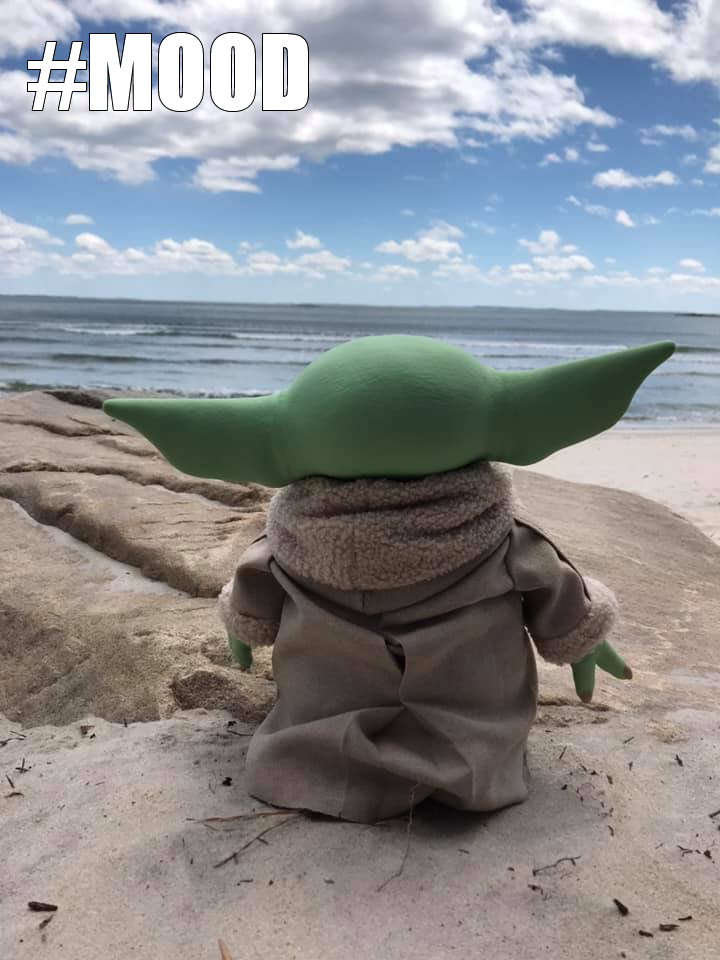
The image shows a small, plush toy of “The Child” (often called “Baby Yoda”) from The Mandalorian series, viewed from behind. The toy is seated on a sandy beach, facing the ocean. The ocean is calm, with subtle waves, and the sky is overcast with white clouds. The lighting is somewhat flat, suggesting an overcast day. The composition is simple, focusing on the toy as a central point and emphasizing the vastness of the ocean and sky behind it. The hashtag "#MOOD" is digitally superimposed over the top of the image, implying a feeling or emotional state. The overall aesthetic is one of quiet contemplation and possibly melancholy.
Foucauldian Genealogical Discourse Analysis
This image, and the hashtag accompanying it, can be read through a Foucauldian lens by examining the discourse surrounding “Baby Yoda” and the concept of “mood.” The rise of “Baby Yoda” as a meme and cultural phenomenon is a clear example of a power/knowledge structure being built. Disney (and Lucasfilm) as institutions, wield power by controlling the imagery and narrative of the character. The discourse surrounding Baby Yoda isn’t just about the character in the show, it's about the character as a cultural object, a source of comfort, and a meme.
The hashtag "#MOOD" itself is a crucial element. It’s a form of short-hand communication that encapsulates a feeling and immediately connects it to a broader digital network. Tracing the genealogy of "#MOOD" reveals it evolved as a form of affect articulation within the internet, used to signal emotional resonance and shared experience. The hashtag acts as an archive, accumulating meanings and associations with each usage.
This image appropriates that already established network of meaning around “Baby Yoda” and “mood” to create a new, condensed statement. The viewer is invited to project their own feelings onto the image, creating a temporary, virtual connection. It’s a demonstration of how power operates through the regulation of emotion and meaning within digital space.
Critical Theory
A Critical Theory reading focuses on how the image reflects and perpetuates broader social ideologies. The image relies heavily on the pre-existing cultural capital of The Mandalorian and its character “Baby Yoda.” The character, in its original context, represents a nostalgic appeal to the “found family” trope and a return to the archetypes of the wise, mentoring figure.
The image leverages this established cultural appeal. Presenting "Baby Yoda" in isolation on a beach evokes a sense of loneliness or existential pondering, prompting viewers to project their feelings onto the character. This can be seen as a subtle form of ideological control: by presenting a seemingly innocent and emotionally resonant image, the image subtly encourages a passive acceptance of emotional states and, by association, the cultural values it represents. The simplicity of the image also serves to flatten complexity; reducing a potential emotional landscape into a single, consumable “mood.”
Marxist Conflict Theory
While not overt, there is a subtle connection to Marxist analysis. The Mandalorian and “Baby Yoda” represent a commodified form of nostalgia and comfort. The image, and the demand for "Baby Yoda" merchandise, are part of the larger capitalist system that thrives on creating desire and consumption.
The image itself is a commodity, shared on social media platforms that depend on user engagement for profit. Even the “mood” the image evokes can be seen as a form of pacification, diverting attention from real social and economic struggles. The image contributes to a culture where emotional states are commodified, shared, and consumed as content, obscuring the underlying power structures that produce those emotions.
Postmodernism
The image strongly exemplifies several aspects of postmodernism. First, it’s a pastiche, blending imagery from a popular culture franchise (The Mandalorian) with a universally recognizable setting (the beach) and a ubiquitous digital shorthand (“#MOOD”). The image does not claim originality; it appropriates existing elements and re-contextualizes them.
The emphasis on feeling (“mood”) over objective meaning aligns with postmodern skepticism towards grand narratives and truth claims. The image doesn’t try to “say” anything definitive; it’s open to interpretation and subjective experience.
The very act of sharing the image on social media reinforces the postmodern condition of hyperreality: the blurring of lines between reality and simulation. The image becomes a simulacrum of emotion, a representation of a feeling that may or may not be authentically felt by the viewer.
Queer Feminist Intersectional Analysis
This section is harder to apply, as the image doesn’t explicitly deal with issues of gender, sexuality, or intersectionality. However, a reading could focus on the cuteness of Baby Yoda and how that appeals to a cultural preference for vulnerability, which, in some contexts, has been linked to a disruption of traditional masculine norms. The plush toy’s perceived innocence and passivity could be seen as a gentle challenge to hegemonic masculinity.
However, this reading is somewhat tenuous. The image doesn’t actively dismantle power structures, and the appeal to “cuteness” could also be seen as reinforcing patriarchal norms by prioritizing aesthetic qualities. Moreover, the image does not acknowledge the complex intersectional experiences of marginalized groups. Without further context or deliberate framing, it remains a fairly neutral image from this perspective.
Let me know if you would like me to expand on any of these sections, or focus on a particular theoretical lens.
simple-description (llama3.2-vision)
The meme features a still image from the Star Wars franchise of a character known as "Baby Yoda" from the series "The Mandalorian". Baby Yoda is sitting on a cliff overlooking the ocean, looking out at the water with a calm and serene expression. The text "I am calm" appears above the image, referencing the character's ability to remain calm in stressful situations.
tesseract-ocr
—_— wy J 7 6 een SE — we a ™ — - a = ee $ Y. ) E ae bo = Reach aia nin aN : ji a F — ze ee , > =a a ao ae sae pe he ae ae pone : Gk fee 2 ee ee a. : : _ =e aaa ae gene — oF a ee eB ace = , Cap 2 a aa ee oc ; E 7 oe Oe ee pe SS sf TOP Nt ee % : \ . = Pe te