First Seen
2023-05-10T21:03:38+00:00
simple-description (llama3.2-vision_11b)
The meme is an image of a man sitting in a chair, surrounded by books and papers, with a caption "I'm not arguing, I'm just explaining why I'm right. If you don't like it, don't read it. If you don't read it, don't come crying to me. If you come crying to me, don't say I didn't warn you. Don't say I didn't warn you, don't say I didn't warn you...".
detailed-analysis (gemma3-27b-vision)
Here's an analysis of the image and quote, broken down into relevant theoretical frameworks. Note that some categories won’t apply directly, and some will overlap.
Visual Description
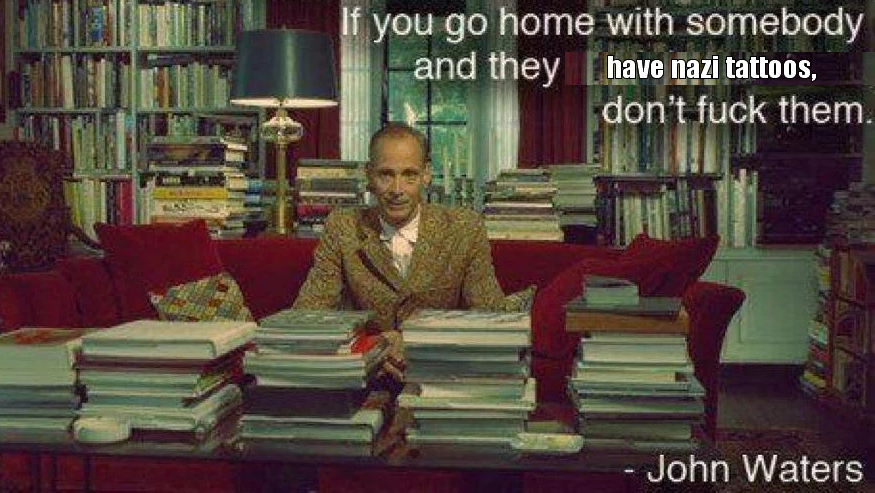
The image is a still from a promotional image featuring filmmaker John Waters. Waters is positioned lounging on a bright red, velvet couch, seemingly amidst a chaotic but curated stack of books. The background is filled with bookshelves crammed with volumes, implying a dedication to reading and intellectual pursuits. The setting is intimate, likely a home interior, and bathed in warm, almost theatrical light. Waters wears a tweed jacket, a patterned shirt, and dark shoes, conveying a somewhat eccentric, professorial aesthetic. A bright red lip balm is held in his hand, offering a playful contrast to his overall image. The central text is a quote attributed to him: "If you go home with somebody and they have Nazi tattoos, don't fuck them." The quote is stylized in a simple, blocky white font.
Foucauldian Genealogical Discourse Analysis
Michel Foucault's genealogical approach focuses on tracing the historical construction of knowledge, power, and discourse. The quote, when viewed through this lens, is less about a moral imperative and more about revealing the power dynamics at play in defining (and refusing) certain bodies.
- Power/Knowledge: Waters isn't simply making a judgement; he's asserting a boundary and defining a line between acceptable and unacceptable partners. This act of defining is itself an exercise of power. The “Nazi tattoo” operates as a signifier within a discourse of historical trauma and political ideology. It immediately assigns meaning and danger to the person bearing it.
- Discipline and Biopolitics: Though the statement is flippant, it speaks to attempts to “police” bodies and behaviors. Choosing to refuse sexual contact with someone based on a marker of their ideology is a form of biopower – controlling access to intimacy and reproduction (albeit in a limited way).
- Genealogical Trace: To fully understand the statement genealogically, we'd need to trace the history of how Nazi symbolism has been constructed as inherently “repulsive” and dangerous. This history is complex and tied to collective memory, historical events, and ongoing political struggles.
Critical Theory
From a Critical Theory perspective, Waters’ quote can be seen as a challenge to dominant norms and a provocation to think critically about desire, sexuality, and political affiliation.
- Enlightenment and Reason: The statement acts as a critique of the idea that desire is purely driven by “natural” impulses. It asserts that political and ethical considerations should override, or at least inform, our choices, even in the realm of intimacy.
- Ideology Critique: The quote implicitly critiques the idea that one can separate a person's political beliefs from their identity. The Nazi tattoos aren’t just aesthetic choices; they represent a dangerous ideology. To engage with someone who espouses such an ideology, even on a purely physical level, is seen as problematic.
- Subjectivity and Agency: The statement empowers the subject (the person potentially "going home" with the tattooed individual) to exercise their agency and make a conscious ethical choice.
Queer Feminist Intersectional Analysis
This analysis acknowledges the overlapping systems of power (gender, sexuality, race, class) that shape experiences of oppression and liberation.
- Sexual Politics: Waters, known for his provocative and transgressive work, often challenges traditional notions of desire and sexuality. This quote could be interpreted as a statement about the need to reject harmful ideologies in all aspects of life, including sexual encounters.
- Power Dynamics in Intimacy: The statement highlights the inherent power imbalances present in sexual relationships. The tattooed person possesses a potentially dangerous ideology, and refusing intimacy is a way to reclaim power and protect oneself.
- Intersectionality: While the quote directly addresses a specific marker (Nazi tattoos), it invites us to consider other markers of identity and ideology that might warrant similar considerations. It encourages us to be critically aware of the baggage that individuals bring into intimate encounters. The fact that this is a queer filmmaker offering the perspective adds another dimension to the discussion. He’s likely dismantling heteronormative expectations about desire and relationships.
It's important to remember that these are just interpretations, and the meaning of the quote (and the image) is open to debate. Waters himself is known for his playful, subversive style, and his work often resists easy categorization.
simple-description (llama3.2-vision)
This meme is a screenshot of a photo of a man sitting at a desk surrounded by books and papers, with a faintly amused expression. The text overlay reads: "If you go home with somebody and they have a tattoo of your ex's name on their body, it's time to re-evaluate that relationship." Below this, a second text overlay reads: "On the other hand, if they have a tattoo of your name on their body, it's a sign that you're in a healthy relationship." The image is then followed by a quote from John Waters, a famous American filmmaker, which reads: "I love people who have a tattoo of my name on their body. It's like, I'm not a great lover, I'm a great friend. If you go home with somebody and they have a tattoo of your ex's name on their body, it's time to re-evaluate that relationship."
tesseract-ocr
bel i lf you:go home with somebody re er Pele Re MAU ne Ly " 1th te es ain them. ; age i | oe ee iS ow Lia it ; ood, PAS SO = ‘ i eh nee —— ==, = - John Waters