First Seen
2023-05-10T21:03:38+00:00
simple-description (llama3.2-vision_11b)
The meme is an image of a woman with a blank expression, captioned "I can explain why I'm not smiling...". The meme is a humorous take on the "I can explain why I'm not smiling..." phrase, which is often used to express sarcasm or annoyance. The image is likely a screenshot of a chat or messaging platform, where the user is responding to a question or comment with a dry or sarcastic tone.
detailed-analysis (gemma3-27b-vision)
Okay, here's an analysis of the image meme, broken down into the requested theoretical frameworks where applicable. This is a complex image, layered with irony and potentially unsettling undertones, so the analysis will reflect that.
Visual Description
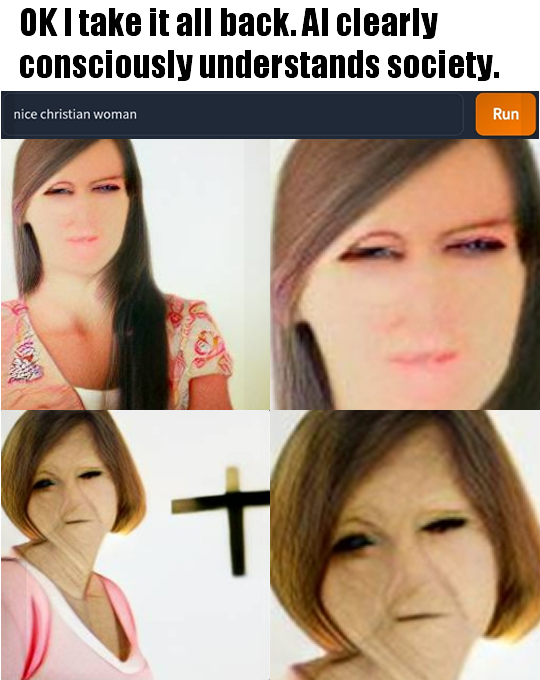
The image is a four-panel meme utilizing a progression of increasingly unsettling images of a woman. The initial two panels depict a young woman with a conventional, pleasant appearance – she is smiling, seemingly approachable. As the meme progresses, the woman's facial expression changes dramatically. Her smile becomes strained, her eyes narrow and darken, and her overall expression shifts to something menacing or disturbing. In the final two panels, the background of her photo is manipulated to emphasize a large, stark cross. The text overlay reads: "OK I take it all back. AI clearly understands society." This is a classic “OK boomer” type of ironic dismissal.
Foucauldian Genealogical Discourse Analysis
This meme can be analyzed through a Foucauldian lens, focusing on the power dynamics and discourses it implicitly engages with.
- Discourse of “Understanding”: The statement “AI clearly understands society” positions AI as an authority on complex social phenomena. This is a subtle shift in power, suggesting that a non-human entity (AI) possesses a superior capacity for understanding compared to human perspectives.
- Genealogy of “Sincerity” vs. “Irony”: The meme’s ironic structure is crucial. The initial, seemingly sincere images of the woman contrast sharply with the unsettling transformation and ironic claim about AI. This illustrates how ‘sincerity’ and ‘irony’ are not fixed categories but rather historically constructed and deployed within specific power relations. The abrupt shift in image underscores the instability of these categories.
- Panoptic Surveillance: The changing expression can be interpreted as a commentary on the feeling of being watched or evaluated. This connects to Foucault’s concept of the panopticon, where the possibility of constant surveillance leads to self-regulation and conformity. The woman’s expression could be read as a reaction to a perceived, all-knowing, AI-driven gaze.
Critical Theory
The meme operates as a critique of several societal aspects:
- Technological Determinism: The statement about AI “understanding” society hints at a belief in technological determinism—the idea that technology shapes society rather than vice-versa. The meme can be seen as ironically endorsing this view, or perhaps mocking the naive acceptance of technology's inherent wisdom.
- Commodification of Emotion & Identity: The manipulation of the woman's image for a meme (and thus, for attention/clicks/engagement) highlights the commodification of emotion and identity in the digital age. Her facial expressions are transformed into a tool for conveying a message.
- The Role of the "Ideal" Subject: The initial images present a woman fitting into certain societal expectations of beauty and pleasantness. The subsequent distortion challenges these ideals, exposing their constructed nature.
Postmodernism
This meme is deeply embedded in postmodern sensibilities:
- Irony & Parody: The meme relies heavily on irony and parody to subvert meaning. The combination of the conventionally pleasant images with the disturbing transformation and the cynical statement about AI is a classic example of postmodern humor.
- Rejection of Grand Narratives: The meme implicitly questions the idea of a single, objective truth about society. The statement about AI “understanding” can be seen as a challenge to traditional narratives of knowledge and authority.
- Simulacra and Simulation: The meme itself is a simulation – a constructed representation of a feeling (irony, cynicism) expressed through manipulated images. It operates within a world of increasingly blurred boundaries between reality and representation.
Queer Feminist Intersectional Analysis
This is where the meme becomes potentially problematic. While not explicitly dealing with queer or feminist issues, its use of a woman's image and the transformation of her expression can be analyzed through a lens of gender and power dynamics:
- The "Mad Woman" Trope: The shift from a pleasant smile to a menacing expression evokes the historical trope of the "mad woman" – a figure used to pathologize and silence female expression. This trope has been used to discredit women who challenge societal norms.
- Objectification & Control: The manipulation of the woman's image for the meme's effect can be seen as an act of objectification and control. Her facial expressions are reduced to a means of conveying a message, rather than being seen as an expression of her own agency.
- Intersectionality & The Gaze: The meme could be interpreted as reflecting the intersectional experience of being scrutinized and judged by an external gaze. The woman's expression could be seen as a reaction to the pressure to conform to societal expectations. The image also begs the question of who is doing the gazing, and why this transformation is being elicited.
It's crucial to note that the meaning of the meme is open to interpretation. These theoretical frameworks provide a way to unpack the complex layers of meaning embedded within the image, but ultimately, the viewer's own background and experiences will shape their understanding.
simple-description (llama3.2-vision)
This meme is a screenshot of a "deep fake" video of a woman who looks like a parody of a "nice Christian woman" with a sarcastic tone. The text overlay reads: "OK, I take it all back. A clearly conscious understanding of society." The meme is likely poking fun at the idea of a "nice Christian woman" stereotype and the absurdity of a "deep fake" video.
tesseract-ocr
OK I take it all back. Al clearly consciously understands society. ) vy —_— % Ziags f ( y ‘ KH p* P a i ( “A \ .