First Seen
2023-05-10T21:03:38+00:00
simple-description (llama3.2-vision_11b)
The meme features a photo of a person in a Star Wars costume, specifically a Stormtrooper, but with a twist: they are holding a sign that says "I can feel your anger. I am letting it go." The text is a reference to a famous line from The Empire Strikes Back, but in this context, it's being used humorously to describe a person's anger at being asked to leave a restaurant.
detailed-analysis (gemma3-27b-vision)
Okay, let's break down this image through the lenses you've requested. It's a surprisingly complex image, so several sections will apply!
Visual Description
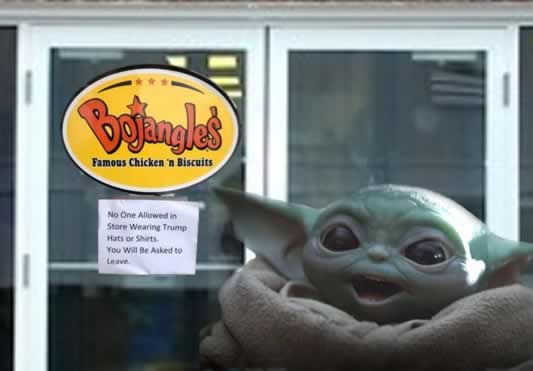
The image depicts a storefront, specifically a Bojangles' Famous Chicken 'n Biscuits restaurant. The primary focus is on a sign posted on the glass door. The sign reads, "No One Allowed in Store Wearing Trump Hats or Shirts. You Will Be Asked to Leave." In the foreground, positioned as if observing the sign, is a plush toy depicting "The Child" (Grogu, commonly known as Baby Yoda) from the Disney+ series The Mandalorian. The plush is cradled in what appears to be a brown, fluffy blanket or sweater. The lighting is somewhat dim and utilitarian, typical of a commercial storefront. The overall aesthetic feels like a candid snapshot rather than a professionally staged photograph.
Foucauldian Genealogical Discourse Analysis
This image is rife with elements ripe for a Foucauldian analysis. The sign itself represents a discourse, a system of thought, ideas, and language that constructs a particular understanding of the world. The sign attempts to exercise power by defining who is "allowed" within the space and who is excluded. This isn't simply about liking or disliking Trump; it’s about controlling the space, and asserting the restaurant owner's values as the norm.
A genealogical approach (tracing the historical emergence of this power dynamic) reveals a specific moment of politicization within a commercial space. Restaurants historically existed as neutral zones for nourishment. However, this sign signifies the breakdown of that neutrality, with the owner actively taking a political stance and attempting to enforce it within the business.
The very act of naming "Trump Hats or Shirts" as problematic is a form of discourse. It establishes a category of "unacceptable" expression. The phrasing “You Will Be Asked to Leave” is an example of disciplinary power: the potential for enforcement, surveillance (employees observing patrons), and normalization of a particular viewpoint.
The inclusion of Baby Yoda as a viewer is interesting. It is positioned to almost observe and approve of the sign's message, adding another layer of cultural significance, positioning Baby Yoda, a symbol of hope and "goodness" in popular culture, as an implied ally of the anti-Trump stance.
Critical Theory
From a broader critical theory perspective, the image showcases the encroachment of political ideology into everyday life. The restaurant, traditionally a site of consumption and social interaction, is now a site of political judgment. This raises questions about the responsibility of private businesses to take political stances, the freedom of expression, and the potential for discrimination (even if framed as a policy).
The sign can be seen as a manifestation of the increasing polarization in contemporary society, where neutral spaces are becoming increasingly rare. It's not just about agreement or disagreement with Trump; it’s about the owner's decision to enforce a boundary, effectively creating an "us vs. them" dynamic. This reflects a wider trend of social sorting and the construction of identity through political affiliation.
Marxist Conflict Theory
The image implicitly highlights class and economic tensions. While seemingly about politics, the owner's decision can be seen as an attempt to attract a specific clientele – those who share the anti-Trump sentiment. This is a form of cultural capital – the owner is aligning the business with a particular ideological group to enhance its appeal and potentially increase profits.
From a Marxist perspective, the sign could be interpreted as a symbolic rejection of certain segments of the population (those who support Trump), potentially leading to a form of exclusionary consumption. Those who identify with Trump might choose not to patronize the restaurant, leading to a conflict between different classes and ideologies within the marketplace. The restaurant is asserting its values, potentially at the expense of alienating a portion of its potential customer base.
Postmodernism
The image can be interpreted through a postmodern lens as a dismantling of traditional boundaries. The restaurant, once a neutral public sphere, is now explicitly political. This reflects a postmodern rejection of grand narratives (like the idea of a neutral public space) and an embrace of fragmented, localized discourses.
The juxtaposition of the political sign with the seemingly innocent Baby Yoda is particularly postmodern. It’s a mixing of signifiers (politics and pop culture) that creates a playful but also potentially unsettling effect. It challenges the viewer to question the relationship between these different spheres and to recognize the ways in which ideology permeates even seemingly harmless aspects of everyday life. The image exemplifies the "hyperreality" described by Baudrillard, where the line between reality and representation becomes blurred.
Queer Feminist Intersectional Analysis
While the most subtle, there is space to analyze this through an intersectional lens. Trump's rhetoric and policies have been widely criticized as being anti-immigrant, xenophobic, and misogynistic. By banning Trump paraphernalia, the restaurant owner might be implicitly signaling a commitment to inclusivity and resistance against these harmful ideologies.
An intersectional analysis would recognize that the impact of this policy is not uniform. For individuals who identify as members of marginalized groups (e.g., people of color, LGBTQ+ individuals, women), the policy might be seen as a welcome affirmation of their values and a rejection of the oppressive forces represented by Trump.
However, it's important to acknowledge the potential for this policy to be exclusionary in other ways. It could be seen as a form of ideological gatekeeping, creating a space where only certain viewpoints are tolerated. This could inadvertently marginalize those who hold different beliefs, even if those beliefs are not explicitly hateful.
In conclusion, this seemingly simple image is remarkably layered. It invites a rich analysis through multiple theoretical lenses, revealing the ways in which power, ideology, and identity intersect in contemporary society.
Let me know if you'd like me to elaborate on any of these points or explore other theoretical frameworks!
simple-description (llama3.2-vision)
The meme is a screenshot of the character Baby Yoda from the TV show "The Mandalorian" sitting at a restaurant called Bojangles, a popular Southern fast food chain. The image is captioned with a quote from the show: "When you're hungry but you're in a place that doesn't have chicken."
tesseract-ocr
| , h | <= Ps