First Seen
2023-05-10T21:03:38+00:00
simple-description (llama3.2-vision_11b)
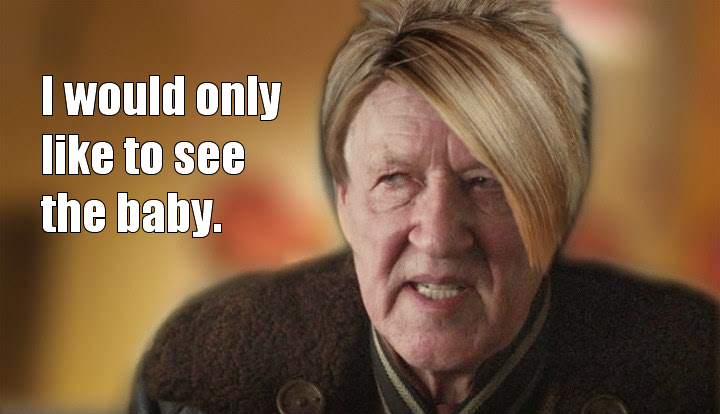
This meme is a photo of an elderly woman with a shocked expression, accompanied by the text "I would only like to see the baby". The meme is likely used to express surprise or disappointment at a situation, implying that the speaker only wants to see one thing, but it's not what they're getting.
detailed-analysis (gemma3-27b-vision)
Okay, let's break down the image and the phrase "I would only like to see the baby" through the requested theoretical lenses.
Visual Description
The image features a close-up shot of a woman, likely an older woman, with light hair. She appears to be in a somber or serious mood. Her face is the focal point, showing wrinkles and suggesting a lifetime of experience. The lighting is warm and subdued, casting shadows on her face, and she is wearing dark clothing. The background is blurry, further concentrating the focus on her expression. The image has a cinematic quality suggesting it is from a movie or television show.
Foucauldian Genealogical Discourse Analysis
The phrase "I would only like to see the baby" becomes very interesting when viewed through a Foucauldian lens. The discourse surrounding “the baby” isn't neutral. It's tied to power dynamics. Historically, and presently, access to and control over reproduction, and particularly the child, has been central to patriarchal structures.
- Power/Knowledge: The seemingly innocent request isn't just about seeing a baby. It's about asserting a claim—a claim of kinship, access, or even ownership. This desire is often embedded in societal expectations around lineage, inheritance, and the continuation of family lines. The power to see can symbolize the power to claim, to oversee, to influence, or even to control.
- Genealogy: Examining the history of this phrase and its implications reveals shifts in ideas about family, lineage, and parental rights. Before modern conceptions of the nuclear family, the idea of 'seeing the baby' could have radically different meanings depending on social class, region, and the specific power dynamics within a community.
- Discipline: The statement can also be a subtle form of social discipline. It's a way of reasserting traditional expectations about familial bonds and proper behavior. By wanting to ‘see the baby’, the speaker subtly reinforces the norms and expectations surrounding motherhood, paternity, and familial responsibility.
Critical Theory
From a Critical Theory perspective (drawing heavily from the Frankfurt School), the phrase can be interpreted as a manifestation of instrumental reason and the control of reproduction.
- Domination and Control: The desire to 'see the baby' can be understood as a desire to assert control over the future—the future generation—and ensure the continuation of existing power structures. It isn’t about simple affection, but potentially about the perpetuation of ideology.
- Ideology: The phrase can also be seen as reinforcing the dominant ideology of the nuclear family as the ideal social unit. The desire to see the baby reinforces the idea that this unit is natural, inevitable, and essential.
- Critique of Enlightenment: Critical Theorists would question whether the "simple" desire to see the baby obscures deeper, potentially oppressive social structures.
Marxist Conflict Theory
From a Marxist perspective, the phrase "I would only like to see the baby" can be viewed through the lens of class and inheritance.
- Property & Inheritance: In a capitalist system, the 'baby' isn't just a human being; it is a potential inheritor of wealth and property. The desire to 'see the baby' could be a subtle way of asserting a claim to that inheritance. It might represent a desire to safeguard family wealth and ensure its continuation across generations.
- Reproduction of Labor: Babies, from a Marxist perspective, are future laborers. The desire to 'see the baby' might symbolize a desire to ensure the continuation of the workforce and the perpetuation of the capitalist mode of production.
- Class Division: The access to 'seeing the baby', or even just the ability to express such a desire, may be indicative of social and economic privilege. The speaker may be from a position of power and authority that allows them to make such a request, while others may be denied that access.
Queer Feminist Intersectional Analysis
A queer feminist intersectional reading offers a complex interpretation.
- Reproductive Control & Cisheteronormativity: The statement inherently assumes a traditional understanding of reproduction and kinship. It reinforces a cisheteronormative assumption about how families are created. This overlooks the diverse range of family structures and reproductive technologies available, and the experiences of LGBTQ+ individuals and families.
- Patriarchal Expectations: The phrase can be read as reflecting patriarchal expectations around lineage and the control of reproduction. It may be driven by a desire to preserve the male line or ensure the continuation of the family name.
- Intersectional Power Dynamics: The significance of "seeing the baby" will be drastically different depending on the speaker's identity and social position, and the context of the situation. For example, a grandmother's desire to see her grandchild might be interpreted differently than a stranger's insistence on seeing a baby.
- Bodies as Property: The statement potentially views the baby as an object of ownership, reinforcing the idea that bodies are property to be controlled.
Important Note: The richness of these analyses lies in recognizing that all of these interpretations can exist simultaneously. The image and the phrase are multi-layered, and the meanings they evoke depend on the analytical framework applied and the social and historical context.
simple-description (llama3.2-vision)
This meme features a screenshot of a character from a TV show or movie, likely a comedic or satirical scene. The character's facial expression is exaggerated and humorous. The text "I would only like to see the baby" is overlaid on the image, implying that the character is being sarcastic or ironic about wanting to see a baby, possibly a child or a newborn.
tesseract-ocr
Ce ee ~ Ay Ty 7 0 the haby. \ +2 d .