First Seen
2023-05-10T21:03:38+00:00
simple-description (llama3.2-vision_11b)
The meme is an image of the character Spock from Star Trek, with a quote that says "The needs of the many outweigh the needs of the few... or the one" from the movie Star Trek II: The Wrath of Khan. However, the quote is altered to say "The needs of the many outweigh the needs of the few... or the one, but let's be real, it's probably just the one". This is a humorous take on the original quote, poking fun at the idea that the needs of the many are always more important than the needs of the individual.
detailed-analysis (gemma3-27b-vision)
Okay, let's break down this meme through a few relevant theoretical lenses. It's a complex meme that touches on a lot of contemporary anxieties, so several sections will apply.
Visual Description
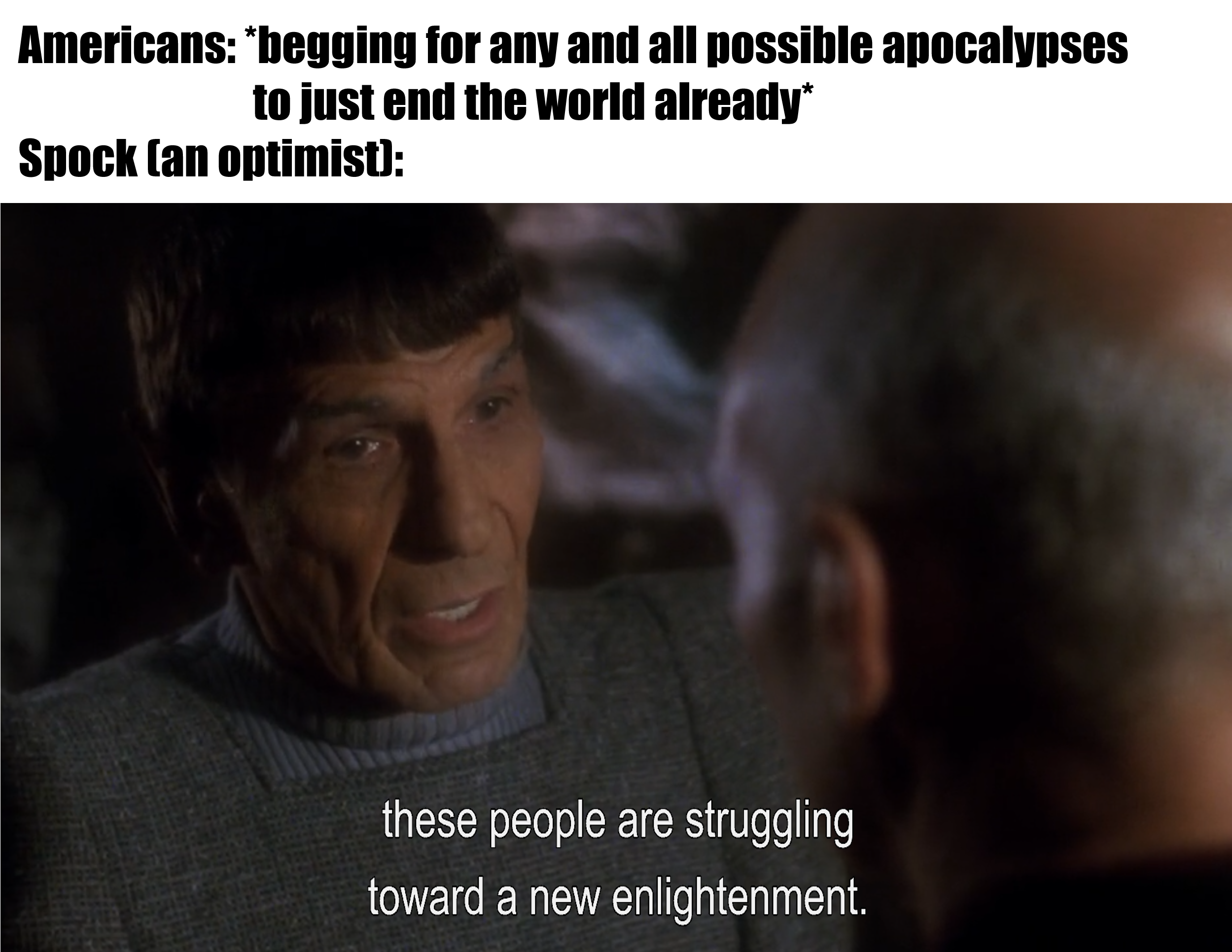
The meme features a still from Star Trek: The Next Generation, depicting Spock, a character known for his logical and detached demeanor. He is looking slightly upward with a thoughtful and seemingly optimistic expression. The image is dimly lit, enhancing the dramatic effect. The text above the image states, "Americans begging for any and all possible apocalypses to just end the world already". Below the image, the text reads, "these people are struggling toward a new enlightenment". The contrast between the bleak statement about American sentiment and Spock's optimistic assessment creates a darkly humorous effect. The overall aesthetic leans into a sense of weary irony.
Critical Theory
This meme powerfully illustrates concepts from critical theory, specifically the idea of disenchantment and the culture industry. The statement that "Americans are begging for any and all possible apocalypses" reflects a profound disillusionment with the prevailing social, political, and economic systems. It suggests a feeling of being trapped in a cycle of crises (climate change, political polarization, economic instability, pandemics, etc.) where the promised progress and betterment haven't materialized.
The meme implies a perceived failure of dominant narratives to provide meaning or hope. The desire for "any and all possible apocalypses" isn't necessarily a desire for destruction, but potentially for a rupture – a complete break with the current order that might allow for a new, potentially better one to emerge.
Spock's assertion, "these people are struggling toward a new enlightenment," is a sarcastic twist. It forces the viewer to question whether this disillusionment (and even the nihilistic desire for an apocalypse) can be seen as a precursor to a radical shift in consciousness. It highlights the idea that sometimes, the complete dismantling of old structures is a necessary condition for genuine progress—a somewhat Hegelian interpretation of historical change.
Postmodernism
The meme operates strongly within a postmodern framework. The juxtaposition of the despairing American sentiment and Spock's optimistic pronouncement creates a deliberate deconstruction of meaning. The meme doesn’t offer a clear-cut answer or a stable truth; it highlights the instability of meaning in the face of widespread anxiety and crisis.
The meme relies on irony and parody. It mocks the notion of a linear progression towards enlightenment while simultaneously suggesting that even in the depths of despair, a potential for change exists. This playful subversion of expectations is characteristic of postmodern aesthetics.
The meme implicitly acknowledges the fragmentation of grand narratives (Lyotard). The idea of universal progress, the "enlightenment," has been undermined by historical events and the recognition of systemic inequalities. This fragmentation leaves individuals feeling alienated and disillusioned. The meme's bleak humor arises from this acknowledgement of the loss of stable, overarching ideologies.
Marxist Conflict Theory
A Marxist reading of the meme would see the "begging for apocalypse" as a symptom of the deep contradictions inherent within late-stage capitalism. The accumulation of wealth and power in the hands of a few, coupled with the exploitation of labor and resources, creates systemic inequalities and widespread precarity.
The desire for an apocalypse could be interpreted as a subconscious recognition that the existing system is unsustainable and fundamentally unjust. The "struggle toward a new enlightenment" (as Spock posits) could be seen as the emergent struggle of the oppressed against the ruling class.
The meme subtly suggests that the current system is so broken that many people feel that even complete collapse would be preferable to the continuation of the status quo. This sentiment, while extreme, underscores the deep dissatisfaction and alienation that are widespread in contemporary society. It's a critique of the system's inability to provide basic needs or a sense of meaning for a large segment of the population.
Foucauldian Genealogical Discourse Analysis
Using a Foucauldian lens, we can analyze how the meme participates in and challenges dominant discourses surrounding crisis, progress, and agency. The meme itself is a discourse – a way of speaking about and understanding a particular social phenomenon.
The discourse of "apocalypse" has been historically linked to religious belief, but has now been secularized and become a common trope in discussions of climate change, political instability, and economic collapse. The meme appropriates this discourse, but re-frames it. The desire for apocalypse isn't presented as a religious belief, but as a response to material conditions and the perceived failure of existing systems.
Spock's statement challenges the power/knowledge dynamic. He asserts a counter-discourse – that the despairing sentiment is actually a form of progress, a "struggle toward a new enlightenment." This challenges the dominant narratives that frame the situation as hopeless or catastrophic. It's an attempt to re-define the meaning of the "struggle" and imbue it with agency.
A genealogical approach would trace the historical development of these discourses – how the concepts of "apocalypse," "enlightenment," and "progress" have been constructed and contested over time. It would reveal how these concepts are intertwined with power relations and how they have been used to justify certain social arrangements while suppressing others.
In Summary:
The meme is a layered and complex commentary on contemporary anxieties, disillusionment, and the potential for radical change. It draws on insights from critical theory, postmodernism, Marxist conflict theory, and Foucauldian discourse analysis to offer a nuanced and provocative reflection on the state of the world. It's a darkly humorous observation that encourages viewers to question the dominant narratives and consider the possibility that even in the depths of despair, a path towards a new, more just future might exist.
simple-description (llama3.2-vision)
This meme is a humorous commentary on the pessimistic outlook of some Americans. The image features a screenshot from the movie "Star Trek II: The Wrath of Khan" where Mr. Spock says "I have been thinking it is time for me to die. But I see it as a time to live." However, the text is altered to say "I have been thinking it is time for me to die. But I see it as a time to live... and also, I have been thinking it is time for me to die. But I see it as a time to live... and also, I have been thinking it is time for me to die. But I see it as a time to live..." and so on, implying that the character is stuck in a time loop and is unable to escape it.
tesseract-ocr
Americans: “begging for any and all possible apocalypses to just end the world already" Spock (an optimist): these people are struggling CONV ETCOMS MAA ACACIA LAN SIAE