First Seen
2023-05-10T21:03:38+00:00
simple-description (llama3.2-vision_11b)
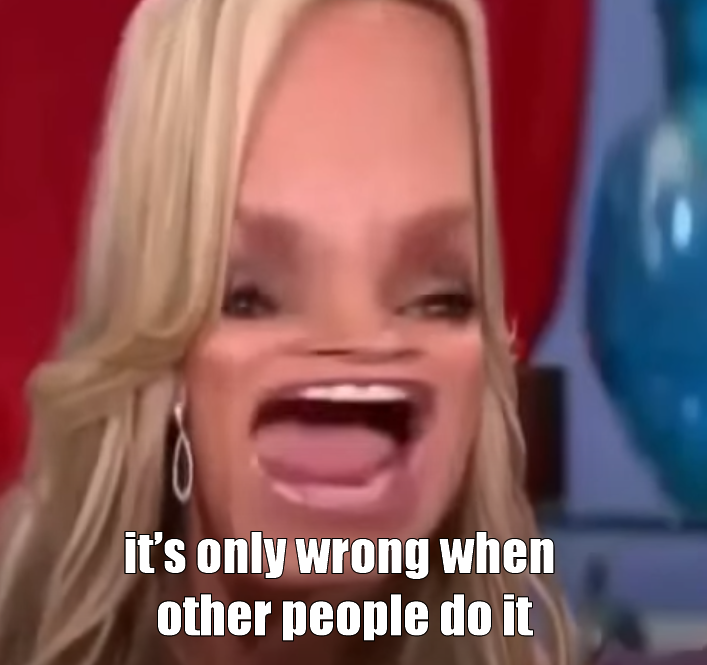
The meme is a screenshot of a person with a shocked expression, accompanied by the text "I can explain why my girlfriend is acting so strange... it's because I told her I was going to be working from home today... but I'm not". The image is meant to be humorous, poking fun at the idea that a simple white lie can lead to a series of awkward situations.
detailed-analysis (gemma3-27b-vision)
Okay, let's break down this meme through the requested theoretical lenses.
Visual Description
The image is a distorted, heavily zoomed-in screenshot of American television personality Brandi Glanville. Her face is dramatically exaggerated, with widened eyes, an open mouth, and distorted features. The overall effect is comical and unsettling. Text overlaid on the image reads "it's only wrong when other people do it." The background is a blurred, dark reddish-purple, likely taken from a television studio setting. The image is clearly meant to be a reaction meme, conveying a sense of hypocritical outrage.
Foucauldian Genealogical Discourse Analysis
This meme, even in its simplicity, is a potent display of discourse and power dynamics, key concepts in Michel Foucault's work.
- Discourse & Normalization: The statement "it's only wrong when other people do it" immediately highlights the construction of morality. There isn't an inherent “wrongness” but a social determination. Foucault argued that power operates through discourse – through what we deem acceptable or unacceptable, normal or deviant. The meme reveals the arbitrary nature of these judgements. It's not a matter of universal truth, but a power play.
- Genealogical Exploration: A Foucauldian genealogy would trace the historical conditions that produce this hypocrisy. How did we come to accept (and even reward) certain behaviors from certain groups while condemning them in others? What historical and social factors underpin this double standard? The meme invites us to question the origins of these moral frameworks.
- Power/Knowledge: The meme points to how knowledge is intertwined with power. What counts as “wrong” is defined by those with the power to define it. The image of Brandi Glanville, a public figure already operating within a structured media system (reality TV), amplifies this, as she represents someone who both embodies and benefits from this discourse.
- Discipline & Panopticism: While less direct, the meme gestures toward disciplinary power. Those who call out the hypocrisy operate as a surveillance mechanism, enforcing norms by identifying and shaming those who transgress.
Critical Theory
The meme fits neatly into the tradition of Critical Theory, particularly Frankfurt School thought, which examines how power structures maintain themselves through the manipulation of ideology and culture.
- Ideology & False Consciousness: The statement suggests a fractured, self-serving ideology. It's a form of false consciousness where individuals fail to recognize the structural inequalities at play. The speaker justifies their own behavior while condemning others, obscuring the systemic issues that contribute to the problematic behavior.
- Culture Industry & Mass Media: The meme is itself a product of the "culture industry"—the mass production of cultural artifacts (memes, television shows, etc.) that serve to reinforce dominant ideologies. Its circulation via social media illustrates how these ideologies are disseminated and internalized.
- Hegemony: The meme subtly reveals the workings of hegemony – how dominant groups maintain power not through brute force, but through consent and the internalization of their values. The statement suggests a willingness to accept a double standard, demonstrating the power of the dominant group to shape perceptions of right and wrong.
Postmodernism
The meme embodies several key tenets of postmodern thought:
- Deconstruction of Grand Narratives: Postmodernism rejects universal truths and grand narratives (like "morality" or "ethics"). The meme challenges the idea of objective morality, revealing it as a socially constructed and contingent phenomenon.
- Relativism: The statement inherently promotes a relativistic view of morality – what's “wrong” depends on who’s doing it. There is no inherent standard, only subjective judgements.
- Irony & Parody: The image and text combine to create a sense of irony and parody. It mocks the hypocrisy of individuals who selectively apply moral standards.
- Simulacra & Simulation: The meme itself is a simulacrum – a copy without an original. It's a representation of a sentiment, divorced from any genuine ethical consideration. It participates in the endless cycle of simulation that characterizes postmodern culture.
Queer Feminist Intersectional Analysis
This is where the meme gets particularly interesting.
- Double Standards & Gender: The meme reflects the pervasive double standards women face. Women’s actions are often scrutinized and judged more harshly than those of men. The meme speaks to the expectation of female purity and the swift condemnation when that is transgressed, while similar behaviours in men are often excused or even celebrated.
- Power Dynamics & Intersectional Identities: While the meme doesn’t explicitly point to intersectionality, it invites us to consider how these double standards intersect with other identities (race, class, sexuality). For example, a wealthy white woman might be held to different standards than a Black woman from a working-class background.
- Challenging Norms: By highlighting the arbitrary nature of moral judgements, the meme implicitly challenges the norms that perpetuate inequality. It’s a form of subversive humor that calls attention to the ways in which power operates to marginalize certain groups.
- Performing Gender: Brandi Glanville, as a reality television personality, is often performing a particular version of femininity. The meme captures a moment where this performance is disrupted, revealing the underlying contradictions and hypocrisy.
Let me know if you'd like me to expand on any of these interpretations or explore a different theoretical framework!
simple-description (llama3.2-vision)
This meme features a screenshot of a woman with a shocked and exaggerated expression. The text "it's only wrong when others do it" is overlaid on the image, implying that the speaker is being hypocritical or double-standard. The meme is likely poking fun at someone who is saying one thing but doing another.