First Seen
2023-05-10T21:03:38+00:00
simple-description (llama3.2-vision_11b)
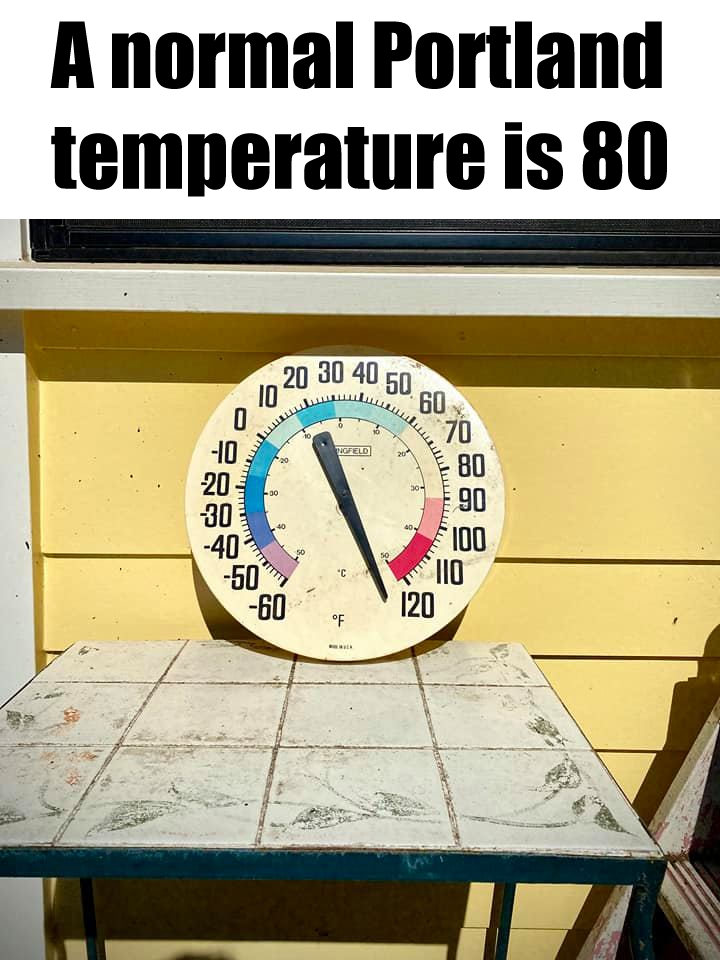
The meme is a photo of a thermometer with the temperature reading "100" and the caption "It's like being in Portland, but not actually being in Portland". The meme is making a humorous comparison between the temperature in Portland, Oregon, which is known for being mild and rainy, and the extreme heat of the thermometer, implying that the heat is so intense it's like being in a different, hotter place.
detailed-analysis (gemma3-27b-vision)
Okay, here’s an analysis of the image, broken down into sections as requested. Given the seemingly simple nature of the image, some sections will be more developed than others.
Visual Description
The image depicts a round, analog thermometer mounted on a slightly chipped and worn, light-gray surface – appearing to be a small table or shelf. The thermometer is a classic dial type, with markings in both Fahrenheit and Celsius. The needle is pointing to approximately 80 degrees Fahrenheit. The background suggests an interior space, with a glimpse of a yellowish wall and what might be a window frame or a piece of furniture. The lighting is somewhat flat and natural. The image feels slightly grainy, suggesting it might be a snapshot rather than a professionally taken photograph. Above the image in large black text it reads "A normal Portland temperature is 80".
Foucauldian Genealogical Discourse Analysis
The phrase "A normal Portland temperature is 80" functions as a discourse. It isn’t simply a statement of fact, but a performance of normalizing power. Foucault argued that power operates not just through repression, but through the construction of norms. This statement creates the norm of 80 degrees Fahrenheit as “normal” for Portland.
- Genealogical Perspective: A genealogical analysis would question how this “norm” came to be. It's not inherently natural. It’s constructed through historical data (weather records), media representation, local narratives about the climate, and potentially even marketing (e.g., promoting Portland as a mild-weather city).
- Disciplinary Power: This normalization has a disciplinary effect. Any temperature significantly different from 80 is perceived as abnormal – too hot, too cold. This leads to practices of adjustment (air conditioning, heating, clothing choices) and potentially anxieties about weather events that deviate from this norm.
- The Thermometer as Instrument of Power: The thermometer itself isn’t a neutral measuring tool. It embodies the logic of quantification and categorization, essential elements in modern disciplinary power. It translates a complex environmental phenomenon into a single, easily comparable number, reinforcing the idea of “normal” and “abnormal.”
Critical Theory
From a Critical Theory perspective, the image and its accompanying text reveal power dynamics related to environmental perception and control.
- Instrumental Reason: The thermometer embodies the principles of instrumental reason—measuring and quantifying phenomena to control and predict them. This emphasis on quantifiable data, while seemingly objective, can obscure other, more qualitative aspects of environmental experience (e.g., humidity, sunlight, air quality).
- Commodification of Climate: The idea of a “normal” temperature can be linked to the commodification of climate. A “desirable” climate – often associated with economic development and tourism – is constructed, and deviations from this norm are seen as problematic. Portland may be positioned as having a desirable, moderate climate to attract residents and businesses.
- Ideology: The statement functions ideologically by presenting a particular view of Portland’s climate as natural and given, rather than a historically and socially constructed reality.
Marxist Conflict Theory
While not overtly a scene of class struggle, a Marxist analysis can still point to underlying conflicts.
- Unequal Impacts of Climate Change: The perception of "normal" is particularly relevant in the context of climate change. Even small deviations from this norm can have disproportionate impacts on vulnerable populations (e.g., those without access to air conditioning or adequate housing). The emphasis on maintaining a “normal” climate can mask the inequalities inherent in climate change adaptation.
- Resource Control: The technology to maintain a "normal" indoor temperature (air conditioning, heating) requires resources and energy, which are unevenly distributed. This links the image to broader questions of resource control and environmental justice.
- Commodification of Comfort: The drive to achieve and maintain a “normal” comfortable temperature represents a commodification of comfort—turning a basic need into a market opportunity.
Postmodernism
From a postmodern perspective, the image disrupts the notion of a fixed, objective reality.
- Subjectivity of Experience: The concept of "normal" is inherently subjective and culturally dependent. What constitutes a comfortable temperature varies from person to person and place to place. The statement is therefore a performance of a particular worldview, not a universal truth.
- Deconstruction of Meaning: The image challenges the idea of a stable meaning. The thermometer's reading is merely a snapshot in time, and the definition of “normal” is constantly shifting.
- Simulation and Hyperreality: The focus on achieving a “normal” temperature can be seen as a form of simulation—creating an artificial environment that feels “natural.” This can contribute to a sense of hyperreality, where the simulation becomes more real than the real.
Queer Feminist Intersectional Analysis
This is the hardest angle to apply, but some possibilities exist:
- Challenging Norms: The assertion of a "normal" temperature is itself a normalizing act that can marginalize those whose bodies experience temperature differently. This might include those with certain medical conditions, disabilities, or those experiencing menopause. Queer and feminist theory critique the ways in which norms are used to exclude and control.
- Environmental Justice & Gender: Women, particularly those in marginalized communities, are often disproportionately affected by climate change and environmental hazards. The idea of maintaining a “normal” climate can ignore the specific vulnerabilities of these populations.
- Intersectional Vulnerability: The experience of temperature is shaped by multiple intersecting identities. A low-income, elderly woman of color may be far more vulnerable to extreme heat or cold than a wealthy, healthy man. The image, with its focus on a single “normal,” obscures these complex realities.
Let me know if you’d like me to expand on any of these sections!
simple-description (llama3.2-vision)
This meme is a humorous take on the concept of "inversion" in meteorology, where the temperature is unexpectedly low for the time of year. The image features a thermometer reading 80 degrees, which is unusually high for Portland, Oregon. The text "A normal Portland temperature is 80" is a play on words, implying that 80 degrees is actually a normal temperature for the city, which is known for its cool and rainy climate.
tesseract-ocr
A normal Portiand temperature is 80 Se a (0 a 8d gg romania : eS 0 08. : 90 , “51 120 ; Ms Utne oe ‘ee 3 J. | \ ss y "ty TT J