First Seen
2023-05-10T21:03:38+00:00
simple-description (llama3.2-vision_11b)
The meme is an image of a character from the animated TV show "The Simpsons" named Krusty the Clown, but with the face of a cartoon character from the show "The Simpsons" named Sideshow Bob, but with a face of a cartoon character from the show "The Simpsons" named Sideshow Bob, but with the face of a cartoon character from the show "The Simpsons" named Sideshow Bob. The text "I can smell the desperation emanating from this town" is written above the image.
detailed-analysis (gemma3-27b-vision)
Okay, let's break down this image and its message through the requested theoretical lenses. Be aware that applying these frameworks to a meme-like image requires interpretation, and there's room for nuanced arguments.
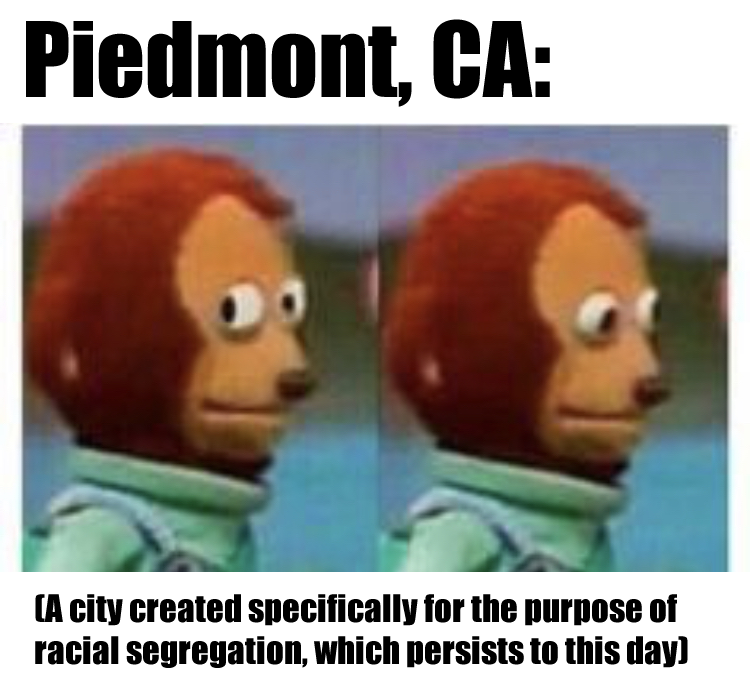
Image Overview: The image features a repeating side-by-side "distracted boyfriend" meme template. The "boyfriend" (a cartoon monkey) is looking at another "woman" while his partner looks displeased. Superimposed on top is the text "Piedmont, CA" and the claim "A city created specifically for the purpose of racial segregation, which persists to this day."
Visual Description
The image employs a widely recognized internet meme—the “distracted boyfriend.” This meme structure inherently communicates a sense of betrayal, attraction to something new/different while ignoring existing commitments, or prioritization of one thing over another. Here, the “distracted boyfriend” symbolizes a societal or individual focus on the seemingly appealing aspects of Piedmont, CA, while ignoring or minimizing the problematic history and ongoing reality of racial segregation the text implies. The monkey depiction (which has historically been connected to racist tropes) further complicates the imagery, potentially suggesting a historically-rooted dynamic of overlooking or perpetuating harmful systems. The repetition of the image (showing the monkey twice) might emphasize the cyclical nature of ignoring or repeating the segregation issues.
Foucauldian Genealogical Discourse Analysis
Michel Foucault's genealogical method seeks to uncover the historical and discursive forces that create knowledge and power relations. Applying this to the image:
- Historical Context: The claim about Piedmont being intentionally created for racial segregation is the starting point. Foucault wouldn't ask if it's true, but how the discourses around city planning, property ownership, and racial classifications at the time produced that outcome. What "truths" about race and desirability were circulating that justified exclusive zoning and housing practices?
- Power/Knowledge: Zoning laws, deed restrictions, and community associations aren't neutral. They are forms of power that create specific spatial and social arrangements. This image implies that these arrangements continue to operate, reproducing a particular (segregated) reality. The image, by bringing attention to this, disrupts the taken-for-granted "truth" of Piedmont as simply a desirable, affluent community.
- Discursive Shift: The image aims to shift the discourse around Piedmont. Instead of being simply a "nice" town, it's framed as a product of explicitly racist intentions with continuing consequences. This attempts to destabilize the existing power relations and expose the historical forces at play.
- Archaeology of Segregation: A Foucauldian analysis would delve into the "archive" of documents, laws, and social norms that enabled the segregation of Piedmont.
Critical Theory
Critical Theory, often associated with the Frankfurt School, examines how power structures maintain domination through ideology and culture.
- Ideology Critique: The image challenges the seemingly neutral appearance of suburban life in Piedmont. It argues that the town's desirability and affluence are built upon a history of exclusion and discrimination. It highlights the hidden interests served by maintaining this system.
- The Culture Industry: The image suggests that representations of Piedmont (real estate ads, lifestyle magazines, etc.) may actively mask its problematic history, contributing to a false consciousness. These representations reinforce the idea of Piedmont as simply a “good” place to live, without acknowledging the underlying inequities.
- Hegemony: The image is implicitly critical of the hegemonic power of those who benefit from the segregation, suggesting that their values and norms have become normalized and accepted as common sense. The meme's intent is to disrupt that normalcy.
- Emancipation: The ultimate goal of Critical Theory is emancipation—the liberation from oppressive social structures. By exposing the history of segregation in Piedmont, the image aims to raise awareness and potentially inspire action toward a more just and equitable future.
Marxist Conflict Theory
From a Marxist perspective, society is defined by class struggle and the exploitation of one group by another. While this image directly addresses race, Marxist analysis can still be relevant:
- Material Conditions: The segregation in Piedmont can be understood as a way to protect the property values and economic interests of a privileged class. Excluding people of color maintained a specific class structure and access to resources.
- Power Dynamics: The city’s origins were about solidifying power and control over land and resources by a specific group.
- False Consciousness: The perceived desirability of Piedmont could be seen as a form of "false consciousness," masking the exploitative nature of the system.
- Class & Race Intertwined: In the US context, race and class are deeply intertwined. Segregation and discriminatory housing practices have historically been used to maintain class hierarchies and limit economic opportunities for people of color.
Postmodernism
Postmodern thought challenges grand narratives and emphasizes the subjective nature of truth.
- Deconstruction of Norms: The image deconstructs the "ideal" suburban lifestyle, revealing its hidden underside of racial exclusion.
- Relativism of Truth: Postmodernism questions the idea of a single, objective truth. The image implies that the dominant narrative about Piedmont is just one interpretation, and there are other, equally valid perspectives to consider.
- Simulacra and Simulation: The image could be interpreted as a comment on how representations of Piedmont (e.g., in marketing materials) have become detached from the reality of its history and ongoing inequities. The "image" of Piedmont becomes a simulacrum—a copy without an original.
- Fragmentation and Hybridity: The meme format itself embodies the fragmented and hybrid nature of postmodern culture.
Queer Feminist Intersectional Analysis
This lens examines how various forms of oppression (race, gender, sexuality, class, etc.) intersect and create unique experiences of marginalization.
- Intersectionality: While the image primarily focuses on race, a queer feminist analysis would ask how racial segregation in Piedmont also impacted LGBTQ+ individuals and women. Were there additional layers of exclusion based on sexual orientation or gender identity? Did segregation reinforce patriarchal norms within the Black community?
- Spatial Justice: Segregation is a form of spatial injustice—the unequal distribution of resources and opportunities based on geography. A queer feminist perspective would emphasize how this injustice affects marginalized groups' access to housing, education, healthcare, and other essential services.
- Power and Control: Segregation is about maintaining power and control over marginalized communities. A queer feminist analysis would examine how this power is exerted through various mechanisms, including housing policies, policing practices, and social norms.
- Resistance and Empowerment: A queer feminist analysis would also highlight the ways in which marginalized communities have resisted segregation and fought for their rights.
Important Note: These theoretical lenses are tools for interpreting the image, not definitive answers. There's room for debate and nuanced understanding. The image is a starting point for a larger conversation about the history of racial segregation and its ongoing consequences.
simple-description (llama3.2-vision)
This meme features a split-screen image of a character with a confused expression. The text "Piedmont, CA" appears at the top, followed by the phrase "A city created specifically for the purpose of racial segregation, which persists to this day" in a smaller font. The image is meant to be humorous and ironic, highlighting the dark history of the city's founding.
tesseract-ocr
Piedmont, CA: 4 “4 . (A city created snecifiealty forthe purpose of racial segregation, which persists to this day)