First Seen
2023-11-12T00:55:53+00:00
simple-description (qwen3.5_2b-q8_0)
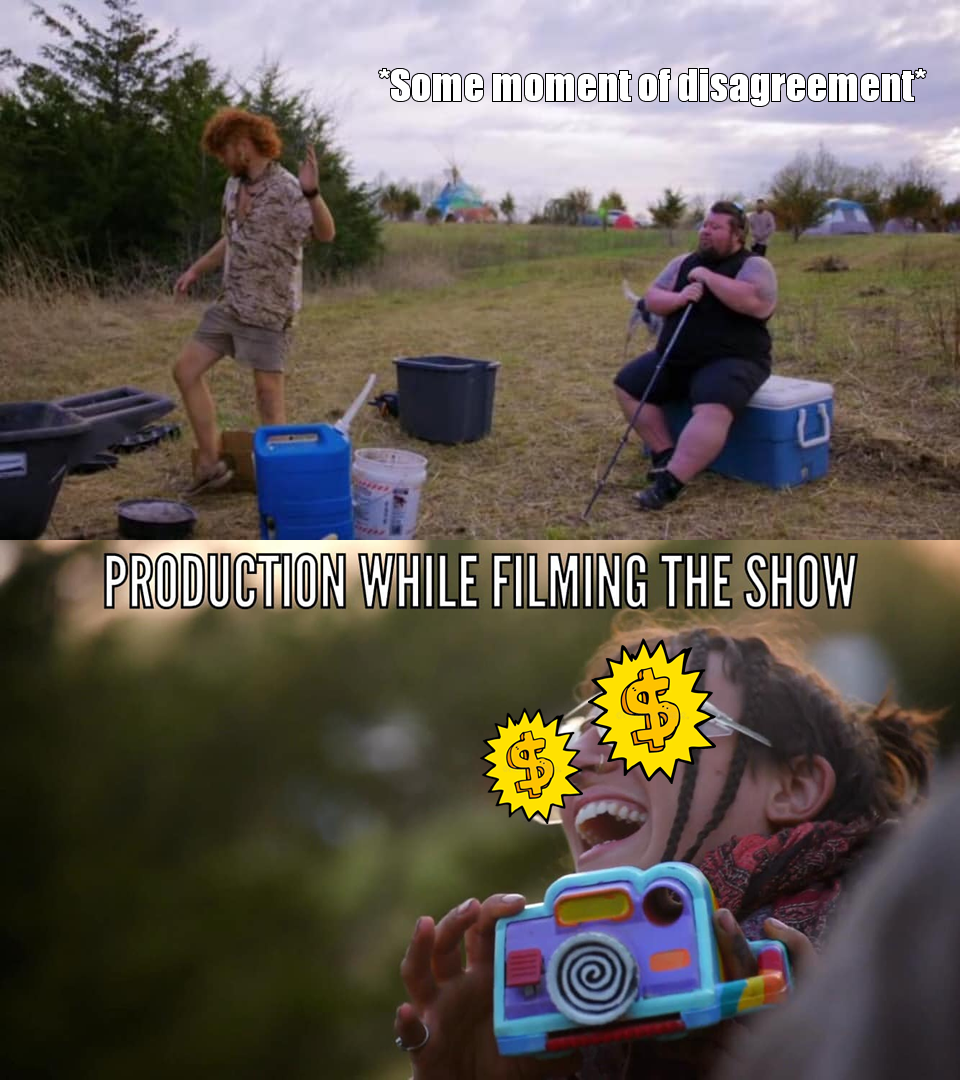
This meme depicts an original character, likely a director, having an off-screen argument with the lead actor. The top text, "Some moment of disagreement," establishes the conflict in an outdoor camp setting, while the bottom text, "PRODUCTION WHILE FILMING THE SHOW," explains that the filming is still taking place. The OC is shown on a spending spree at the bottom, with a toy camera and yellow "$" symbols popping up, indicating the main character went to the store to buy expensive gear to fix the filming problem.
simple-description (llama3.2-vision_11b)
The meme is a humorous commentary on the challenges of working in the entertainment industry, specifically in film and television production. The image depicts a chaotic and disorganized set, with crew members scrambling to prepare for a scene. The text "Production: Chaos Ensues" is overlaid on the image, highlighting the absurdity of the situation.
detailed-analysis (gemma3-27b-vision)
Okay, here's an analysis of the image based on your requested theoretical frameworks, focusing on what elements of the picture lend themselves to those analyses. I'll only include sections that seem particularly relevant, and I'll indicate where the connection is tenuous.
Please Note: This is an interpretation based solely on the visual information. Without context about the show being filmed, it’s somewhat speculative.
Visual Description
The image captures a moment during what appears to be a film or television production. The scene is outdoors, in a grassy, somewhat rural setting. Two figures are visible:
- Figure 1: A person, likely female, is striding purposefully with their arms raised and head looking down. Their posture is assertive, suggesting either an instruction or response in a potentially heated exchange.
- Figure 2: A person seated on a folding chair, appearing larger in build, facing away. They appear to be wearing denim shorts and a black t-shirt. This person appears to be engaging in a conversation with Figure 1.
- Foreground: A pink vintage-style instant camera is prominently displayed, held by a person (mostly obscured by the camera itself). The photo is framed to capture the unfolding scene. Digital currency symbols ($) are added in yellow explosions around the camera.
- Setting: Several plastic tubs, a black box or object, and folding chairs are scattered around, indicating a temporary set or production location.
The image overall has a candid, behind-the-scenes feel. The superimposed text ("PRODUCTION WHILE FILMING THE SHOW") and ("Some moment of disagreement") reinforces this impression.
Foucauldian Genealogical Discourse Analysis
The scene can be read as a microcosm of power dynamics inherent in filmmaking. Foucault’s work focuses on how power operates not through repression, but through the production of discourses.
- Discourses in Production: The act of directing, giving instructions (possibly shown in the gesture of the walking figure), and the very act of creating a narrative are all forms of discourse that establish norms and control. The "disagreement" indicated in the text implies a negotiation of these discourses, a struggle over meaning and control within the production.
- Panoptic Surveillance: The camera itself can be seen as a tool of surveillance, not necessarily in a sinister way, but as a mechanism for observing and shaping behavior. The act of filming creates a self-conscious performance, altering the behavior of those being filmed. The camera in the foreground is emblematic of this observation and power dynamic.
- Normalization: The production process itself seeks to normalize certain behaviors and appearances within the narrative. The disagreement could be about aligning individuals with these norms.
Critical Theory
The image can be examined through the lens of Critical Theory, focusing on the social structures and power relations that underpin media production.
- Ideology: The creation of media content inherently involves the propagation of ideologies – beliefs, values, and assumptions. The “disagreement” might be about the ideological implications of the narrative being filmed. Whose values are being represented, and whose are being excluded?
- Commodification of Culture: The digital currency signs ($) are a direct indication of commodification. The entire film production, and the very act of filming this ‘moment of disagreement’ are driven by financial considerations and intended for consumption as a commodity.
- Power and Representation: The bodies in the image are being represented. Critical Theory asks who is doing the representing, and how are they being represented. There are questions of power and the potential for reinforcing or challenging existing social hierarchies.
Marxist Conflict Theory
This framework focuses on the inherent class struggles within society. While not overtly visible, it’s applicable due to the visual emphasis on commodification.
- Labor & Exploitation: Film production, like any other industry, relies on labor. The individuals in the image are participating in a process of production, where their labor is being used to create a commodity. Marxist theory would question the distribution of profits and the potential for exploitation.
- Commodification of Conflict: The digital currency symbols superimposed on the camera highlight how conflict itself (the “disagreement”) is becoming commodified and turned into a product for consumption.
- Ownership & Control of Production: The individuals in the image are likely employees or contracted workers, not owners of the means of production (the studio, equipment, etc.). This inherent imbalance of power is a key tenet of Marxist thought.
Postmodernism
This section is a bit more tenuous, but some elements can be interpreted through a postmodern lens.
- Meta-Narrative: The image about making a film (a behind-the-scenes moment) blurs the lines between reality and representation. It is a meta-narrative – a story about a story being made.
- Deconstruction of Authenticity: The staging of a "moment of disagreement" raises questions about authenticity. Is the conflict genuine, or is it constructed for dramatic effect? Postmodernism challenges the idea of objective truth.
- Fragmentation and Playfulness: The added currency symbols are a playful disruption of the image, suggesting a self-awareness of its constructed nature.
I hope this analysis is helpful! Let me know if you'd like me to expand on any particular section.
simple-description (llama3.2-vision)
The meme is a humorous comparison between two scenes from a TV show. The top image shows two actors arguing on set, with one of them shouting "CUT!" The bottom image shows a woman holding a camera and laughing, with the caption "Production" above her and "Filming" below. The text "Some people are arguing, some people are filming" appears in the middle.
tesseract-ocr
eae o.. ew | a | ODE TLOGU ETT ATANINIAAT TSN Te te ay