First Seen
2024-09-12T20:38:27.501345+00:00
simple-description (qwen3.5_2b-q8_0)
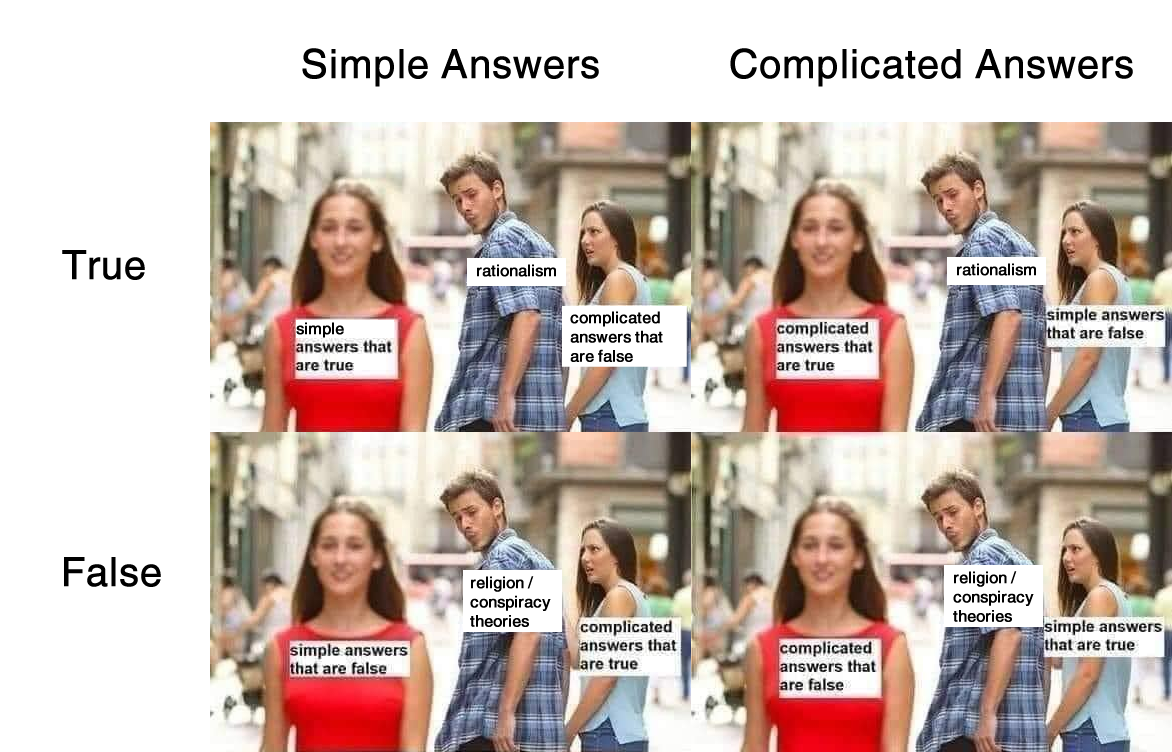
This meme depicts the famous philosophical joke about the relationship between simple and complex arguments. It shows a man and a woman, with text labeling their positions as either "simple answers that are true," "simple answers that are false," "complicated answers that are true," or "complicated answers that are false." In the top panels, a simple answer (labeled "rationalism") is the true one, and the man turns his back and walks away. In the bottom panels, a complicated answer (labeled "religion / conspiracy theories") is the true one, but the man is still shown leaving the woman. The humor is conveyed by the repeating text and the idea that he walks away regardless of who is correct.
detailed-analysis (gemma3_27b-it-q8_0)
Okay, let's break down this meme through the lenses you've provided. This is a complex meme, and a nuanced analysis will require diving into the theoretical frameworks.
Visual Description
The meme is a four-panel image utilizing the "Distracted Boyfriend" stock photo. The core structure remains consistent: a man walking with a girlfriend turns his head to look longingly at another woman. The labeling is where the humor and critical commentary lie.
- Top Row (Truth): The boyfriend represents “rationalism” and is distracted by “complicated answers that are false.” His girlfriend represents "simple answers that are true."
- Bottom Row (Falsehood): The boyfriend, again rationalism, is distracted by "complicated answers that are true" while his girlfriend represents “simple answers that are false.” The woman he is distracted by is labeled “religion/conspiracy theories.”
The meme visually communicates a preference for complexity, even when that complexity leads to incorrect conclusions, over accepting simpler, demonstrably true ideas. The visual metaphor immediately highlights a tension between different ways of knowing and valuing information.
Foucauldian Genealogical Discourse Analysis
From a Foucauldian perspective, this meme isn't about truth or falsehood in an objective sense. Instead, it's about the power/knowledge nexus.
- Discourse: The meme maps onto competing discourses: the discourse of "rationalism" (presented as a norm/baseline) versus discourses linked to "religion/conspiracy theories." Foucault would argue these aren’t simply about different beliefs, but different ways of constructing knowledge, producing truth, and exercising power.
- Genealogy: A genealogical tracing might examine how "rationalism" came to be dominant, and how “complicated answers” became associated with a perceived intellectual superiority. It would ask where the categories of 'simple' and 'complex' originated, and what power dynamics cemented those labels. The meme suggests a history where complex arguments, even those debunked, gain traction because they seem more 'sophisticated' or 'informed.'
- Power: The distraction itself is a power dynamic. The boyfriend (rationalism) is choosing to engage with the distracting figure (complicated, often false ideas). This choice reveals a preference for a knowledge system (complex arguments) that may be serving particular interests.
- Subjectivation: The meme implies a 'subject' (the rationalist) who constructs their identity through engagement with this complexity. The act of seeking out and embracing "complicated" explanations becomes a way to define oneself as intelligent and discerning.
Critical Theory
This meme can be interpreted as a critique of the Enlightenment project and its faith in reason.
- Instrumental Reason: Critical theorists like Horkheimer and Adorno would see the emphasis on "rationalism" as potentially turning into "instrumental reason" - reason used not for emancipation but for control and domination. The meme suggests that even when rationalism leads to demonstrably false conclusions, it is still preferred.
- Ideology: The preference for complex, even false, explanations can be seen as ideological. It's a way of obscuring underlying power structures and legitimizing existing inequalities. The appeal to complexity can function as a smokescreen, preventing critical examination of fundamental issues.
- The Culture Industry: The meme resonates with a critical theory of the culture industry. The constant bombardment of complex narratives, conspiracy theories, and sophisticated misinformation in the media fosters a dependence on pre-packaged, "intellectually stimulating" content – even when that content is harmful or untrue.
- Critique of Positivism: The meme implicitly critiques positivism (the idea that knowledge must be based on empirical observation). By suggesting a preference for complex, even non-empirical ideas, the meme undermines the notion of objective truth.
Marxist Conflict Theory
From a Marxist perspective, the meme touches upon class interests and the control of ideology.
- False Consciousness: The embrace of “complicated answers that are false” could be seen as a manifestation of “false consciousness.” The “rationalist” is misled into believing something that is not in their best interest, potentially by narratives that serve the interests of the ruling class.
- Ideological Apparatuses: The meme implicates the role of ideological apparatuses (e.g., media, education) in promoting these complex, distracting narratives. These apparatuses perpetuate ideologies that reinforce the existing power structure.
- Hegemony: The meme could be interpreted as demonstrating the power of cultural hegemony. The dominant class shapes beliefs and values in a way that makes its worldview seem natural and inevitable. The preference for complexity, even when false, could be a result of hegemonic influence.
- Material Conditions: A deeper analysis might explore the material conditions that make individuals more susceptible to complex, conspiratorial explanations. Economic insecurity, social alienation, and a lack of access to reliable information can all contribute to a distrust of simple truths.
Postmodernism
A postmodern reading would highlight the instability of truth and the subjectivity of knowledge.
- Deconstruction: The meme deconstructs the binary opposition between “simple” and “complex,” “true” and “false.” It shows how these categories are not fixed but are fluid and contingent.
- Simulacra and Simulation: The meme aligns with Baudrillard's concept of simulacra – copies that have no original. The “complicated answers” are often simulations of understanding, lacking a foundation in empirical reality. The focus shifts from finding truth to engaging with representations of truth.
- Meta-narratives: The meme implicitly critiques "meta-narratives" or overarching explanations of the world. The preference for complexity suggests a rejection of grand theories in favor of localized, fragmented knowledge.
- Relativism: The meme emphasizes the idea that truth is relative to perspective and context. There is no objective standard by which to judge the validity of different beliefs.
Queer Feminist Intersectional Analysis
This is a more complex application, but relevant.
- Epistemic Violence: The dismissal of "simple answers that are true" can be seen as a form of epistemic violence – the suppression of knowledge produced by marginalized groups. For example, lived experiences of oppression are often easily understood, yet systematically discounted in favor of complex theoretical frameworks.
- Privilege & Complexity: The preference for complexity could be linked to privilege. Those with more access to education and resources may feel entitled to (and even require) complex explanations. This can obscure the validity of simpler understandings that arise from lived experience.
- Intersectional Knowledge: Intersectional knowledge – the understanding of how different forms of oppression intersect – often starts with recognizing simple truths about systemic injustices. The meme critiques a tendency to overcomplicate these issues, potentially erasing the experiences of those most affected.
- Challenging Dominant Narratives: Queer and feminist perspectives inherently challenge dominant narratives, which are often complex and designed to maintain the status quo. The meme suggests that an embrace of complexity can be a way of avoiding confronting uncomfortable truths about power and inequality.
In conclusion, the meme is a deceptively simple visual that encapsulates complex ideas about knowledge, power, and the human tendency to seek out validation in sophistication, even at the expense of truth. The different frameworks provide tools to unpack the meme's layers of meaning and expose its underlying critiques.
simple-description (llama3.2-vision_11b)
The meme is a humorous representation of the challenges of explaining complex ideas in simple terms. It features a split-screen image of a person trying to explain a concept, with the words "simple answers" and "complicated answers" on either side. The image shows a woman looking at the man with a confused expression, as if she can't understand his explanation.
detailed-analysis (gemma3-27b-vision)
Okay, here's a breakdown of the image, attempting to address each theoretical lens you've requested, where applicable. Given the content, certain lenses are more relevant and can be explored in greater depth.
Visual Description
The image is a 2x2 grid of photographs depicting a young white woman and a young white man in a casual setting (likely an interview or public event). Each quadrant categorizes their stances/statements as either "True" or "False" and further divides those into "Simple Answers" and "Complicated Answers". The image uses text overlays to label the four categories. The expressions and postures of the individuals vary across the quadrants, appearing to be staged or at least selected for their expressiveness in relation to the assigned labels. The overall impression is that the image intends to visually represent the perceived relationship between truth, falsehood, simplicity, and complexity in communication or beliefs.
Foucauldian Genealogical Discourse Analysis
This image is a rich territory for Foucauldian analysis.
- Discourse & Power: The categorization itself ("True," "False," "Simple," "Complicated") is a discourse. It establishes a system of classifying statements and, critically, establishes a power dynamic through that classification. The image asserts who gets to define what is "true" or "false," "simple" or "complicated," and therefore wields power. This categorization implies a hierarchy of knowledge and credibility.
- Genealogy: Tracing the genealogy of these categories reveals that they aren't neutral or objective. "Truth" is historically constructed and tied to institutions of knowledge (science, law, education) which have been used to legitimize certain beliefs and marginalize others. Similarly, the very idea of "simplicity" being associated with truth has a historical lineage, often linked to Enlightenment ideals and a rejection of "superstition" or "obscurantism."
- Subject Formation: The image implicitly contributes to how "subjects" (individuals who hold beliefs) are formed. By associating certain expressions or answers with truth/falsehood, it encourages viewers to categorize others (and themselves) accordingly, reinforcing particular modes of thinking and behaving.
Specific Observation: The placement of "Rationalism" and "Religion/Conspiracy Theories" is highly significant. It positions rationalism as the pathway to truth, implicitly framing religion/conspiracy theories as inherently false or at least suspect. This is a clear exercise of power through discourse.
Critical Theory
The image embodies several concerns of Critical Theory:
- Ideology: The image presents a seemingly neutral categorization but actually promotes a specific ideology—that rational, complicated answers are aligned with truth, while simple or religiously/conspiracy-based answers are aligned with falsehood. This perpetuates a dominant worldview that privileges certain forms of knowledge and marginalizes others.
- Hegemony: The image works to maintain hegemonic power structures by subtly reinforcing the idea that certain ways of knowing (rationalism, complexity) are superior. This naturalizes power imbalances and discourages critical questioning of dominant beliefs.
- Instrumental Reason: The categorization of answers as "true" or "false" can be seen as a manifestation of "instrumental reason"—a focus on efficiency and control at the expense of meaning and ethical considerations. The image prioritizes identifying “correct” answers over understanding the complexities of belief.
Marxist Conflict Theory
While the image isn't explicitly about economic class, Marxist conflict theory can still offer a lens:
- Ideological Struggle: The image can be interpreted as a representation of an ideological struggle. The categorization of answers reveals a conflict between different worldviews—rationalism versus religion/conspiracy—and suggests that one worldview is dominant over the other.
- Power & Knowledge: Within a Marxist framework, power is often linked to control over knowledge. The image suggests that those who control the definitions of "truth" and "falsehood" have a privileged position in society.
- False Consciousness: The image can contribute to a "false consciousness" by discouraging critical examination of dominant narratives and reinforcing the idea that certain beliefs are inherently "correct."
Postmodernism
Postmodern thought would deconstruct the very idea of objective "truth" and "falsehood" presented in the image:
- Relativism: A postmodern perspective would argue that "truth" is not absolute but is relative to context, perspective, and power relations. There is no single, objective "truth" to be discovered.
- Deconstruction: The image's categories ("True," "False," "Simple," "Complicated") are seen as binary oppositions that are constructed and unstable. A postmodern analysis would challenge the idea that these categories are natural or self-evident.
- Meta-Narratives: The image relies on a "meta-narrative" — a grand story about the relationship between knowledge, truth, and rationality. Postmodernism rejects these meta-narratives, arguing that they are oppressive and exclude alternative ways of knowing.
Queer Feminist Intersectional Analysis
This lens is a bit more challenging to apply directly, but possible:
- Epistemic Violence: The image demonstrates epistemic violence through the prioritization of rationalism over other ways of knowing. Knowledge constructed by marginalized groups—including religious communities and those exploring conspiracy theories—can be invalidated or dismissed.
- Intersectionality: The categorization of answers ignores the intersectional nature of knowledge and power. Factors like race, class, gender, and sexuality all shape how individuals perceive and construct "truth."
- Silencing Marginalized Voices: Framing certain answers as "false" or "simple" can contribute to the silencing of marginalized voices and the perpetuation of dominant narratives.
- Deconstructing Binaries: The image also reinforces the binary of 'True/False', which is a construction that can exclude nuanced perspectives, particularly those of individuals with marginalized identities.
I've tried to provide a comprehensive analysis across these theoretical lenses. Let me know if you'd like me to elaborate on any specific point or explore another perspective!
simple-description (llama3.2-vision)
This meme is a play on the popular "Distracted Boyfriend" image, where a man is looking at another woman while his girlfriend or wife walks behind him. In this version, the woman he's looking at is a "Simple Answer" (a woman in a red dress), while his girlfriend/wife is a "Complicated Answer" (a woman in a more subdued outfit). The text "Simple Answers" and "Complicated Answers" are written on the women's clothing.