First Seen
2023-07-05T20:24:20+00:00
simple-description (qwen3.5_2b-q8_0)
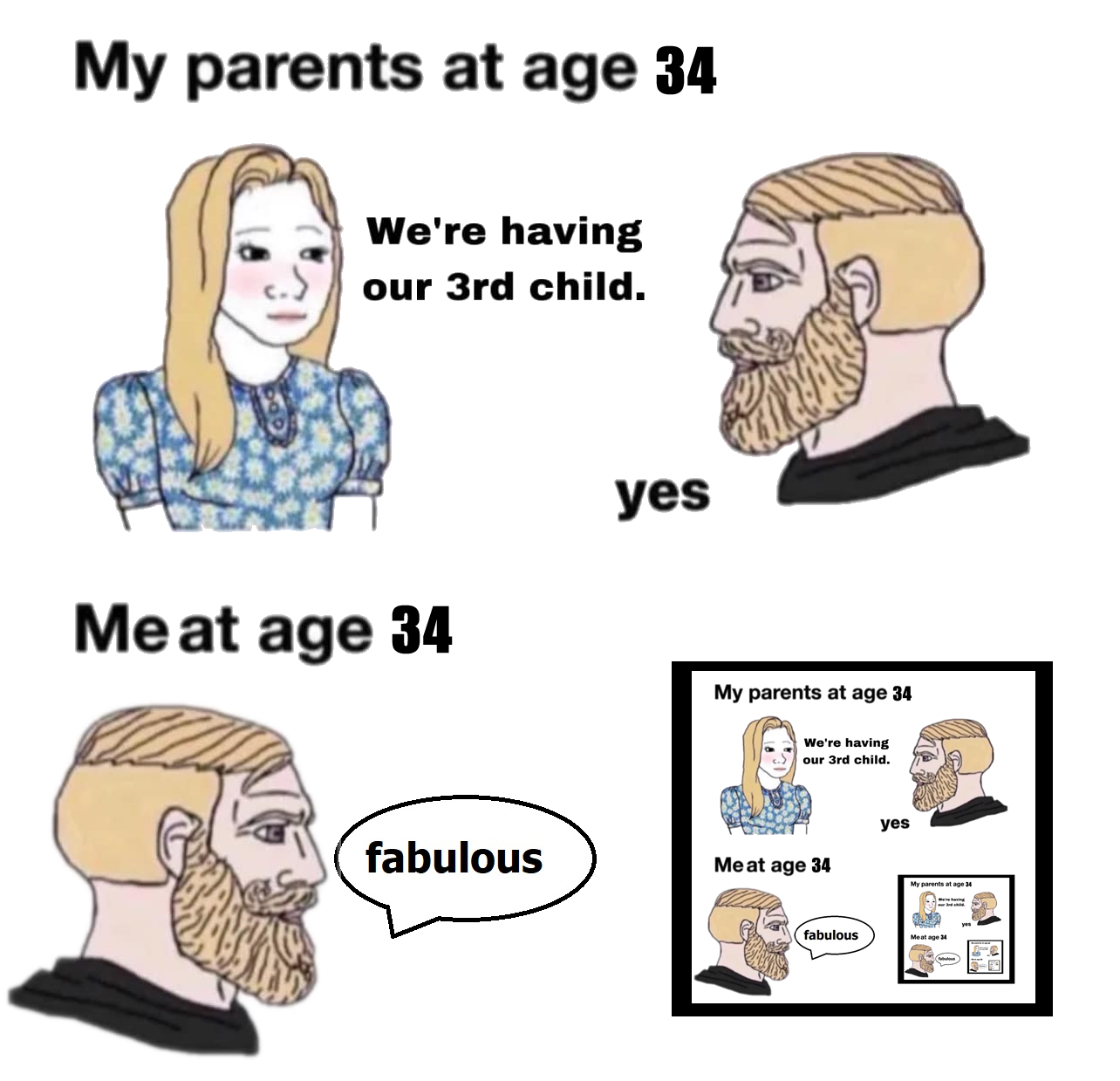
This meme features a conversation where a character tells their parents they are having their third child, which the parents respond to with the simple word "yes." The character then replies to that interaction with "Me at age 34" and the dialogue "fabulous." The bottom right corner reveals the recursion by placing the entire original interaction inside the new scene, showing the same "yes" and "fabulous" response continuing inside the loop.
simple-description (llama3.2-vision_11b)
This meme is a humorous example of an "OC" (original content) meme, which is a type of image or text that is created and shared by an individual, often on social media platforms. The meme features a split-screen image with a young girl saying "I'm 10" and an old man saying "I'm 10,000". The text "I'm 10" is written in a childish font, while the old man's response is written in a bold, playful font. The meme is meant to be humorous and relatable, poking fun at the idea that people's ages can be misleading.
detailed-analysis (gemma3-27b-vision)
Okay, here's an analysis of the meme, broken down into the sections you requested, with explanations on where each lens applies. It's important to note that a meme's simplicity sometimes limits the depth of analysis, but we can still apply these frameworks in meaningful ways.
Visual Description
The meme utilizes the Wojak/Feels Guy archetype, a series of internet images used to express emotions and social commentary. The meme is a triptych—three panels placed side-by-side.
- Panel 1: Depicts a conventionally attractive, pale woman with blonde hair, wearing a light blue cardigan or sweater. Text above states "My parents at age 34," and she says, "We're having our 3rd child."
- Panel 2: Shows a pale man with a short beard, wearing a black shirt. Text above repeats, "My parents at age 34," and he simply responds with "yes".
- Panel 3: Depicts a heavily muscled, exaggeratedly masculine man with a full beard, referred to as "Meat at age 34," with the caption "fabulous."
The style is minimalist and intentionally crude, characteristic of Wojak memes. The presentation of the panels, especially the third, is designed to be ironic and humorous.
Foucauldian Genealogical Discourse Analysis
This is where the meme offers some interesting points for analysis.
- Discourse & Power/Knowledge: The meme taps into the discourse around masculinity, parenthood, and societal expectations. Historically, power dynamics have been built around prescribed roles for men and women. The meme is critiquing this by juxtaposing a conventionally "ideal" parental unit with a hyper-masculine figure expressing "fabulous." It questions what is considered "normal" or "acceptable" within these discourses.
- Genealogy: Looking at the historical lineage of ideas, this meme draws on earlier internet tropes about "gym culture," "alpha males" and the performance of masculinity. It also implicitly contrasts this with a more "traditional" (and potentially stereotyped) image of parenting. The meme isn't offering a new idea, but rather rearranging and re-contextualizing existing discourses.
- Normalization & Deviance: The meme subtly positions the "Meat" panel as a deviation from the "normal" parental image. The label “fabulous” in this context, coupled with the exaggerated physique, is a challenge to conventional notions of fatherhood and masculinity. By highlighting this 'deviation,' the meme invites viewers to question what constitutes acceptable masculine performance.
Critical Theory
The meme operates well within a Critical Theory framework, particularly concerning societal norms and cultural critique.
- Ideology: The meme reveals implicit ideologies around gender roles, family structure, and the performance of masculinity. The "parents" panel presents a seemingly "traditional" image, while the "Meat" panel disrupts that expectation.
- Hegemony: The presumed “normal” parental image in the first two panels could be interpreted as a representation of hegemonic values—those that appear natural or universally accepted but are actually socially constructed. The third panel disrupts this perceived naturalness, exposing the constructedness of these norms.
- Commodification of Identity: The "Meat" panel suggests a highly curated and performative masculinity, potentially linked to consumer culture (gym memberships, protein supplements, clothing, etc.). This ties into a critical understanding of how identity becomes a commodity within capitalist systems.
Marxist Conflict Theory
While not the primary focus, there are threads of Marxist thought here.
- Material Conditions and Ideology: The emphasis on physical appearance and the pursuit of a hyper-masculine physique can be linked to capitalist ideals of self-improvement and consumerism. The "Meat" panel can be seen as a product of a culture that valorizes physical strength and external validation.
- Class and the Body: The ability to devote time and resources to achieving a hyper-masculine physique is often tied to economic privilege. This hints at the way class structures shape bodily ideals and self-expression.
- Alienation: The "Meat" panel could be interpreted as a representation of alienation from one's authentic self, driven by societal pressures and the pursuit of external validation.
Postmodernism
This framework is strongly applicable.
- Irony and Parody: The meme relies heavily on irony and parody. It mocks the conventional images of parenthood and masculinity, subverting expectations.
- Deconstruction: The meme deconstructs the very notion of "normal" parenthood. By juxtaposing contrasting images, it challenges the idea that there's a singular, correct way to be a parent.
- Simulation and Hyperreality: The "Meat" panel can be seen as a representation of hyperreality—a simulation of reality that becomes more real than reality itself. The exaggerated physique is a constructed ideal, a performance that dominates and potentially eclipses the lived experience.
Queer Feminist Intersectional Analysis
This offers a potentially insightful, though more nuanced, reading.
- Performance of Gender: This meme taps into the concept of gender as performance, a core tenet of queer theory. The "Meat" panel presents an exaggerated and consciously constructed masculinity.
- Challenging Hegemonic Masculinity: The meme disrupts traditional notions of masculinity. The caption "fabulous," applied to a hyper-masculine figure, subverts expectations and creates a playful ambiguity.
- Intersection of Identities: While the meme doesn't explicitly address intersectionality, it implicitly acknowledges the multiple layers of identity that shape individual experiences. The meme highlights how masculinity is constructed and performed within specific social contexts, and how it may intersect with other identities (e.g., parent, body type).
- Critique of Compulsory Heteronormativity: The "normal" representation of parents in the first two panels can be seen as perpetuating heteronormative assumptions about family structure. The subversion of this norm in the third panel, while playful, challenges the assumption that there is one "correct" way to be a family.
Important Note: The meme's meaning is open to interpretation. These analytical frameworks provide different lenses through which to understand its potential messages and implications. The meme's humor often arises from its ambiguity and the tension between different interpretations.
simple-description (llama3.2-vision)
The meme is a comic strip with two panels. The first panel features a character with a caption "My parents at 34" and the second panel features the same character with a caption "Me at 34". The text in the second panel reads "We're having our 3rd child" and the character responds with "We're having our 3rd child". The character then responds with "We're having our 3rd child" and the character responds with "We're having our 3rd child".
tesseract-ocr
My parents at age 34 r~\ SQ & We're having fee coatiaen’ our 3rd child. = |< jos YS | oy a IN > SANS Th) WET NY dhe eae Cw et yes Meat age 34 — My parents at age 34 (Lip juste Oe) Gh, 7 Meat age 34 - tS) ‘ Sf fig Ez AYOAK Gh once) me & [eB