First Seen
2023-05-10T21:03:38+00:00
simple-description (llama3.2-vision_11b)
The meme is a humorous image of a character from the popular animated series "Rick and Morty" with a caption "I can explain it in 2 words: 'I can explain it in 2 words: '". The image is a play on the character's signature catchphrase, "Wubba lubba dub dub", and the phrase "I can explain it in 2 words" is a clever reference to the show's absurdity. The meme is a lighthearted poke at the show's tendency to get overly complex and absurd.
detailed-analysis (gemma3-27b-vision)
Okay, let's break down this meme through several critical lenses. It's a deeply weird image, so some lenses will be more applicable than others.
Visual Description
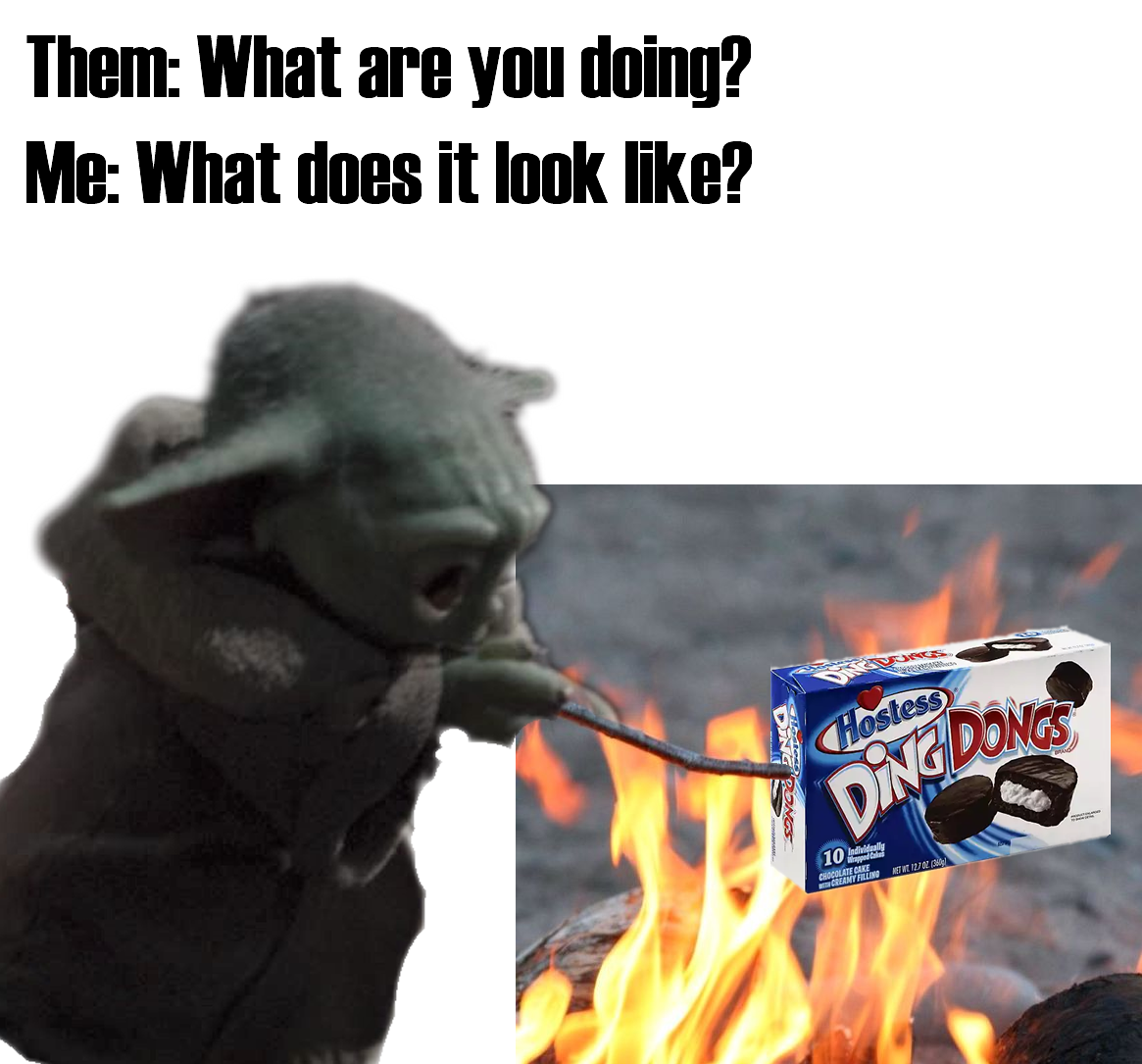
The image depicts Yoda, the iconic Star Wars character, seemingly roasting a box of Ding Dongs over an open fire. The composition is stark: Yoda is in the left foreground, in profile, looking determined. The fire and the box of Ding Dongs dominate the central and right areas. The lighting is dramatic, emphasizing the contrast between Yoda's dark form and the fiery glow. The box of Ding Dongs is visibly impaled on a makeshift skewer, suggesting a deliberate act of destruction/cooking. The text "Them: What are you doing? Me: What does it look like?" appears as a caption, framing the image as a defiant or absurdist retort. It is a digital manipulation.
Foucauldian Genealogical Discourse Analysis
This image can be analyzed through a Foucauldian lens as a disruption of established discourses surrounding "value" and "consumption."
- Discourse of Childhood/Treats: Ding Dongs are generally associated with childhood nostalgia, reward, and simple pleasure. Yoda, a figure of wisdom and mastery, engaging in what appears to be the willful destruction of this childhood symbol is a transgression.
- Discourse of Wisdom/Mastery: Yoda is traditionally depicted as a benevolent and disciplined master. His action here challenges the expected behavior of a wise figure. It’s an episteme that is disrupted.
- Power/Knowledge: The simple, dismissive response ("What does it look like?") is a power play. Yoda doesn't need to justify his actions; he asserts dominance by refusing to engage in rational explanation. This is a demonstration of power through controlling the discourse. He's operating outside the normal expectations of justification.
- Genealogy: The genealogy of this image could trace the cultural association of certain foods with comfort/reward, the figure of the wise elder, and the contemporary trend of absurdist internet humor. It reveals how these seemingly separate elements converge in a surprising and unsettling image.
Critical Theory
From a Critical Theory perspective, the image critiques the commodification of joy and nostalgia.
- Commodification: Ding Dongs represent a manufactured form of happiness, a pre-packaged treat. Yoda’s act can be interpreted as a rejection of this superficial form of pleasure.
- Alienation: The deliberate destruction of the Ding Dongs suggests a broader critique of consumer culture and the alienation it creates. Yoda might be symbolically rejecting the emptiness of material possessions.
- Ideology: The image challenges the ideology that encourages the pursuit of pleasure through consumption. It suggests a rejection of the "always wanting more" mentality.
- The Absurdity of Capital: The act itself is irrational – roasting Ding Dongs is not a practical or desirable act. This reinforces the notion that consumer culture often promotes irrational behavior.
Marxist Conflict Theory
Through a Marxist lens, the image could be interpreted as a symbolic class struggle.
- Commodity Fetishism: Ding Dongs, as a manufactured good, embody commodity fetishism. The focus is on the object itself, obscuring the labor and exploitation involved in its production.
- Revolutionary Act: Yoda, as a figure of authority, destroying the commodity could be seen as a symbolic act of rebellion against the capitalist system. It is a rejection of the values and priorities of the ruling class.
- Subversion of Value: The act devalues the commodity. By roasting the Ding Dongs, Yoda renders them useless, demonstrating the arbitrary nature of value in a capitalist system.
- Labor/Consumption: There's an implicit commentary on the consumption of labor. The Ding Dongs represent that labor; destroying them can be seen as an indirect critique of exploitative production.
Postmodernism
The image deeply resonates with postmodern principles.
- Pastiche and Intertextuality: It’s a blend of disparate elements: Star Wars, a children’s snack, fire, and a minimalist dialogue. It lacks a clear narrative or message, relying on the shock value of juxtaposition.
- Deconstruction: It deconstructs the established meaning of each element. Yoda is no longer simply a wise Jedi Master; Ding Dongs are no longer just a treat. The meaning is unstable and open to interpretation.
- Irony and Absurdity: The entire image is steeped in irony and absurdity. The lack of logical explanation is a hallmark of postmodern art.
- Rejection of Grand Narratives: There is no underlying "truth" or "message" to be found. It's a playful, fragmented image that rejects the notion of a single, coherent meaning.
Queer Feminist Intersectional Analysis
This is perhaps the most challenging lens to apply, but possible.
- Disruption of Expectation/Norms: Yoda’s action is fundamentally unexpected. This disruption of expectation can be understood as a challenging of established norms. The image is queer because it resists easy categorization and challenges conventional expectations.
- Refusal to Justify: Yoda's response ("What does it look like?") is a refusal to be subjected to scrutiny or explanation, mirroring the experiences of marginalized groups who are often required to justify their existence or actions.
- The Materiality of Food and Desire: The destruction of the Ding Dongs could be seen as a rejection of societal pressures surrounding food and desire. Perhaps a commentary on the fetishization of sugary foods and the unrealistic expectations around body image.
- Intersectional Ambiguity: The intersectionality is subtle. The image is less about a specific marginalized identity and more about a broader rejection of societal norms and expectations.
It's important to note that these interpretations are not mutually exclusive. The image is complex enough to support multiple readings, and the most compelling analysis might draw from several of these critical lenses.
simple-description (llama3.2-vision)
The meme is an image of the character Baby Yoda from the Star Wars series, holding a stick with a box of Hostess Ding Dongs in the flames of a campfire. The text "Them: What are you doing? Me: What does it look like?" is overlaid on the image, referencing a common meme format where someone is asked to explain their actions and responds with a humorous or sarcastic answer.
tesseract-ocr
Them: What are you doing? Me: What does it look like? | . mer _) y i Fag e —_ mS. Vek oN 7 f TP, °