First Seen
2023-10-12T23:08:01+00:00
simple-description (qwen3.5_2b-q8_0)
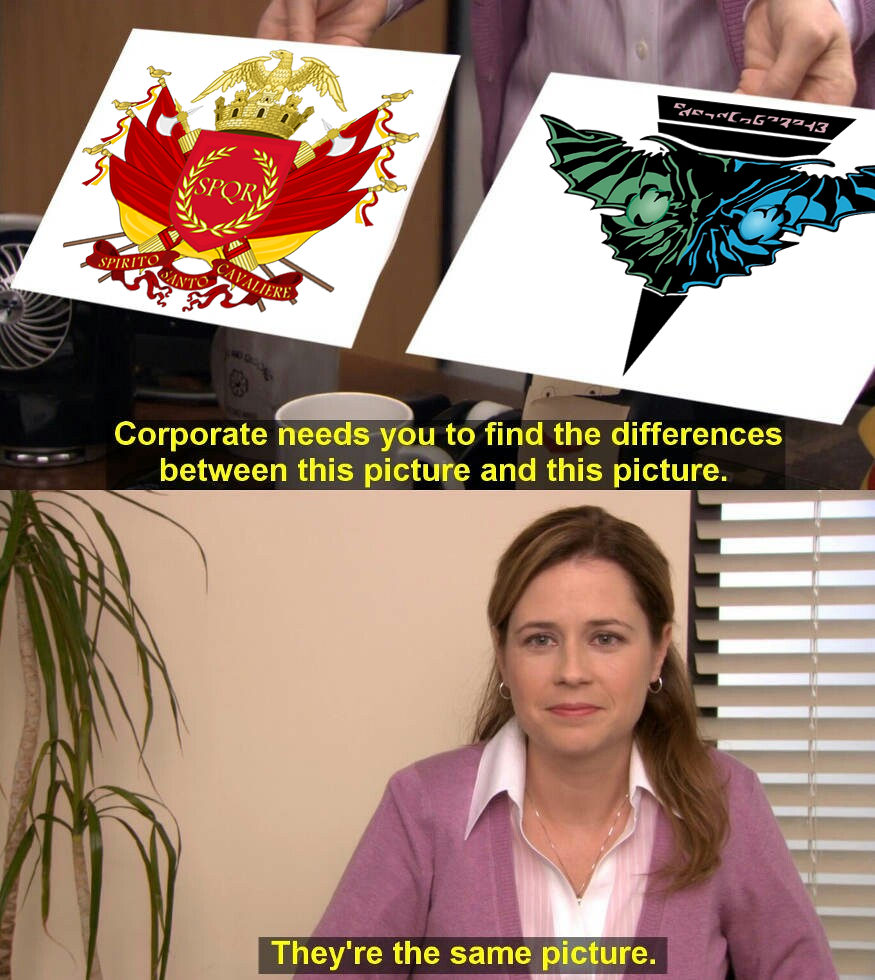
This meme is a humorous satire of corporate bureaucracy and the absurdity of performance reviews. The top half displays two logos that look completely unrelated to each other—one is a formal, red-and-gold Italian coat of arms with the Roman symbols "SPQR" and an eagle, while the other is a dark, stylized green and black bat-like creature. The text at the top asks the viewer to "find the differences between this picture and this picture."
The bottom half shows a woman (played by Leslie Jones from The Office) looking baffled and unimpressed. She replies with the caption, "They're the same picture." The joke highlights the ridiculousness of asking an employee to be creative ("make the logo") when they are given two identical designs, mocking the pressure to generate "originality" or "improvement" in boring jobs.
simple-description (llama3.2-vision_11b)
The meme is a comparison between two logos, one from the popular video game series "Dark Souls" and the other from the "Mortal Kombat" series. The text "They're not the same" is a quote from the TV show "The Office," but in this context, it's used to highlight the absurdity of comparing two vastly different logos. The meme is poking fun at the idea that someone would try to find similarities between these two logos, when in reality, they are extremely distinct.
detailed-analysis (gemma3-27b-vision)
Okay, here's an analysis of the image, broken down into relevant sections based on the provided theoretical frameworks. I'll avoid applying categories where they don't significantly contribute to the interpretation.
Visual Description
The image is a screenshot from the US television show The Office, featuring a scene with the character Angela Martin in the foreground. Angela, known for her rigid and judgmental personality, looks directly at the viewer with a stern expression. Superimposed above her are two seemingly distinct images: a colorful heraldic crest featuring an eagle, shield, and Latin motto ("SPQR - Senatus Populusque Romanus - The Senate and People of Rome"), and a darkly rendered bat-shaped signal. Text overlaying the images states "Corporate needs you to find the differences between this and this picture." Below Angela, text states "They're the same picture." The visual effect cleverly masks the fact that both images are, in fact, the same picture of a bat signal, superimposed on each other.
Foucauldian Genealogical Discourse Analysis
This image is powerfully suggestive of the function of discourse and power/knowledge as outlined by Michel Foucault. The central premise – a demand to identify differences where none exist – is a microcosm of how systems of power (here, embodied by “Corporate”) construct reality through discourse.
- The Demand as a Power Mechanism: The request to find differences isn't about discovering objective truth; it's about enforcing a particular mode of seeing. It’s a subtle exercise of power, requiring compliance and participation in a meaningless task. It simulates a "panoptic" dynamic: Angela, and by extension, the viewer, is positioned as both subject and object of surveillance. Corporate (the implied authority) observes how readily we accept and participate in the demand.
- Genealogy of "Difference": We could trace the genealogy of the concept of "difference" itself, how it’s been historically constructed and deployed to create hierarchies and justify social control. In the image, this concept is reduced to absurdity, revealing its potential to be arbitrary and manufactured.
- Normalization of the Absurd: The image suggests how systems normalize illogical or nonsensical demands, pushing individuals to participate in their own subjugation. Angela’s deadpan expression embodies a passive acceptance, suggesting a deep internalization of these systems.
Critical Theory
The image is a sharp critique of several aspects of modern society, specifically relating to capitalist structures and the pressures of corporate culture.
- Alienation: Angela's expression perfectly captures the alienation of labor – a central concept in Critical Theory. She's a cog in a machine, being asked to perform a task devoid of meaning. The task itself is a representation of the disconnect between labor and its product; there’s no genuine outcome, only the performance of compliance.
- Ideology and False Consciousness: The corporate demand represents a form of ideology. It promotes a belief system that difference must always be identified, reinforcing a particular worldview. The “truth” of the situation (that the images are the same) is obscured by the demand.
- Dehumanization: By reducing Angela (and by implication, individuals) to a function of identifying superficial differences, the image suggests a broader dehumanizing effect of corporate culture.
Marxist Conflict Theory
The image can be interpreted as a commentary on class conflict and the exploitation inherent in the capitalist system.
- Corporate as the Bourgeoisie: “Corporate” represents the ruling class (bourgeoisie) imposing demands on the workforce (represented by Angela). These demands are not about productivity or efficiency, but about maintaining control and reinforcing the existing power structure.
- Alienated Labor: As mentioned above, Angela’s expression symbolizes the alienation of labor under capitalism. Workers are separated from the fruits of their labor and reduced to mere instruments of production. The meaningless task underscores the dehumanizing aspects of this system.
- False Consciousness: The demand to find differences can be seen as a mechanism for maintaining the status quo. It distracts from the real issues of exploitation and inequality, keeping the workforce docile and compliant.
Postmodernism
The image leans heavily into postmodern themes of simulation and hyperreality.
- The Simulacrum: The image presents a simulacrum – a copy without an original. The request for differences is a simulation of meaning, devoid of substantive content. The “difference” is fabricated, a constructed illusion.
- Deconstruction of Meaning: The image actively deconstructs the concept of difference. By revealing that the images are identical, it undermines the notion that differences are inherent or objective.
- Irony and Parody: The image uses irony and parody to critique the absurdities of modern life. It mocks the relentless pursuit of difference and the meaningless tasks that often define our existence.
Queer Feminist Intersectional Analysis
While not as central as the other themes, this framework can offer additional layers of interpretation.
- Pressure to Conform & “See” Difference: The demand to find differences can be seen as mirroring societal pressures for individuals (especially those marginalized) to differentiate themselves, to “fit” into predefined categories. The absurdity of the task highlights the artificiality of these categories.
- Devaluation of Subjective Experience: The corporate demand prioritizes a superficial, visual distinction over subjective understanding. It devalues individual perception and reinforces a rigid, patriarchal system of knowledge.
- Intersectionality of Oppression: The image can be viewed as a broader commentary on systems of oppression. The demand to identify differences is analogous to the ways in which marginalized groups are often forced to constantly explain and justify their existence.
In conclusion, the image is a rich and complex work that speaks to a range of contemporary issues. It effectively uses visual irony and textual cues to create a powerful critique of corporate culture, social control, and the search for meaning in a hyperreal world.
simple-description (llama3.2-vision)
This meme is a visual comparison between two images, with the top image showing the logo of the Roman Empire's military legion, the "Legio XX" (20th Legion), and the bottom image showing a logo of the modern-day US military's 20th Air Force. The meme is captioned: "In 2,000 years, we went from 'Legio XX' to '20th Air Force'".
tesseract-ocr
- bs f} # aoe a 4 “Rts lye ya a Corporate needs you to find the differences am between this picture and this picture. y \ J We \ =, } \ i —— oN i oh on y pS P ‘ ten i) N )\ \y A ! a : i a oo } They're the same picture. » —