First Seen
2023-11-12T20:15:18+00:00
simple-description (qwen3.5_2b-q8_0)
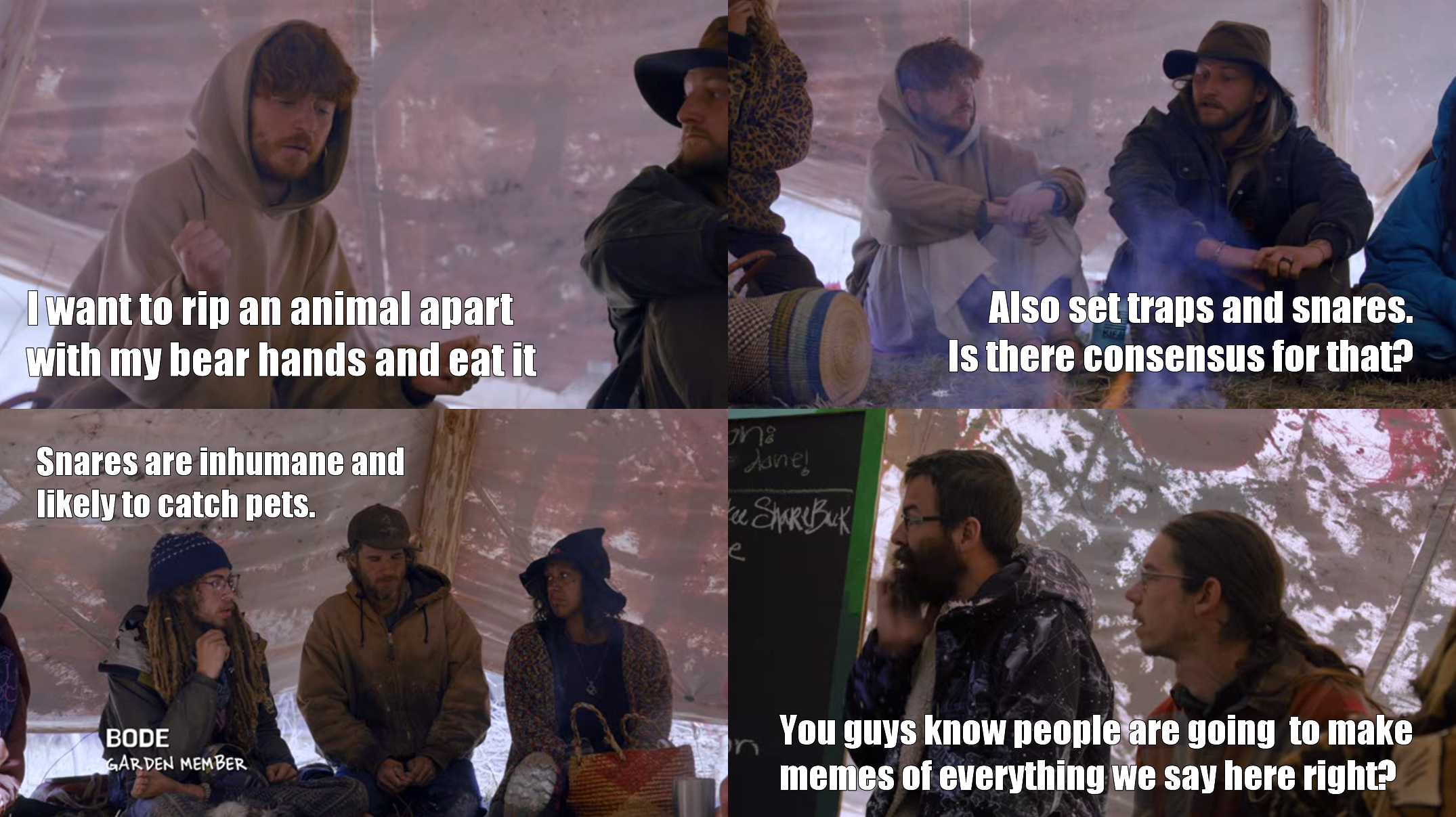
This meme, created by Original Characters (OCs), portrays a humorous debate scene where the cast members from the show Inside are deciding how to tackle a bear. One character enthusiastically demands to rip the bear apart with his "bear hands," but this is immediately countered by another member who objects that snares are inhumane and likely to catch pets. The scene culminates in a meta-joke where a narrator character sarcastically remarks that everyone is "making memes of everything we say here right," implying that the group's logic is so absurd it needs a name.
simple-description (llama3.2-vision_11b)
The meme is a screenshot of a conversation from the TV show "Rick and Morty". In the image, Rick is explaining a complex concept to Morty, and the text overlay reads: "I want to explain something without explaining it". This meme is used to express the frustration of trying to explain a complex idea in a simple way.
detailed-analysis (gemma3-27b-vision)
Okay, let's break down this image and its embedded textual statements through various critical lenses. It's a complex image with statements that invite layered analysis.
Visual Description
The image is a still from what appears to be a reality television show, possibly related to survival or homesteading. A group of approximately 8-10 individuals are gathered in a somewhat rustic outdoor setting, likely a field. The overall lighting suggests daylight, but it's somewhat muted and grainy, giving it a raw, unpolished feel.
The individuals are dressed in various outdoor and work clothes – jeans, jackets, hats, and some are carrying tools or equipment. The framing is close enough to allow for facial expressions, which range from intensity to casual curiosity. A chalkboard with some writing is partially visible in the background.
Crucially, the image is overlaid with four text bubbles, appearing as if direct quotes from the individuals. The text bubbles contain rather startling and specific statements. One describes a desire to rip an animal apart and eat it. Another asks about a consensus on using traps and snares. A third offers an opinion on snares being inhumane and likely to catch pets. The final statement acknowledges the inevitable meme-ification of the conversation.
Foucauldian Genealogical Discourse Analysis
This image provides fertile ground for a Foucauldian analysis, especially regarding the discourse of survival, predation, and human-animal relations.
- Power/Knowledge: The stated desire to "rip an animal apart and eat it" doesn't simply represent personal preference. It's a performative act of asserting dominance over the natural world. It produces a particular understanding of survival—one where violence against animals is normalized, even celebrated. The act of talking about it, and the group's engagement, establishes and reinforces this discourse.
- Genealogy: The idea of "survival of the fittest" has a long genealogy, tracing back to Darwinism (often misinterpreted), colonialism, and frontier narratives. The statements in the image tap into these historical understandings. The normalization of predation reflects a lineage of human dominance over nature.
- Disciplinary Power: The question about "consensus" highlights how even discussions of potentially violent acts are subject to group negotiation and control. It's not just about the act itself, but how it's discussed and legitimized within the group. This is a subtle form of disciplinary power.
- Animalization & Dehumanization: The desire for raw violence enacted on an animal suggests a distancing of the animal from moral consideration, animalization. At the same time, the claim of needing to hunt and kill for survival can operate as a self-justification for what is otherwise violence, subtly dehumanizing the animal through portraying it as mere sustenance.
Critical Theory
The image begs for a Critical Theory reading, focusing on the ideology embedded in its statements and the potential for critique.
- Domination of Nature: The desire to "rip an animal apart and eat it" embodies a key tenet of Western ideology: the domination of nature. It reinforces a worldview where humans are seen as superior to and entitled to exploit the natural world for their own needs. This is often presented as "natural" and necessary, obscuring the ethical implications.
- The Illusion of Self-Sufficiency: The focus on hunting and trapping can be interpreted as a performance of self-sufficiency, an ideological construct often celebrated in certain subcultures. However, this overlooks the complex economic and social systems that support even "off-grid" lifestyles.
- Critique of Consumer Culture: Paradoxically, the pursuit of "self-sufficiency" might be seen as a reaction against consumer culture, yet it can also be a form of performance and branding, especially if the group is involved in reality television.
- The Spectacle: The final statement ("You guys know people are going to make memes…") is highly significant. It draws attention to the spectacle of this conversation. The group is aware they are being watched and that their statements will be circulated and potentially recontextualized, becoming fodder for entertainment. This illustrates how even seemingly "authentic" experiences can be commodified and mediated.
Postmodernism
A Postmodern lens emphasizes the fragmentation of meaning, the blurring of boundaries, and the self-reflexivity of the image.
- Hyperreality & Simulation: The image is a simulation of "real" survival, presented through the lens of reality television. It's a constructed reality that blurs the line between authenticity and performance. The awareness of meme-ification further emphasizes the simulated nature of the experience.
- Deconstruction of "Nature": The image challenges the notion of a pristine, untouched "nature." It demonstrates how even in seemingly remote settings, human intervention and cultural constructs are always present. The act of hunting and trapping is not simply a "natural" act, but a culturally mediated one.
- Irony & Parody: The statements are laced with a degree of irony. The juxtaposition of the violent statement about ripping an animal apart with the concern about snares catching pets creates a dissonance that invites questioning. The awareness of the meme-ification adds a layer of self-parody.
Queer Feminist Intersectional Analysis
While not immediately obvious, an intersectional lens can reveal how power dynamics operate within the image.
- Traditional Masculinity & Domination: The boastful statement about tearing an animal apart taps into traditional notions of masculinity, associated with strength, aggression, and dominance over nature. This can be seen as reinforcing patriarchal power structures.
- The Discomfort with Animal Suffering: The counter-statement about snares being inhumane and catching pets demonstrates a different ethical stance, one that values compassion and recognizes the sentience of animals. This can be seen as a form of resistance against the dominant ideology of exploitation.
- Power Dynamics within the Group: The image suggests a potential power dynamic within the group. Who is making the violent statements, and who is voicing concerns? How are these statements being received? Analyzing the body language and facial expressions of the individuals could provide further insights into these dynamics.
- Environmental Justice: The treatment of animals and the exploitation of nature are often linked to broader issues of environmental justice. Marginalized communities are often disproportionately affected by environmental degradation and the loss of biodiversity. This image could be interpreted as a microcosm of these larger power imbalances.
In conclusion, this seemingly simple image is rich with meaning and invites multiple layers of critical analysis. Each lens offers a unique perspective on the power dynamics, ideological constructs, and ethical implications embedded within the statements and the visual context.
simple-description (llama3.2-vision)
The meme is a screenshot from a TV show or movie where a character is trying to convince others to eat a raw animal's flesh. The text "I want to eat this animal raw" is overlaid on the image, and the character is responding to a question about why they want to do this.
tesseract-ocr
: ’ “4 a - ' = 7 . ss 1 . ee ey ' ; ) ; B if & Want to rip an animal apart — Also settraps and snares. i ith my bear hands and eatit y | e : ih er ae he nl ; _ Snares are inhumane and i = ES, IN Oe Denar oe wg | : Ree SP tes ae. ig a) : a we Pa Yee, : F 2 E | S ; : ; a ie : ; . 3 / , es . i a wy, ea 3 ss , > ae Y You guys know people/are going to make Sm Oe 3 wT Tee Le