First Seen
2023-11-08T02:15:37+00:00
simple-description (qwen3.5_2b-q8_0)
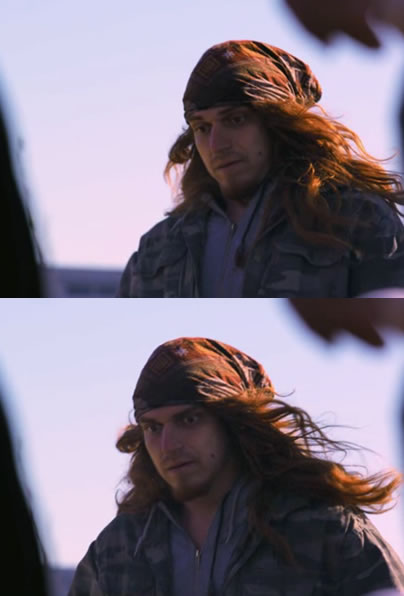
This meme features an Original Character (OC) with long reddish hair and a patterned bandana, wearing a camouflage jacket over a hoodie. In the background of the top panel, the text "KINGS ROW" is visible on a sign, which adds a setting to the scene. The character’s appearance, particularly the long hair and bandana, strongly resembles the android "Steve" from the TV show Westworld, implying the OC is an android or robot in a human disguise or simply a humorous depiction of a robot.
simple-description (llama3.2-vision_11b)
This meme is a screenshot from the 2002 film "Pirates of the Caribbean: The Curse of the Black Pearl" featuring Johnny Depp as Captain Jack Sparrow. The image shows Depp's character with a confused expression, captioned "When you're trying to explain something but they just don't care".
detailed-analysis (gemma3-27b-vision)
Here's an analysis of the image, broken down into sections, touching on requested theoretical frameworks where relevant. Because the image is relatively simple, certain frameworks will yield less detailed analysis than others.
Visual Description
The image features a close-up of a man with long, reddish-brown hair. He's wearing a paisley-patterned bandana tied around his head and a camouflage jacket. The lighting is somewhat grainy and has a warm, almost sepia tone, evoking a nostalgic or possibly vintage aesthetic. His expression is rather stoic or contemplative, with a slight furrow in his brow. There's wind visibly blowing through his hair, suggesting an outdoor setting. The image is captured from a low angle, and a partial view of what appears to be a raised platform or structure is visible in the background. The composition is relatively symmetrical, focusing primarily on the man’s face and flowing hair. There are two images provided which are nearly identical, and offer a slightly different angle.
Foucauldian Genealogical Discourse Analysis
The image allows for discussion of how masculinity and rugged individualism are constructed and maintained through visual representation. The long hair, traditionally associated with rebellion or nonconformity, is juxtaposed with the camouflage jacket, a symbol of military discipline and often hypermasculinity. This combination creates a tension—a subject positioned outside conventional norms, yet adopting elements of a traditionally power-laden iconography.
- Power/Knowledge: The depiction reinforces the societal construction of “masculinity,” and how specific visual markers (hair length, clothing) become imbued with meaning. The bandana, for example, might be coded as “rebellious” or “free-spirited” in contrast to the disciplined camouflage.
- Genealogy: We can trace a history of representations of “rugged individualists” in popular culture (e.g., cowboys, frontiersmen, Vietnam-era veterans) and see how those tropes are being adapted and re-presented in this image. The camouflage references a specific historical power structure (the military) and its association with masculinity.
- Discourse: The image participates in a discourse about masculinity, presenting a subject that is simultaneously unconventional and empowered.
Critical Theory
Applying Critical Theory, the image can be interpreted as a potential critique of the idealized masculine subject. The subject’s expression hints at internal conflict or questioning. This could be a rejection of the traditionally stoic and unfeeling masculine archetype. The subject doesn’t perform masculinity in a brash or dominant way, which opens a space for questioning the structures of power and control that often dictate such performance.
The visual elements – the seemingly contrasting bandana and camouflage jacket – suggest a tension between the individual and the institution, the free spirit and the controlled.
Marxist Conflict Theory
From a Marxist perspective, the camouflage jacket is significant. It is a symbol of a specific class and institution (the military) associated with power, control, and often, exploitation. The man, wearing this symbol, suggests a potential connection to, or perhaps rebellion against, these structures. Is he part of the military-industrial complex? Is he a veteran grappling with the consequences of conflict? The image, however, doesn't explicitly offer answers.
The contrast with the bandana could be read as a symbol of resistance – an individual’s attempt to express independence outside the constraints of the established order. The image, therefore, potentially highlights the inherent tensions between individual freedom and the forces of control within a capitalist society.
Postmodernism
The image can be viewed as embracing postmodern characteristics. The juxtaposition of the bandana and camouflage jacket is an example of pastiche—blending seemingly disparate elements in a way that challenges conventional categorization. The man’s ambiguous expression can be interpreted as a rejection of fixed meaning, embracing the fluidity and instability that characterize postmodern thought. The image is not attempting to convey a singular, coherent message, but rather, inviting multiple interpretations.
Queer Feminist Intersectional Analysis
This lens has the most limited application here, as the image lacks explicit gender or sexuality markers. However, we can explore how the image disrupts traditional masculine tropes. The long hair is often coded as feminine, and its presence on a male subject challenges conventional understandings of masculinity. This disruption can be seen as a destabilization of the gender binary.
Intersectional analysis is limited, but we can consider how the visual signifiers (clothing, hairstyle) might intersect with other social categories (race, class, etc.) to create complex understandings of identity and power. For example, if the man’s race were known, we could analyze how the visual markers intersect with racial stereotypes and power dynamics.
It's important to note that these are all interpretive frameworks, and the meaning of the image is open to ongoing discussion.
simple-description (llama3.2-vision)
This meme is an image of a man with a confused expression, taken from the movie "Pirates of the Caribbean: The Curse of the Black Pearl". The text "I just wanted to go for a run" appears above the image.
tesseract-ocr
ES, ” : . rN.