First Seen
2023-05-10T21:03:38+00:00
simple-description (llama3.2-vision_11b)
This meme is from the "OC" category, which stands for "Original Content," referring to user-generated content on the internet. The meme is a humorous image of a character from the animated TV series "Adventure Time" named Finn, who is wearing a "I Can Read" hat and holding a book. The image is captioned "I can read" but the text is actually a parody of a popular meme, with the words "I can read" being replaced with "I can read" but actually being "I don't have the attention span to read".
detailed-analysis (gemma3-27b-vision)
Okay, let's analyze this image through the lenses of various critical theories.
Visual Description
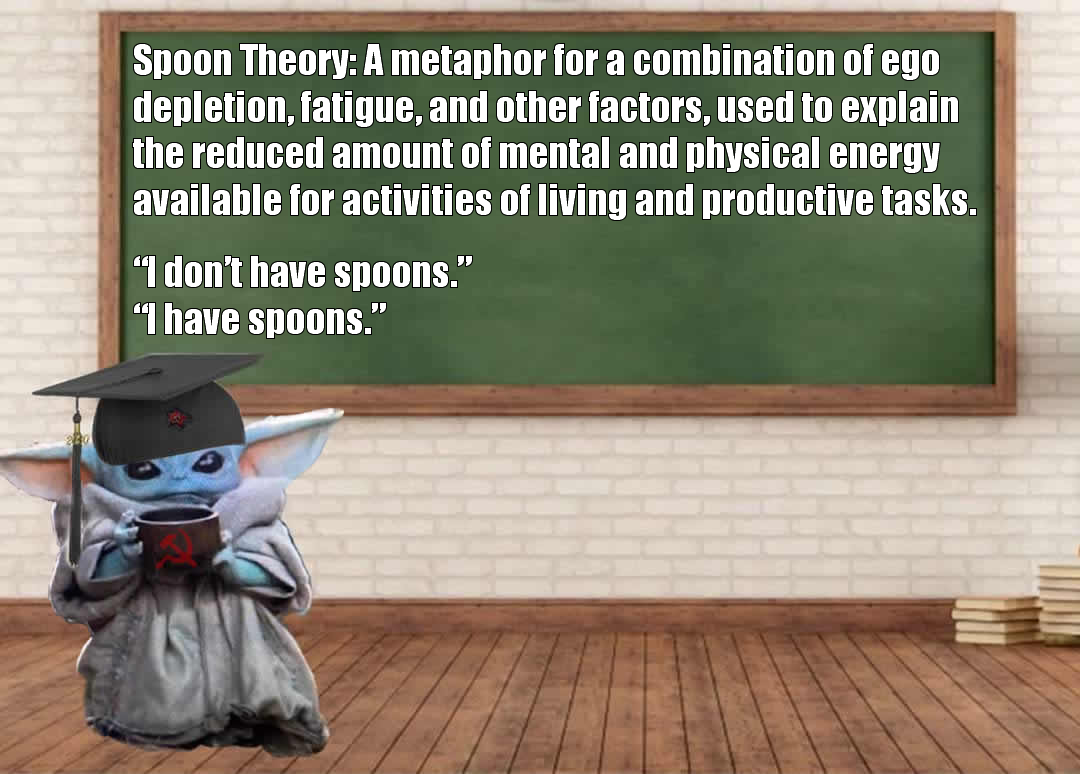
The image depicts “Baby Yoda” (Grogu) from The Mandalorian wearing a graduation cap. Grogu is positioned in front of a chalkboard that reads, "Spoon Theory: a metaphor for a combination of ego depletion, fatigue, and other factors, used to explain the reduced amount of mental and physical energy available for activities of living and productive tasks." Below this definition are the phrases "I don't have spoons." and "I have spoons." A small stack of books is to the right of Grogu, suggesting a learning or academic context. The overall impression is one of using a popular culture character to communicate a concept related to disability, chronic illness, or mental health. The setting is a polished hardwood floor.
Foucauldian Genealogical Discourse Analysis
The image and its accompanying text are deeply intertwined with the discourse surrounding chronic illness and disability. A Foucauldian genealogical approach would examine how the concept of “spoon theory” came to be, and the power dynamics at play in its popularization.
- Historical Contingency: Spoon theory, created by Christine Miserandino, emerged from a specific moment - a need to explain her experience with chronic illness (specifically lupus) to a friend in a way that went beyond traditional medical explanations. It wasn’t a universal, pre-existing concept but arose from a particular social context.
- Power/Knowledge: The theory offers a counter-discourse to the medical gaze, which often pathologizes and objectifies individuals with chronic illness. It allows individuals to self-define their energy limitations, rather than being defined by medical diagnoses or societal expectations.
- Discipline & Normalization: The phrase “I don’t have spoons” or “I have spoons” becomes a means of navigating social interactions and negotiating boundaries. It's a way of disciplining others' expectations and establishing a different framework for productivity.
- The use of a Pop Culture Character: The framing of this in terms of “Baby Yoda,” a popular character, works to normalize the concept and make it more accessible to a wider audience. This can be seen as a form of cultural “translation,” potentially increasing acceptance and understanding.
Critical Theory
This image can be interpreted through a critical theoretical lens focusing on the social construction of disability and illness.
- Challenging Normative Assumptions: The image implicitly challenges the assumption that everyone has an unlimited amount of energy available for “productive tasks.” It questions the capitalist emphasis on constant productivity and the societal devaluation of rest and self-care.
- Deconstructing "Health": The very concept of "health" is deconstructed. It suggests that "health" isn't simply the absence of disease, but a dynamic relationship between energy expenditure and available resources.
- Alienation: The “spoon” metaphor speaks to a kind of alienation. Individuals with chronic illness may feel alienated from societal expectations of productivity and forced to operate within a different framework.
- The Role of Representation: The image’s use of a beloved character helps shift the narrative. It is a visible declaration that limitations aren’t a sign of weakness, but a reality for many.
Queer Feminist Intersectional Analysis
An intersectional feminist approach recognizes that experiences of disability, chronic illness, and energy limitations are often compounded by other forms of oppression.
- Gendered Expectations: Women are often socialized to prioritize caregiving and self-sacrifice, which can lead to chronic overextension and energy depletion. The “spoon theory” provides a language for articulating these experiences.
- Disability & Queer Embodiment: The experience of managing limited energy can be seen as a form of “disability,” whether formally diagnosed or not. This aligns with queer and disability studies’ emphasis on diverse embodiments and the rejection of normative standards.
- Interlocking Systems of Oppression: For individuals who experience multiple marginalized identities (e.g., a disabled, queer, person of color), the effects of energy depletion are likely to be exacerbated by systemic barriers and discrimination.
- Challenging the "Superwoman" Myth: This image challenges the myth that women can “have it all” without experiencing consequences. It normalizes the need for rest and self-care.
- Inclusivity: The use of an image like Baby Yoda (though arguably neutral) can work to include a diverse range of people in the conversation about energy limitations.
Let me know if you would like me to delve deeper into any of these theoretical frameworks, or explore additional analytical lenses!
simple-description (llama3.2-vision)
The meme is a play on the concept of "Spoon Theory" which is a metaphor for managing chronic illness. The image features a character from the Star Wars franchise, Baby Yoda, sitting in a classroom with a blackboard behind him. The text on the blackboard reads: "Spoon Theory: A metaphor for a combination of ego depletion, fatigue, and other factors, used to explain the reduced amount of mental and physical energy available for daily activities. I don't have spoons."
tesseract-ocr
SMUT EET LC a ae TET OGL LD depletion, fatigue, and other factors, used to explain the reduced amount of mental and physical energy available for activities of living and productive tasks. ‘dont have spoons.” ‘have spoons.” ae eS , — = ‘ CVA == aN