First Seen
2023-05-10T21:03:38+00:00
simple-description (llama3.2-vision_11b)
The meme is a playful reference to the popular American snack, Twinkies, with a creative twist. The image features a Twinkies package with a photo of a person's face Photoshopped to resemble a Twinkies cake, with the text "Twinkies" replaced with "Twinks" and the phrase "I can smell the desperation" written below.
detailed-analysis (gemma3-27b-vision)
Okay, here's an analysis of the "Star Spangled Ding Dongs" box, broken down into sections based on the theoretical frameworks you requested. I'll indicate when a section doesn't apply, explaining why.
Visual Description
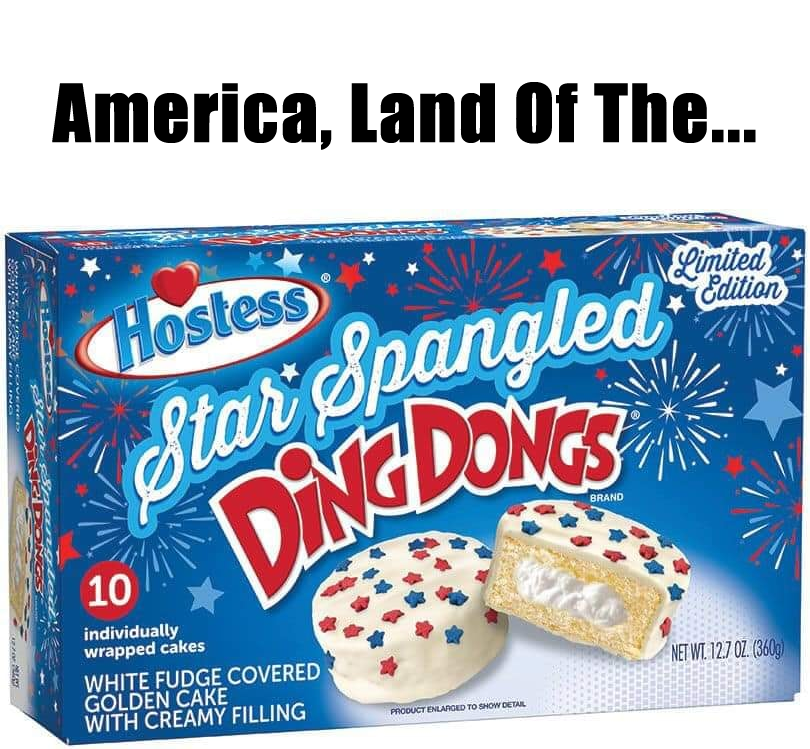
The image is a box of Hostess "Star Spangled Ding Dongs." The packaging is primarily blue and red, evoking the colors of the American flag. The product name is prominently displayed in a bold, cursive, red font embellished with white outlining. A small heart-shaped logo is positioned above the product name. The package is marked as a "Limited Edition" product.
A depiction of 10 individually wrapped Ding Dongs is featured on the front, covered in patriotic red, white, and blue sprinkles. There is a firework-like burst around them. The packaging text highlights the cake as "White covered golden cake with creamy filling." The package states there are 10 individually wrapped cakes inside. The net weight is 12.7oz (360g). The font is generally playful and designed to appeal to a mass consumer audience. The image is clearly constructed to be visually appealing and associate the product with American patriotism.
Foucauldian Genealogical Discourse Analysis
This packaging is a prime example of how power operates through discourse. The "Star Spangled Ding Dongs" don't just represent patriotism; they actively construct a specific discourse around it.
- Genealogy: Tracing the history of associating food with national identity reveals a long-standing practice. During wartime, certain foods were rationed or promoted to foster a sense of collective identity. Now, food items like this utilize patriotism as a marketing tool.
- Discourse & Power: The packaging produces a discourse linking sweet treats with American ideals. This creates a "truth" – that indulging in these Ding Dongs is, on some level, a patriotic act. This is a subtle exercise of power, shaping consumer behavior and reinforcing nationalistic sentiment.
- Normalization: By repeatedly associating sugar-filled cakes with national pride, the packaging normalizes a particular type of consumerism as patriotic behavior. It presents a specific version of American identity as one that can be purchased and consumed. The "limited edition" aspect creates artificial scarcity which further enhances the power dynamic, urging consumption before it's "gone."
- Subject Formation: The packaging encourages subjects to view themselves as patriotic by consuming the product. It taps into cultural values and desires, potentially creating a sense of obligation or desire to participate in this consumer-driven patriotism.
Critical Theory
From a critical theory perspective, this packaging exemplifies the ways in which culture (in this case, a snack food) becomes a vehicle for ideological reproduction.
- Culture Industry: This product fits squarely within Adorno and Horkheimer's concept of the culture industry. It's a mass-produced commodity designed to generate profit by appealing to pre-existing cultural values (patriotism, nostalgia).
- Commodification of Patriotism: The packaging commodifies patriotism, turning a complex set of values and ideals into a saleable item. This diminishes the genuine meaning of patriotism, reducing it to a superficial consumer act.
- False Consciousness: The packaging could be seen as contributing to a form of false consciousness, leading consumers to believe that buying a snack food somehow expresses or reinforces their national identity. This distracts from more substantive forms of civic engagement.
- Ideology: The packaging propagates an ideology that links consumerism with American identity. This reinforces the idea that happiness and belonging can be achieved through purchasing goods.
Marxist Conflict Theory
Applying a Marxist lens, the "Star Spangled Ding Dongs" reveal underlying class dynamics and the exploitation inherent in capitalism.
- Commodity Fetishism: The packaging obscures the labor and resources required to produce these Ding Dongs, presenting them as simply desirable objects. This is a prime example of commodity fetishism – focusing on the appearance of the product rather than its underlying conditions of production.
- Capital Accumulation: The sale of these Ding Dongs contributes to the accumulation of capital for Hostess and its shareholders. The profits generated from this product ultimately benefit a small elite, while the workers involved in its production receive a fraction of the value they create.
- Class Appeal: The packaging appeals to a broad consumer base, but it potentially reinforces class divisions. The idea of indulging in a sweet treat can be particularly appealing to those experiencing economic hardship, offering a temporary escape from their daily struggles.
- Distraction from Real Issues: By promoting a superficial form of patriotism through consumerism, the packaging distracts from more pressing social and economic issues affecting the working class.
Postmodernism
A postmodern reading highlights the play of signs and the blurring of boundaries between authenticity and simulation.
- Hyperreality: The packaging creates a hyperreal version of patriotism – a simulation of national identity that is more compelling than the "real thing." The flag-themed sprinkles and star-spangled design are not genuine expressions of national pride, but rather stylized representations designed to evoke a feeling.
- Pastiche & Intertextuality: The packaging draws on familiar visual motifs associated with American patriotism (the flag, fireworks, red, white, and blue). It’s a pastiche – a playful combination of existing styles and symbols.
- Deconstruction of Meaning: A postmodern approach would deconstruct the seemingly straightforward message of the packaging. The idea of "American patriotism" is not a fixed or universal concept, but rather a contested and fluid one.
- Irony & Parody: One could argue that the packaging is somewhat ironic or parodic, playing with the notion of national identity and turning it into a consumer commodity.
Queer Feminist Intersectional Analysis
This framework, while applicable, requires more nuanced consideration, as the packaging isn't explicitly gendered or focused on queer issues. However, we can explore intersections of power.
- Commodification of Identity: Patriotism, like any identity marker, can be commodified and used to control or exclude. The packaging perpetuates a specific, often exclusionary, vision of “Americanness” that might not include diverse genders, sexualities, or cultural backgrounds.
- Gendered Labor & Consumption: The snacks are likely produced by a workforce including many women, whose labor is often undervalued. At the same time, the marketing often targets families and gendered expectations around care and indulgence.
- Exclusionary Nationalism: Patriotic branding can reinforce exclusionary nationalist sentiments, historically linked to oppression of marginalized groups.
- Intersection of Consumption & Identity: The consumer's choice to purchase and consume the item becomes a performative act of aligning with the packaged idea of "Americanness". This is especially pertinent for individuals who may already feel marginalized within mainstream American culture, as purchasing this snack could be seen as an attempt to conform or signal belonging.
I hope this detailed analysis is helpful! Let me know if you'd like me to elaborate on any of these points.
simple-description (llama3.2-vision)
The meme is a humorous commentary on the state of America, comparing it to a popular snack food, Hostess's Star Spangled Ding Dongs. The image is likely a photo of a box of Star Spangled Ding Dongs, with the text "America, Land of the...". The text is left incomplete, implying that the country's greatness is being questioned or mocked.
tesseract-ocr
erica, Land Of The... SSS See er Fie a> mr : = Vee Sea an H gstess . aril Pe Ng in ae Or 2s ea Se, AMONG. este yore wy 0h) meg, RIYA ~ bea iar Se a rece DONG as 2 7a ie } am iS in WINS \ a. 2 ie - ae F gy iM BY NV of Se “a {Hh Weieay the, al fog” Oe J as ee Raitehinetecn | * Aino. im Rae a lated = Beet