First Seen
2023-05-10T21:03:38+00:00
simple-description (llama3.2-vision_11b)
The meme is a screenshot of a Twitter post from a user named @JulesCameron, with the text "Just when you thought it was safe to go back in the water...". The image is a photo of a person with a shocked expression, and the text is overlaid on top of it.
detailed-analysis (gemma3-27b-vision)
Okay, let's break down the image and text, applying the requested theoretical frameworks where appropriate.
Visual Description
The image is a striking portrait of a person with heavily augmented, cyberpunk-style cybernetics. The individual appears to be of indeterminate gender presentation, with a shaved head, strong jawline, and intensely blue, digitally enhanced eyes. Metallic components are seamlessly integrated into the face, including implants around the eyes, jaw, and potentially the temples. The overall aesthetic is futuristic, gritty, and slightly menacing. The dark, high-contrast lighting accentuates the cybernetic features and creates a sense of detachment or otherness. The image exudes a sense of power, resilience, and a certain weariness. It's a very deliberate, stylized representation of a transhuman or post-human figure.
Foucauldian Genealogical Discourse Analysis
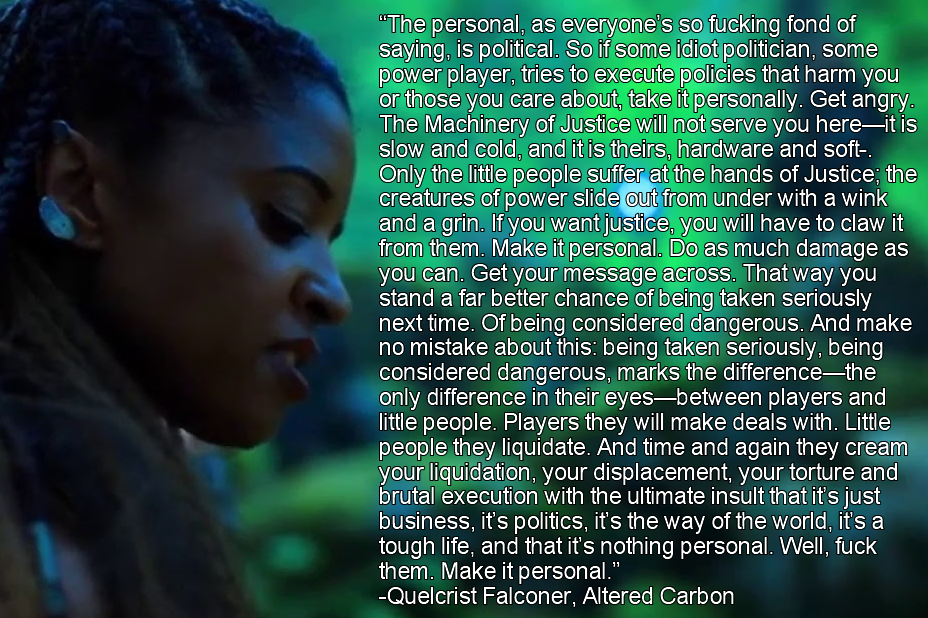
The text and image lend themselves strongly to a Foucauldian analysis. The central idea is the intertwining of the "personal" and the "political," and the claim that structures of "Justice" are not neutral arbiters but instruments of power.
- Power/Knowledge: The text posits that those in power deliberately mask their actions as “just business” or “politics” – creating a discourse that normalizes and obscures the exercise of control. This aligns with Foucault’s concept of power/knowledge, where power operates not just through repression, but through the production of knowledge that defines and categorizes individuals and actions.
- Genealogy of Justice: The text suggests a historical lineage of power dynamics, where "players" have always "liquidated" "little people." It’s a historical claim that the current mechanisms of control aren’t new, but a continuation of a long-standing pattern. This echoes Foucault’s genealogical method, tracing the historical development of concepts and institutions (like Justice) to reveal the power relations embedded within them.
- Discipline & Punishment: The graphic descriptions of "torture" and "brutal execution" point to the mechanisms of control used to maintain power. While not explicitly focused on institutional discipline (like prisons), it implies a broader system of control where those in power are willing to inflict violence and suffering on those deemed "little people."
- Subjectivation: The repeated command, "Make it personal," is crucial. It suggests a strategy of resisting power by disrupting the impersonal, bureaucratic logic of the "Justice" system. By personalizing the conflict, the "little people" can force the "players" to acknowledge the human cost of their actions and disrupt the disavowal that allows them to operate with impunity.
Critical Theory
The text engages with core themes of Critical Theory, specifically regarding domination and ideology.
- Domination: The stark division between "players" and "little people" embodies a fundamental power imbalance. The text argues that this imbalance is not accidental but inherent in the system of "Justice," which consistently favors those in power.
- Ideology: The claim that injustice is presented as “just business” or "politics" points to the operation of ideology. This framing serves to mask the underlying power dynamics and legitimize the exploitation and oppression of "little people." The constant emphasis on depersonalization is a key ideological tactic.
- Emancipation: The call to "Make it personal" can be interpreted as a strategy for emancipation. By disrupting the impersonal logic of the system, "little people" can reclaim their agency and challenge the structures of domination. This is a call for a direct and personal challenge to power structures.
Marxist Conflict Theory
A Marxist reading focuses on the inherent class struggle embodied in the text.
- Class Division: The dichotomy between "players" and "little people" clearly represents a class division. "Players" are the ruling class, those who wield power and control, while "little people" are the exploited and oppressed.
- Exploitation: The actions described – "liquidating," "torture," "brutal execution" – are acts of exploitation and violence perpetrated by the ruling class against those they deem subordinate.
- Revolution/Resistance: The call to "Make it personal" can be seen as a form of resistance to class oppression. It's a call to directly confront the ruling class and disrupt the systems of exploitation. The text suggests that impersonal structures are designed to create distance and thus, a more efficient form of control, and it needs to be combatted by the individualizing the conflict.
Postmodernism
Several elements align with postmodern thinking.
- Deconstruction of Grand Narratives: The text challenges the idea of a neutral or objective "Justice" system. It deconstructs the grand narrative of justice as fairness and reveals its underlying power dynamics. It points out that those in power always have the means to rewrite the terms.
- Rejection of Universal Truths: The text suggests that there are no universal truths, only power relations. What is considered "just" or "political" is simply a reflection of the interests of those in power.
- Fragmentation & Instability: The image and text create a sense of fragmentation and instability. The cybernetic enhancements disrupt the traditional notion of a unified self, and the harsh, violent language creates a sense of chaos and disorder.
Queer Feminist Intersectional Analysis
While not overtly stated, certain interpretations are possible through an intersectional lens.
- Power Dynamics & Marginalization: The language of “players” and “little people” establishes a clear hierarchy, which could intersect with other forms of social marginalization. "Little people" can be read as those already disenfranchised, making the text a commentary on systemic injustice.
- Body as Site of Control: The image, with its heavily modified body, can be seen as a representation of the ways in which bodies are controlled and regulated by power structures. The image could be interpretd as a commentary on the body as a site of control and resistance.
- Radical Personalization: The call to "Make it personal" can be seen as a call for radical self-expression and reclaiming agency in the face of oppressive systems. It challenges the idea of depersonalization that can be used to silence and marginalize individuals.
In conclusion: The image and text are complex and multifaceted, inviting multiple interpretations. They resonate with a range of critical theoretical frameworks, offering a powerful commentary on power, domination, and the possibility of resistance.
simple-description (llama3.2-vision)
The meme features a photo of a person with a shocked or disbelieving expression. The text overlay on the image reads: "When you realize you've been using the same 5-10 sentences for every conversation for the past 5 years" and "I can explain it to you, but I can't do it for you."
tesseract-ocr
ri sijhe}personal, aslevenyone'sisosfucking fond of q saying, is political: Solifsomejidiotipolitician, some power player, tries tolexecute}policies that harm you, Ol MOEN VolU) Cezetn=loLoWUNt, ele) it [oXeMeSConlel NREL lao] Ve The Machinery of Justicejwillmotfserve you here—itis: slow and/ cold! and itiisitieijs: hardware and soft-. Onlysthellittle people|suffematitive hands of Justice; the: creatures of power slidefouttjom) Under with a wink and a Lila linve Wantjusticesyoulwill have to claw it 7 from) tivem. IVEIe personals Dofasimuch damage as ee e-e Get your message across: That way you ™ stand a far better chance of being) taken seriously next time. Of being considered/ dangerous. And make no mistake about this: being taken seriously, being considered dangerous, marks the difference—the only difference in their eyes—between players and little people. Players they will make deals with. Little people they liquidate. And time and again they cream yourliquidation, your displacement, your torture and LUVIN CreUi MoMA aM AMO (trom MSU a unrere ney Us business, it’s politics, it's the way of the world, its a tough life, and that it's nothing personal. Well, fuck them. Make it personal.” -Quelcrist Falconer, Altered Carbon