First Seen
2023-05-10T21:03:38+00:00
simple-description (llama3.2-vision_11b)
The meme is a photo of a character from the animated TV series "Star Wars: The Clone Wars" (Anakin Skywalker) in a classroom setting. The character is holding a chalkboard that reads: "This land is my land. This land is your land. It's not my land. It's your land. It's not your land. It's my land. It's not my land. It's your land. This land is my land. This land is your land. It's not my land. It's your land. This land is my land. This land is your land. It's not my land. It's your land. This land is my land. This land is your land. It's not my land. It's your land." The meme is a humorous take on the classic Woody Guthrie song "This Land is Your Land" and is meant to be ironic and satirical.
detailed-analysis (gemma3-27b-vision)
Here's an analysis of the image broken down into the requested theoretical frameworks, based on the elements present.
Visual Description
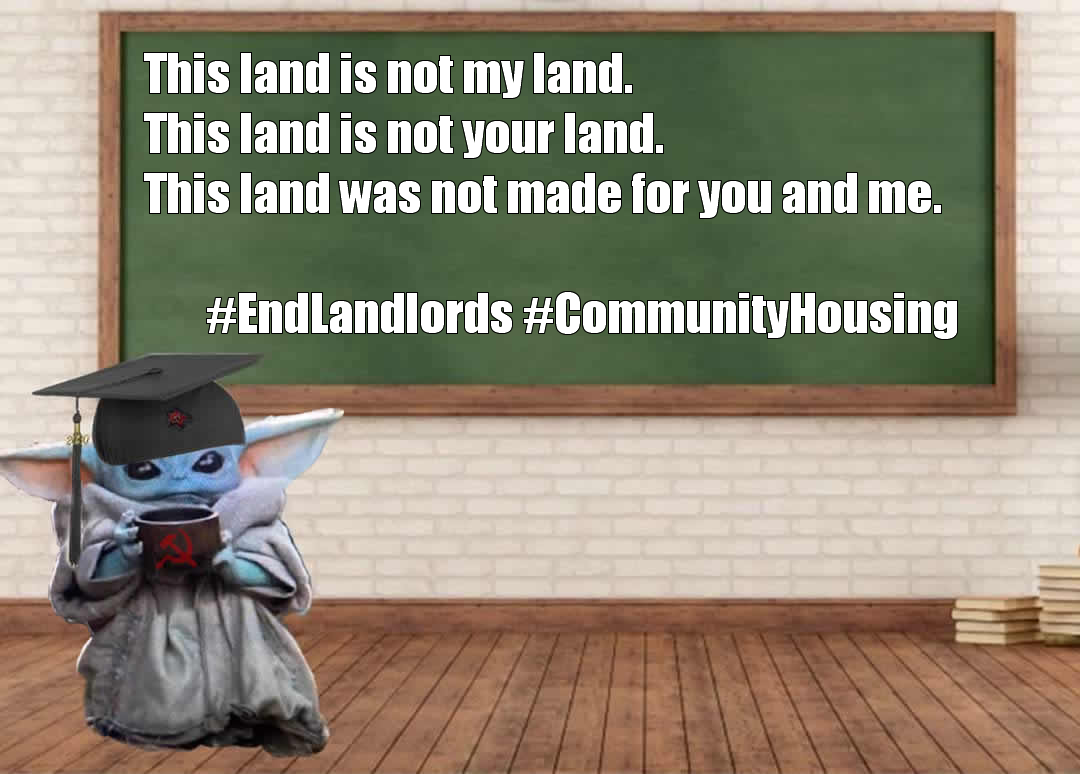
The image features a digitally altered depiction of “Baby Yoda” (Grogu) from the Star Wars series The Mandalorian. Baby Yoda is depicted wearing a graduation cap and gown, and is seated in front of a chalkboard, suggesting a setting of education or protest. The chalkboard’s text reads: "This land is not my land. This land is not your land. This land was not made for you and me." Below the text are the hashtags #EndLandlords and #CommunityHousing. Stacks of books are placed on either side of the figure. The overall aesthetic is digitally composed, and relies on a popular culture reference to deliver a socio-political message. The use of “Baby Yoda” is a strategic choice for its cultural appeal and accessibility.
Foucauldian Genealogical Discourse Analysis
The image is a strong example of a discursive intervention. The message deliberately re-appropriates the lyrics from Woody Guthrie’s "This Land is Your Land," turning a song of perceived inclusivity into a statement of exclusion, and importantly, challenging the very notion of ownership.
A genealogical approach asks: how did the idea of land ownership come to be accepted as natural and legitimate? This image implies that land ownership is not natural, but a constructed system. The rejection of ownership is a power move. It disrupts the established discourse of property rights. The hashtags reveal a focused critique of the landlord system—a specific manifestation of power/knowledge relations around land.
This isn't about simply claiming different ownership, but deconstructing the very concept. The image suggests that the historical and social conditions that led to land ownership have created unequal power dynamics. It's a rejection of the normalizing force of property law, and a call for a different way of relating to the land.
Marxist Conflict Theory
This image is steeped in Marxist analysis. The core message directly implicates the relationship between classes and land ownership. Land, a means of production, is central to the Marxist understanding of capital. Landlords, as owners of this key resource, are the bourgeoisie extracting surplus value (rent) from those who require it (the proletariat).
The message explicitly rejects the legitimacy of this arrangement. The hashtags #EndLandlords and #CommunityHousing point towards a solution rooted in collective ownership and resource sharing. Community housing represents a move away from private ownership and towards a socialist model where land is held in common for the benefit of all. The image can be interpreted as a visual call for the expropriation of land from landlords, and a redistribution of resources to meet collective needs. The conflict is stark: those who own vs. those who are excluded from access to land.
Postmodernism
Postmodernism comes into play through the juxtaposition of elements and the use of popular culture. The image layers a well-known cultural icon (Baby Yoda) with a serious political statement. This is a typical postmodern strategy—challenging grand narratives and disrupting traditional forms of communication.
The image deconstructs the original lyrics of Woody Guthrie’s song. Guthrie’s song suggests a shared ownership of the land, the image inverts this, pointing to the systemic exclusion of many. It's a questioning of the universal claims made by the song, suggesting that the land is not equally accessible to all. The image is a pastiche of cultural references and political messaging, embracing fragmentation and a lack of a singular, overarching truth.
Queer Feminist Intersectional Analysis
While not immediately central, an intersectional lens can add depth. The demand for community housing isn’t just about economic justice, but a dismantling of systems that marginalize various groups. Lack of safe and affordable housing disproportionately affects women (especially single mothers), LGBTQ+ individuals, people of color, and disabled people.
The image can be read as a challenge to patriarchal structures that historically deny women and queer individuals access to property ownership. Land ownership has been linked to patriarchal power dynamics, and a move towards community housing could challenge these dynamics. The image can be a call for a more inclusive and equitable housing system that addresses the specific needs of marginalized groups. While Baby Yoda doesn't directly represent a specific marginalized group, the use of a widely beloved, non-traditional figure can disrupt normative expectations and open up space for more inclusive visions of community.
In conclusion: The image is a politically charged piece that draws on multiple theoretical frameworks. Its core message is a rejection of the legitimacy of land ownership and a call for a more equitable housing system. The combination of popular culture, political messaging, and theoretical underpinnings makes it a powerful and thought-provoking piece of visual communication.
simple-description (llama3.2-vision)
This meme features a picture of Baby Yoda from the Star Wars franchise, dressed in a graduation cap and gown, sitting at a desk with a sign that reads "This land is not my land" (a play on the classic folk song "This Land Is My Land"). The text is a humorous take on the song's original lyrics, with Baby Yoda's voice replacing the original singer's words.
tesseract-ocr
This land is not my land. This land is not your land. This land was not made for you and me. #Endlandlords PAHS TIE oe = , — = ; RS ei We = y NT NN