First Seen
2023-05-10T21:03:38+00:00
simple-description (llama3.2-vision_11b)
The meme is an image of a character from the animated series "Star Wars" (specifically, a young version of the character Anakin Skywalker) with a caption that says "This land is my land. This land is your land. This land is my land. This land is your land. It's my land. It's not your land." The meme is poking fun at the idea that a character from a fictional universe is making a claim to ownership of a fictional land, highlighting the absurdity of the situation.
detailed-analysis (gemma3-27b-vision)
Okay, let's break down this image through the requested theoretical lenses.
Visual Description
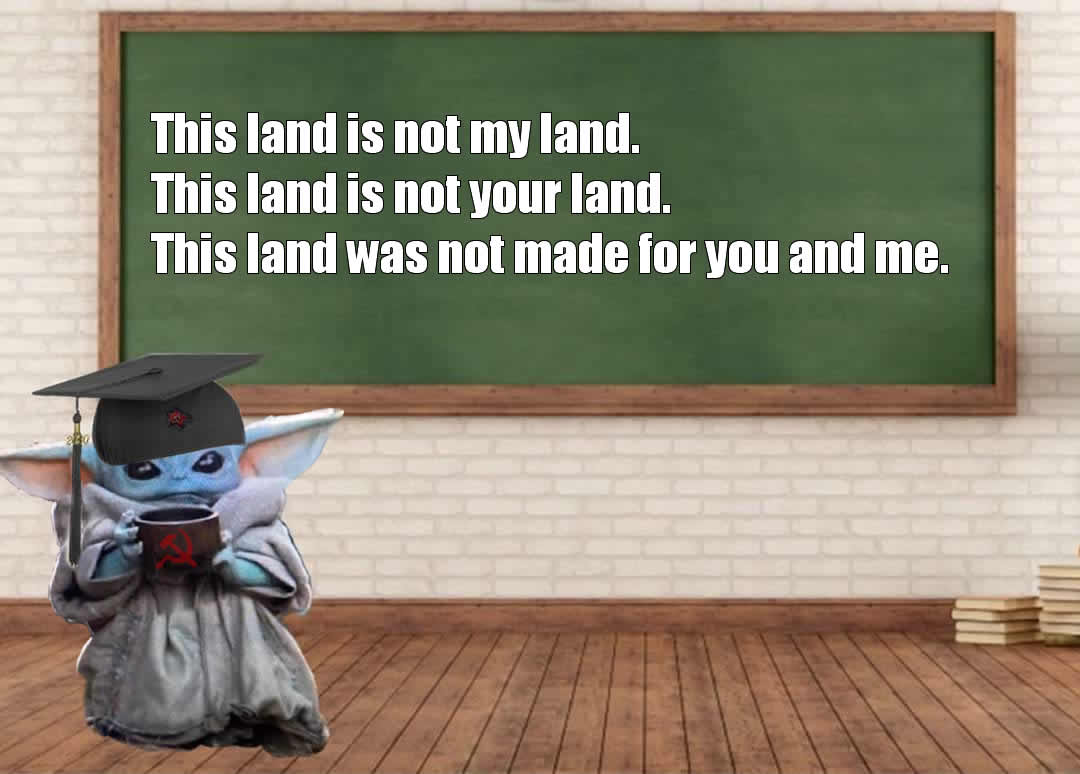
The image features a digitally-altered depiction of “Grogu” (Baby Yoda) from The Mandalorian, dressed in a graduation cap and gown, and holding a cup. He is positioned in front of a chalkboard with the text "This land is not my land. This land is not your land. This land was not made for you and me." The setting appears to be a classroom, indicated by the brick wall, wooden floor, and a stack of books. The overall effect is whimsical but carries a message of displacement and ownership. The use of a pop culture figure (Grogu) in this context is attention-grabbing and invites a potentially ironic or subversive reading of the message.
Foucauldian Genealogical Discourse Analysis
The phrase “This land is not my land. This land is not your land. This land was not made for you and me.” directly references Woody Guthrie’s folk song “This Land Is Your Land.” This seemingly simple act of quotation, and alteration, is a critical starting point. A Foucauldian analysis would trace the discourse around land ownership, national identity, and belonging.
- Power/Knowledge: Guthrie's song, initially framed as inclusive, can be seen as reinforcing a specific (American) notion of national identity and citizenship. The alteration of the lyrics in this image disrupts this "naturalized" understanding. It highlights how "land" and "ownership" are not neutral concepts, but are constructed through discourse and embedded with power relations.
- Archaeology of Knowledge: Tracing the history of land ownership, colonialism, and displacement reveals how the very notion of "land" has been defined and justified through particular historical discourses. For example, the concept of “terra nullius” (land belonging to no one) was used to justify colonial claims, masking the existing presence and rights of Indigenous populations. The image, using Grogu, introduces a science fiction layer of otherness.
- Genealogy: The image's deconstruction of the song creates space for alternative narratives about land ownership. By centering Grogu, a non-human/non-native being, the image destabilizes the human-centric assumptions embedded in traditional notions of belonging.
Critical Theory
This image fits firmly within the tradition of Critical Theory, particularly its emphasis on challenging dominant ideologies.
- Ideology Critique: The altered lyrics critique the ideology of national ownership and the often unacknowledged histories of dispossession and colonization associated with it. By asserting "This land was not made for you and me," it exposes the exclusionary nature of many narratives about national belonging.
- Emancipation: The image could be interpreted as a call for a more just and equitable relationship with the land, one that acknowledges the rights of marginalized groups and challenges the existing power structures that perpetuate inequality.
- Reification: The original Guthrie song, and concepts of land ownership, reify abstract ideas into concrete entities. The image, through alteration, attempts to de-reify this process by questioning the assumptions underlying the concept of “land” and “ownership”
Marxist Conflict Theory
This image, from a Marxist perspective, speaks to the core concept of class struggle and the inherent conflict over resources.
- Means of Production: Land, as a primary means of production, has historically been a source of conflict between different groups. The image hints at this conflict by suggesting that some groups have been systematically excluded from accessing or benefiting from the land.
- Class Consciousness: The image, by identifying “you and me” as distinct from the landowners, could be seen as an attempt to raise class consciousness. The focus on exclusion, from a Marxist perspective, is a sign of class struggle.
- Alienation: The feeling of not belonging or not having access to resources is related to the Marxist concept of alienation. The image can be seen as expressing the alienation felt by those who are dispossessed or excluded from the benefits of land ownership.
Postmodernism
The image embodies several characteristics of postmodern thought.
- Deconstruction: The alteration of the familiar lyrics of Woody Guthrie’s song is an act of deconstruction. It challenges the original meaning of the song and opens up space for alternative interpretations.
- Intertextuality: The image relies on the viewer’s prior knowledge of both The Mandalorian and Woody Guthrie’s song. It creates meaning through the interplay between these different texts.
- Irony and Playfulness: The use of a pop culture figure (Grogu) and the juxtaposition of serious political themes with a whimsical image creates a sense of irony and playfulness. This aligns with the postmodern tendency to blur boundaries and challenge established conventions.
- Simulacra and Simulation: The digitally altered image itself can be viewed as a simulacrum – a copy without an original. It highlights the increasingly mediated nature of our experience and the difficulty of accessing “reality” outside of representation.
Queer Feminist Intersectional Analysis
While not immediately obvious, this image can be read through an intersectional lens:
- Displacement & Marginalization: Queer and feminist theories often address the systemic displacement and marginalization of certain groups. The image's message of not belonging resonates with the experiences of those who have been historically excluded from land ownership and access to resources (e.g., Indigenous women, queer people of color).
- Challenging Hegemonic Structures: The image challenges the hegemonic structures of power that perpetuate inequality. It questions the traditional, patriarchal, and colonial assumptions about who “belongs” to the land.
- Intersectionality: Intersectionality emphasizes how different forms of oppression (e.g., race, gender, class, sexuality) intersect and create unique experiences of marginalization. The image, by focusing on the exclusion of “you and me,” implicitly acknowledges the complex interplay of these different forms of oppression.
- Otherness: The depiction of Grogu (an alien being) can be interpreted as a metaphor for those who are considered “othered” or marginalized by society. It highlights the need for a more inclusive and equitable relationship with the land, one that recognizes the rights of all beings, regardless of their background or identity.
I hope this detailed breakdown, covering these theoretical perspectives, is helpful! Let me know if you’d like me to elaborate on any particular point or approach.
simple-description (llama3.2-vision)
The meme features a picture of Baby Yoda (also known as "The Child") from the Star Wars franchise, dressed in a graduation cap and holding a degree. The text above the image reads: "This land is not my land, this land is not your land, this land is not our land, it's Baby Yoda's land." The meme is a play on the classic Woody Guthrie song "This Land is Your Land", but with a humorous twist by replacing the singer with Baby Yoda.
tesseract-ocr
This land is not A) land. This land is not your land. This land was not mate for you EY Uy ) eee aS == aN =