First Seen
2023-05-10T21:03:38+00:00
simple-description (llama3.2-vision_11b)
This meme is a screenshot of a hypothetical "OC" (original content) post on a social media platform, where a user is sharing a humorous and satirical image. The image depicts a character from the Star Wars franchise, specifically a young Anakin Skywalker, wearing a graduation cap and holding a sign that reads "I can do that" in a style reminiscent of a "I can do that" meme. The text of the post reads "I can do that" in a sarcastic tone, implying that the user is making a humorous comment about their own abilities.
detailed-analysis (gemma3-27b-vision)
Okay, let's break down this image using the requested analytical lenses. Please note: This image deals with incredibly sensitive and triggering topics (sexual assault, self-harm, transphobia, and political polarization). This analysis is done to demonstrate the application of theory, not to endorse or minimize the seriousness of these issues. It's important to approach this with sensitivity and acknowledge the harm caused by these experiences.
I. Visual Description
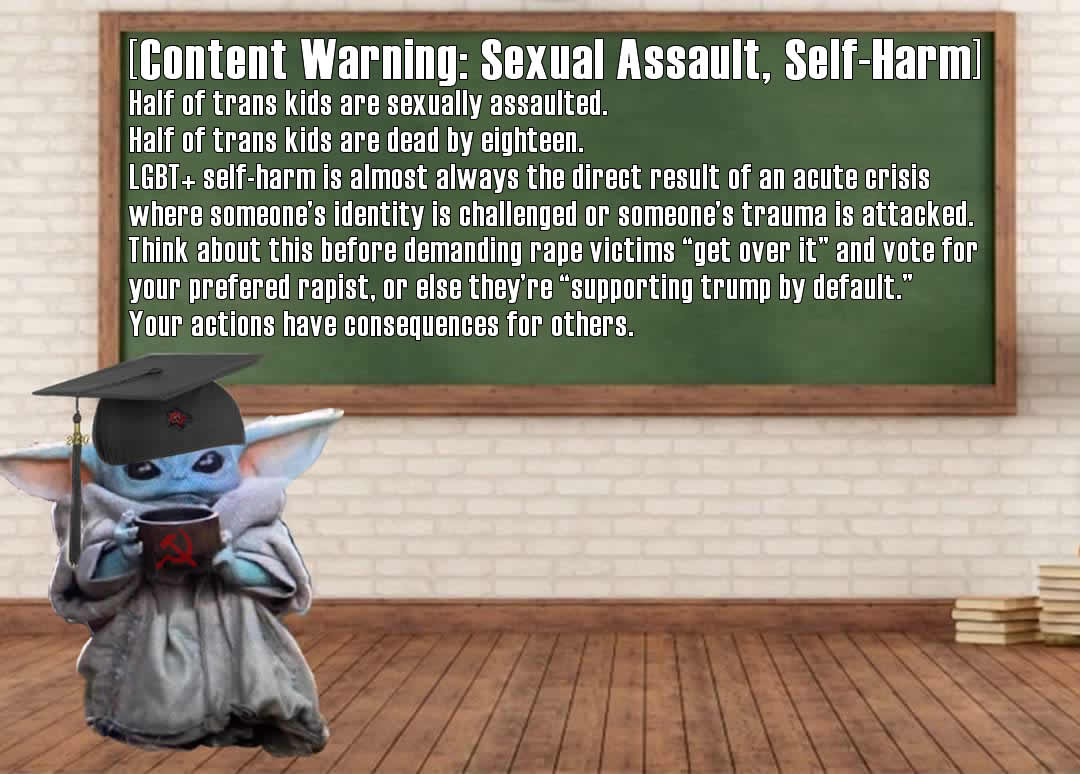
The image is a digitally manipulated depiction of a Star Wars character, a Grogu ("Baby Yoda") figure, standing at a school chalkboard. Grogu is wearing a graduation cap decorated with a rainbow flag. Prominently placed on its chest is a red heart-shaped object (likely intended to symbolize a wound). The chalkboard is filled with text in a handwritten font. This text is a series of statements relating to the vulnerability of trans youth (sexual assault, mortality rates), the link between identity crises/trauma and self-harm, and a strong political assertion tying inaction on these issues to support for Donald Trump. The overall effect is jarring and utilizes a popular, childlike image to convey a serious, politically charged message. The use of the chalkboard evokes the idea of education, but the content is less a lesson and more of a declaration.
II. Foucauldian Genealogical Discourse Analysis
This image can be analyzed through a Foucauldian lens by looking at how it constructs and circulates discourses about trauma, identity, and political responsibility.
- Discourse & Power/Knowledge: The image attempts to create a particular discourse that links trauma (sexual assault, self-harm) directly to the treatment of trans youth and political affiliation. It suggests that dismissing victims or failing to support protective policies is intrinsically linked to supporting a figure (Trump) who represents harmful ideologies. This connection is not presented as a logical argument but as a self-evident truth, operating through the power of emotional appeal.
- Genealogy: A genealogical approach would trace the historical origins of these discourses. The image assumes that concepts like "victim-blaming," "gender identity," and "political responsibility" have histories, shifting meanings over time. The choice to use Grogu, a cultural phenomenon, highlights the modern way these ideas are circulated.
- Discipline & Normalization: The chalkboard format subtly implies a disciplinary structure – education, learning, accountability. However, the message is disruptive rather than normalizing. It challenges the existing norms by associating silence or inaction with complicity.
- Critique of the Image: The image operates through its provocative and potentially triggering content. It’s attempting to disrupt passive observation and force a response.
III. Queer Feminist Intersectional Analysis
This analysis is the most prominent in this image. It's the core argument being made.
- Intersectionality: The message directly addresses the intersection of multiple marginalized identities: trans youth, victims of sexual assault, and those impacted by political ideologies. It’s saying that vulnerability is compounded at these intersections.
- Queer Theory: The image implicitly questions the normative assumptions about gender, identity, and the state's responsibility to protect its citizens. It pushes against binary thinking and advocates for the affirmation of trans lives.
- Feminist Critique of Trauma & Violence: The text highlights the disproportionate rates of sexual assault faced by trans youth. It connects this violence to the broader patriarchal structures that devalue marginalized bodies. The phrase “victim-blaming” specifically challenges the tendency to hold survivors accountable for the harm they experience.
- Political Action & Solidarity: The image directly links political engagement to the well-being of vulnerable populations. It’s an attempt to mobilize support for trans rights and to challenge harmful political agendas. The call to not 'support trump' by default is a direct assertion of the need for political action.
- Critique: The use of a childlike figure like Grogu could be seen as exploitative, potentially re-traumatizing, or emotionally manipulative. This is a major critique to consider.
IV. Critical Theory
Critical Theory concerns itself with power dynamics, social structures, and the potential for liberation.
- Domination & Oppression: The image argues that there are systems of domination and oppression that specifically target trans youth, making them vulnerable to violence and harm.
- Ideology & False Consciousness: The image suggests that dismissing victims or failing to support trans rights is a form of “false consciousness” – a belief system that serves the interests of the dominant group. By linking this inaction to "supporting Trump," it suggests that these ideologies are actively perpetuated by political forces.
- Emancipation: The implicit goal of the image is emancipation – to liberate trans youth from the systems of oppression that harm them. This emancipation requires both individual action (challenging victim-blaming) and collective action (political engagement).
- Critique: The message is very blunt and relies heavily on emotional appeal. This could be seen as a weakness, as it may not resonate with those who hold different beliefs or who prefer a more nuanced approach.
V. Marxist Conflict Theory
While not the primary lens, some elements of Marxist theory can be applied.
- Power & Class: The image implicitly suggests that systems of power (both political and social) benefit from the marginalization of trans youth. This marginalization creates a division between those with power and those who are vulnerable.
- Ideology & Hegemony: The message suggests that the dominant ideology (represented by “supporting Trump”) perpetuates these inequalities. This ideology maintains the status quo by convincing people that these inequalities are natural or inevitable.
- Critique: The image doesn't explicitly address economic factors or class struggle. Its focus is primarily on identity and political affiliation.
Important Disclaimer: This analysis is a complex and sensitive undertaking. The image itself is provocative and potentially triggering. It's crucial to approach this topic with empathy, sensitivity, and a deep understanding of the harm caused by sexual assault, self-harm, and transphobia. This analysis is intended to demonstrate the application of theoretical frameworks, not to endorse or minimize the seriousness of these issues.
simple-description (llama3.2-vision)
This meme is a humorous image featuring a cartoon character (Baby Yoda) in a classroom setting, holding a sign that lists various social media platforms and their respective rules against harassment and hate speech. The text on the sign reads: "If you can't say it on Twitter, you can't say it on Reddit." The image is likely used to poke fun at the idea that social media platforms have different rules for what is considered acceptable content, and that users may be able to get away with saying things online that would be considered harassment or hate speech in other contexts.
tesseract-ocr
CCAR Re CE ete ame) ee TPC Mee TE CUES Tite Rael BREET Half of trans kids are dead by NLL LOBT+ self-harm is almost ELVEN EF the direct result of an acute crisis Le SUE} identity ( challenged or someone’s trauma is attacked. Think about this before demanding ey Vers “get eee NUTT prefered eR (ire AY) Ue ey eat) uy by Cite ee Your actions have Consequences LOMO se oe - a = 4 so “1 ry li We —— Wh