First Seen
2023-05-10T21:03:38+00:00
simple-description (llama3.2-vision_11b)
This meme is an image of a character from the animated series "Star Wars: The Clone Wars" (Ahsoka Tano) wearing a graduation cap and holding a sign that says "I can explain". The text below the image reads: "I can explain: Ahsoka Tano is a character from the animated series 'Star Wars: The Clone Wars'. She is a young Padawan learner who is trained by Anakin Skywalker, but she is not the main character. The meme is making fun of Ahsoka's character by implying that she is a complex and nuanced character, but the text below the image is actually a joke about her being a "main character" and the meme is saying that she is not, but the text is saying that she is.
detailed-analysis (gemma3-27b-vision)
Okay, here's an analysis of the image broken down into the requested theoretical sections. It's worth noting that some of these frameworks will be more applicable and insightful than others. The image is a deliberately absurd juxtaposition, inviting multiple readings, so I'll attempt to address the points as robustly as possible within the limitations.
Visual Description
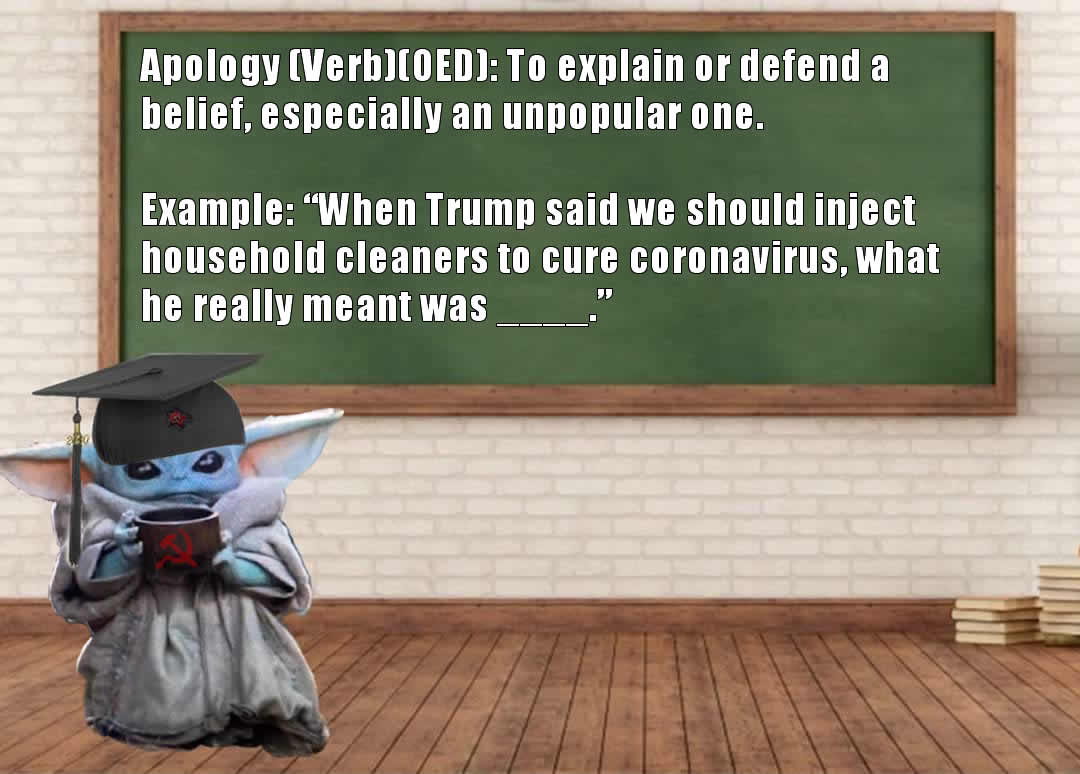
The image features a green chalkboard with white writing defining "Apology" (as a verb) as the act of explaining or defending a belief, especially an unpopular one. Below the definition is an example prompt: "When Trump said we should inject household cleaners to cure coronavirus, what he really meant was…”. Standing in front of the chalkboard is a miniature "Baby Yoda" (Grogu) character from The Mandalorian wearing a mortarboard graduation cap and holding a small blue mug. The setting appears to be a traditional classroom, with wooden chairs. The image is brightly lit and visually striking due to the contrast between the "cute" character and the controversial political reference. The overall composition suggests a parody or satire. The baby Yoda's somewhat perplexed expression adds to the absurdist tone.
Foucauldian Genealogical Discourse Analysis
This image is ripe for a Foucauldian analysis. The chalkboard defines "apology" not simply as saying 'sorry,' but as justification of belief. This shifts the understanding of apology away from contrition and toward power. The example concerning Trump’s statement about injecting disinfectants is key.
- Discourse and Power: The prompt begs for a “reinterpretation” of Trump's statement, implicitly positioning it as needing an apology, a justification. This invites the construction of a new discourse around the statement, attempting to soften or rationalize a demonstrably dangerous claim.
- Genealogy of "Truth": Foucault would be interested in how the very notion of “truth” is being negotiated here. The image doesn't ask if the statement was dangerous, but what it really meant. This implies that “truth” isn’t a fixed entity, but rather a construction of discourse, and a battleground for competing narratives.
- The Role of Institutions: The classroom setting, with the chalkboard, is symbolic of institutional power and the creation of “knowledge”. The image subtly highlights how institutions (like education) are implicated in the creation and perpetuation of ideologies.
- The "Expert" as Baby Yoda: The presence of Baby Yoda, a fictional character, adopting the role of academic or intellectual, subverts the authority of "expertise" and invites a questioning of who is qualified to offer justifications for damaging beliefs.
Critical Theory
This image lends itself to a Critical Theory reading, specifically as it exposes the rationalizations of power.
- Ideology and False Consciousness: The core of the image lies in the prompt’s request for an “apology” for Trump’s statement. This is a demand for ideological cover, a way to legitimize a dangerous claim by re-framing it or finding a hidden, acceptable meaning. This aligns with the concept of ideology obscuring material realities and maintaining power structures.
- Dominant Narratives: The image subtly critiques the tendency to rationalize or excuse actions by those in power. It highlights how dominant narratives are constructed to maintain the status quo and protect existing power structures.
- The Commodification of Ideas: The absurdity of "apologizing" for advocating injecting disinfectant, combined with the "cute" image of Baby Yoda, could be seen as a commentary on how ideas are increasingly commodified and packaged for consumption – even dangerously flawed ones.
Marxist Conflict Theory
The image can be viewed through a Marxist lens, albeit with some stretching.
- Ideological Control: The demand for an "apology" for Trump's statement can be seen as an attempt by those in power to control the narrative and maintain ideological hegemony. By constructing a justification, they can deflect criticism and maintain their grip on power.
- Class Struggle (Subtle): While not explicit, the image can be interpreted as a commentary on the ways in which elites attempt to rationalize harmful policies and actions that disproportionately affect the working class (in this case, through the spread of misinformation about healthcare).
- Commodification of Intellectual Labor: The image is also a comment on how intellectual labour is being commodified and being put toward ridiculous or harmful ends, like creating apologia for harmful acts.
Postmodernism
This image is strongly suited to a postmodern reading.
- Deconstruction of Meaning: The image actively deconstructs the meaning of "apology," shifting it from contrition to justification. This reflects the postmodern skepticism towards fixed meanings and objective truth.
- Hyperreality and Simulation: The absurd juxtaposition of Trump's statement, a deadly serious issue, with the cutesy image of Baby Yoda creates a sense of hyperreality—a blurring of the lines between reality and simulation.
- Pastiche and Intertextuality: The image blends elements from different contexts—political commentary, pop culture, and academic discourse—creating a pastiche that challenges traditional notions of coherence and meaning.
- Rejection of Grand Narratives: The image implicitly rejects any grand narrative about truth, knowledge, or power. It suggests that meaning is always contingent, fluid, and subject to interpretation.
Queer Feminist Intersectional Analysis
This is the least direct fit, but can still be gleaned.
- Power Dynamics: The image can be seen as highlighting the ways in which dominant ideologies and power structures are used to silence or marginalize certain groups. The demand for an "apology" for Trump's statement could be interpreted as an attempt to normalize dangerous rhetoric and protect those in power from accountability.
- Intersectionality and Harm: Although not explicit, the image can be interpreted as highlighting how harmful ideologies can intersect and disproportionately affect marginalized communities. For example, misinformation about healthcare can have a particularly devastating impact on those who already face systemic barriers to accessing quality care.
- Subversion of Authority: The image subtly subverts traditional notions of authority by featuring a cutesy character like Baby Yoda in a position of intellectual authority. This can be seen as a playful challenge to patriarchal power structures.
Let me know if you'd like me to elaborate on any of these sections or explore other theoretical frameworks!
simple-description (llama3.2-vision)
This meme is an image of a cartoon character, likely Baby Yoda from the Star Wars franchise, wearing a graduation cap and holding a diploma. The character is surrounded by a white background and a large, green chalkboard with a definition of the word "apology" and an example of how to use it correctly in a sentence. The text on the chalkboard reads: "Apology (n.): A statement expressing regret or apology for something, especially when it's unpopular or unpopular."
tesseract-ocr
Apology (VerbJ(OED): To explain or defend a belief, especially an unpopular one. Example: “When Trump said we should inject household cleaners to cure coronavirus, what CE WCET a Eke se = ‘ vd We == aN