First Seen
2023-05-10T21:03:38+00:00
simple-description (llama3.2-vision_11b)
The meme features a screenshot of a Twitter conversation between Donald Trump and a Twitter user named @RoguePianist. The user tweets "I just found out that the CDC is not following the protocols to keep us safe" and Trump responds with "That's a good one". The meme is captioned "I just found out that the CDC is not following the protocols to keep us safe" and Trump's response is highlighted in bold. The meme is a commentary on Trump's handling of the COVID-19 pandemic and the lack of transparency and accountability in his administration.
detailed-analysis (gemma3-27b-vision)
Okay, let's break down this image using the requested theoretical lenses. It’s a highly charged image combining pop culture with a political timeline.
Visual Description
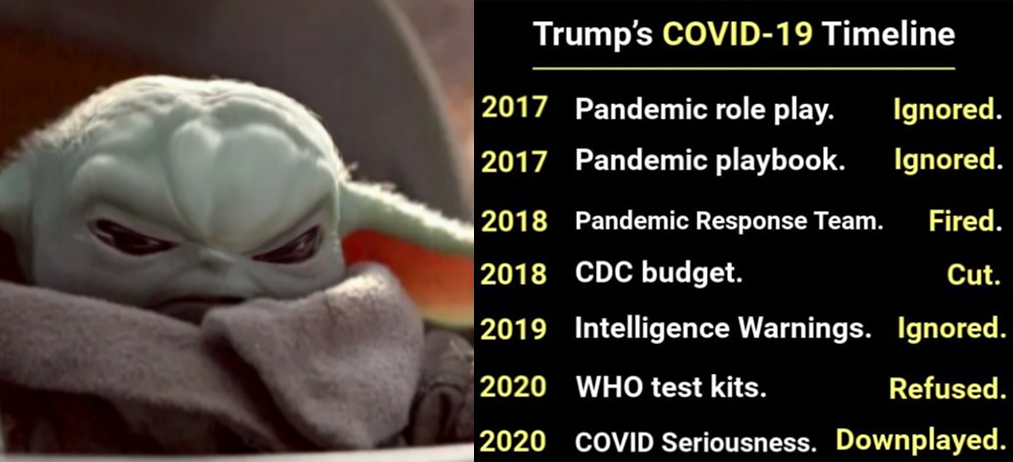
The image features a close-up of “Baby Yoda” (Grogu) from the Disney+ series The Mandalorian. Grogu’s expression is a striking combination of intense, almost angry, focus. His eyes are narrowed, and his brow is furrowed, a look rarely seen in the series. The image is overlaid with a black bar on the right, containing a chronological list labeled "Trump's COVID Timeline". The timeline entries consist of years (2017-2020) followed by warnings or preparations regarding a pandemic and the action (or inaction) taken by the Trump administration. The entries read: “Pandemic Role Play. Ignored.”, “Pandemic Playbook. Ignored”, “Pandemic Response Team. Fired”, “CDC Budget. Cut”, “Intelligence Warnings. Ignored”, “WHO test kits. Refused”, and “COVID Seriousness. Downplayed”. The stark contrast between the cute, seemingly innocent Baby Yoda and the list of failures relating to pandemic preparation/response creates a jarring and provocative effect.
Foucauldian Genealogical Discourse Analysis
This image is potent through its juxtaposition of seemingly unrelated elements. A Foucauldian analysis focuses on how knowledge is produced and wielded in relation to power.
- Discourse & Power/Knowledge: The timeline itself creates a discourse around the Trump administration's response to the pandemic. It’s a condensed, visual argument presenting a narrative of deliberate negligence. The timeline doesn’t simply report facts, it constructs a meaning. This meaning is inherently about power – specifically, the failure to exercise responsible governance.
- Genealogy: The timeline isn’t a straight-line progression of events. It's a fragmented genealogy. The events presented aren’t merely about the pandemic itself; they’re about a history of decisions (or non-decisions) that created the conditions for the pandemic's severity. Cutting budgets, firing teams, ignoring warnings—these are acts of power that shaped the situation.
- The Role of the Image: Baby Yoda functions as a disruption. Its inherent "cuteness" and cultural value draw you in, and then the jarring timeline forces you to confront a negative narrative about power. This makes the image memorable and acts as an affective (emotional) lever to push you towards a specific interpretation. The image destabilizes expectations and forces a re-evaluation of the timeline.
Critical Theory
A Critical Theory lens focuses on how power structures maintain themselves and create inequalities.
- Ideology: The image critiques the ideology of (perceived) American exceptionalism and a belief that market forces can solve all problems. The timeline implies that a disregard for scientific expertise and public health infrastructure were prioritised over the wellbeing of the population.
- Hegemony: The image challenges the dominant narrative surrounding the Trump administration’s handling of the pandemic. It aims to disrupt the “official” story and offer an alternative reading. It functions as counter-hegemonic, pushing back against attempts to normalize inaction or downplay the severity of the crisis.
- Commodification: Using Baby Yoda, a highly marketable and commodified character, is a significant choice. The image capitalizes on the existing cultural value of the character to attract attention and amplify its message. This highlights how even critical analyses can be embedded within the structures of consumer culture.
Marxist Conflict Theory
From a Marxist perspective, the image highlights a conflict between different classes and their interests.
- Class Interests: The timeline implies that the Trump administration’s actions prioritized the interests of corporate profit and political gain over the health and safety of the working class and vulnerable populations. Cutting funding for public health infrastructure can be seen as benefitting those who profit from private healthcare systems.
- Capitalist Crisis: The pandemic itself, and the government's response, can be viewed as a manifestation of inherent contradictions within the capitalist system. The prioritizing of profit over public health exacerbates existing inequalities.
- False Consciousness: The image aims to break through "false consciousness"–the idea that individuals are unaware of the systemic forces that shape their lives. It attempts to expose the ways in which power structures operate to maintain the status quo.
Postmodernism
A postmodern analysis would focus on the breakdown of grand narratives and the instability of meaning.
- Intertextuality: The image heavily relies on intertextuality – the interplay between different texts and cultural references. Baby Yoda is drawn from a specific media property, and its association with the timeline creates a new, unexpected meaning.
- Simulacra and Simulation: Baby Yoda, in this context, can be seen as a simulacrum – a copy without an original. It’s a cultural icon divorced from its source material, used to represent something else entirely. The timeline itself can be seen as a construction of meaning, rather than a neutral representation of events.
- Deconstruction: The image “deconstructs” the official narrative surrounding the pandemic response. It challenges the notion of a coherent, rational government policy and exposes the contradictions and inconsistencies in the Trump administration’s actions.
Queer Feminist Intersectional Analysis
While not immediately obvious, an intersectional analysis can reveal layers of meaning:
- Vulnerability & Marginalization: The image implies that the failures documented in the timeline disproportionately impacted marginalized communities—people of color, low-income individuals, disabled people, and LGBTQ+ individuals—who already face systemic barriers to healthcare and economic security.
- Disregard for Care Work: The downplaying of the pandemic's seriousness can be seen as a broader disregard for the value of care work—often performed by women and people of color—which is essential for maintaining communities during crises.
- Power & the Body: The pandemic is an example of power operating on the body – determining who lives and who dies based on systemic inequalities. The image, with its juxtaposition of a “cute” character and a critical timeline, draws attention to this vulnerability.
I hope this detailed analysis provides a comprehensive understanding of the image through these theoretical lenses. Let me know if you’d like me to elaborate on any specific point.
simple-description (llama3.2-vision)
This meme features a screenshot of a Twitter thread from Donald Trump's account, which is now a "read-only" account due to permanent suspension. The text "In 2020" appears above a table with a list of events that occurred in 2020, with each event marked as "—" (not completed).
tesseract-ocr
Trump's COVID-19 Timeline 2017 Pandemic role play. Ignored. 2017 Pandemic playbook. Ignored. ‘ " 2018 Pandemic Response Team. Fired. = 2018 CDC budget. rena 2019 Intelligence Warnings. Ignored. PU eces cs Ceres : 2020 COVID Seriousness. Downplayed.