First Seen
2023-11-10T05:30:12+00:00
simple-description (qwen3.5_2b-q8_0)
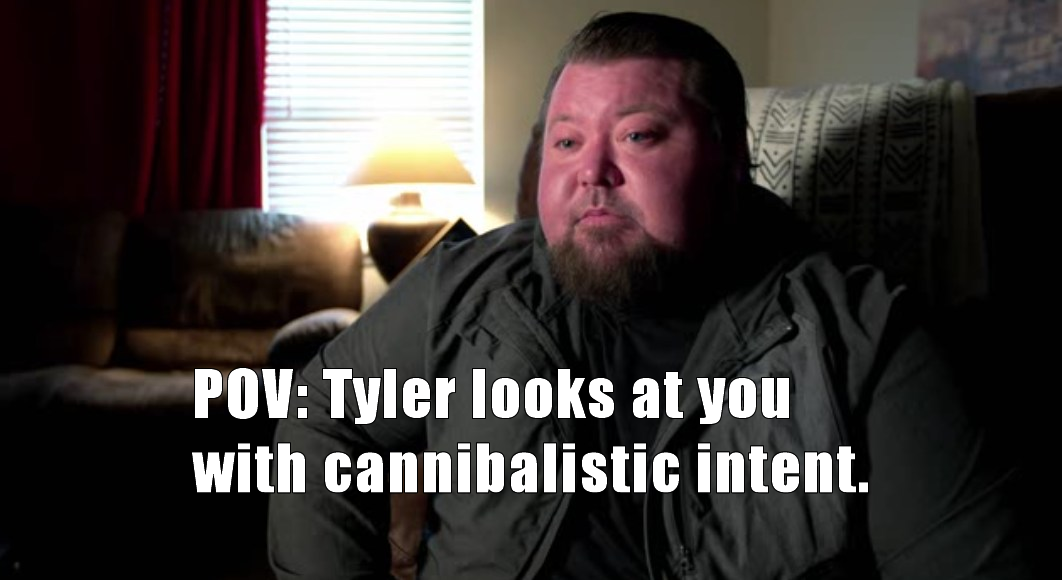
This meme is designed to create a creepy atmosphere by describing the facial expression of a man named Tyler, who is seen sitting in a dimly lit room and staring directly at the viewer with an intense, blank look. Overlaid on the bottom of the screen is white text that reads "POV: Tyler looks at you with cannibalistic intent," suggesting that the character is perceived as having a deep-seated, predatory hunger for human flesh.
simple-description (llama3.2-vision_11b)
The meme is an image of a person with a shocked expression, with the caption "I can see your true form" in a playful, sarcastic tone, implying that the person's appearance is not what it seems.
detailed-analysis (gemma3-27b-vision)
Here's an analysis of the image, structured according to the requested theoretical frameworks. It's important to note that applying these frameworks is interpretive, and some frameworks will be more relevant than others.
Visual Description
The image is a point-of-view (POV) shot, placing the viewer in the position of being looked at by a man named Tyler. Tyler is a heavyset white man with a full beard. He’s wearing a dark-colored robe or jacket, suggesting a domestic setting. His gaze is direct and intense, staring into the camera. The lighting is dim, with strong shadows. A dark expanse occupies much of the frame, creating an unsettling and claustrophobic feel. Background details include curtains, a lamp, and the corner of a bed, further suggesting a home environment. The framing and Tyler's stare are the primary focus of the image, creating a feeling of vulnerability and potential threat. The text superimposed over the image ("POV: Tyler looks at you with cannibalistic intent") immediately introduces a strong and disturbing narrative frame.
Foucauldian Genealogical Discourse Analysis
This image provides a fascinating entry point for Foucauldian analysis. The discourse surrounding cannibalism, and the way it’s constructed, is central. The phrase “cannibalistic intent” isn’t about literal acts of eating flesh but about power. Historically, cannibalism has been used as a marker of “otherness,” a way to define groups deemed barbaric or outside the bounds of civilized society. The image plays on this historical construction. Tyler, presented through this lens, represents a disruption of norms. He's not presented as a savage “other” but as an ordinary-looking man within a domestic setting – this creates a more disturbing form of "othering" because the threat is internal. The 'intent' itself isn't the act, but the assertion of power over the viewed subject. Genealogy would trace how the concept of cannibalism moved from literal practice (historical examples exist) to a metaphor for domination and exploitation. The image functions as a power/knowledge nexus – the assertion of intent constructs a power dynamic where the viewer is positioned as vulnerable and powerless.
Critical Theory (specifically, the Frankfurt School)
From a Critical Theory perspective, the image highlights the dehumanization of the individual within a capitalist system. While ostensibly about cannibalism, the underlying theme is a reduction of the "other" to an object of desire (or in this case, consumption). This echoes the commodification of individuals in late capitalism, where people are often reduced to their utility or as consumers to be exploited. The emphasis on "intent" suggests a predatory gaze, mirroring the predatory practices of unchecked capitalism. The dim lighting and domestic setting further highlight the pervasiveness of this predatory logic – it’s not confined to the marketplace, but infiltrates the most intimate spaces. This is a metaphorical representation of exploitation.
Marxist Conflict Theory
Although not immediately obvious, a Marxist interpretation can be applied. The implied act of “consumption” (cannibalism) can be read as a metaphor for the class struggle. Tyler, positioned as the predatory figure, embodies the exploitative upper class, “consuming” the resources (in this case, symbolic "flesh") of the lower classes (represented by the viewer). The power dynamic is stark, and the threat of consumption signifies the systemic imbalance inherent in capitalist society. It's a violent metaphor for the way capital accumulates by extracting value from labor.
Postmodernism
The image actively plays with the simulacra and simulation described by Jean Baudrillard. The “cannibalistic intent” is not a real threat, but a fabricated one, a signifier detached from a concrete referent. It’s a hyperreal representation of predatory desire. The image’s power comes from the illusion of threat, the unsettling play of signs. The blurring of lines between reality and representation is central. The image rejects any "authentic" meaning, instead presenting a spectacle of desire and power that is ultimately empty. It's not about actual cannibalism but about the idea of it, and the ways that idea is used to construct a power dynamic. The text amplifies this, explicitly creating a narrative layer that isn’t inherent in the visual elements themselves.
Queer Feminist Intersectional Analysis
A queer feminist reading (though less direct than other frameworks) could address the objectification inherent in the gaze. The image establishes a power dynamic where Tyler is the subject and the viewer is the object of his desire. This mirrors the ways women and marginalized genders are often objectified and reduced to their bodies. While the image doesn't explicitly portray gender or sexuality, the predatory gaze can be read through a feminist lens as an assertion of dominance and control. Intersectional analysis would further explore how the vulnerability of the viewer might be compounded by other factors, such as race, class, or disability. The image relies on a pre-existing cultural understanding of the threatening male gaze, a trope often used to depict male power and female vulnerability. The "cannibalistic intent" can be seen as a hyper-violent extension of that power dynamic.
Disclaimer: It's important to note that these interpretations are subjective and open to debate. The image is complex and can be analyzed from multiple perspectives. The effectiveness of each framework depends on the interpreter's own theoretical biases and critical lens.
simple-description (llama3.2-vision)
This meme features a photo of a man with a shocked expression. The text overlaid on the image reads: "POV: You're the guy who just told your girlfriend that you're leaving her for the woman you met on Tinder."
tesseract-ocr
a A Cm Ce aT TUTE Oe iL