First Seen
2023-05-10T21:03:38+00:00
simple-description (llama3.2-vision_11b)
The meme is a picture of a cartoon character, likely from a children's show, with a caption that appears to be a quote from a politician. The text "I'm with stupid" is written above the character's head, implying that the character is being used to mock a politician's statement.
detailed-analysis (gemma3-27b-vision)
Okay, let's break down this image/meme through the lenses you've provided. It's a layered piece, playing on cuteness, political messaging, and complex socio-political themes.
Visual Description
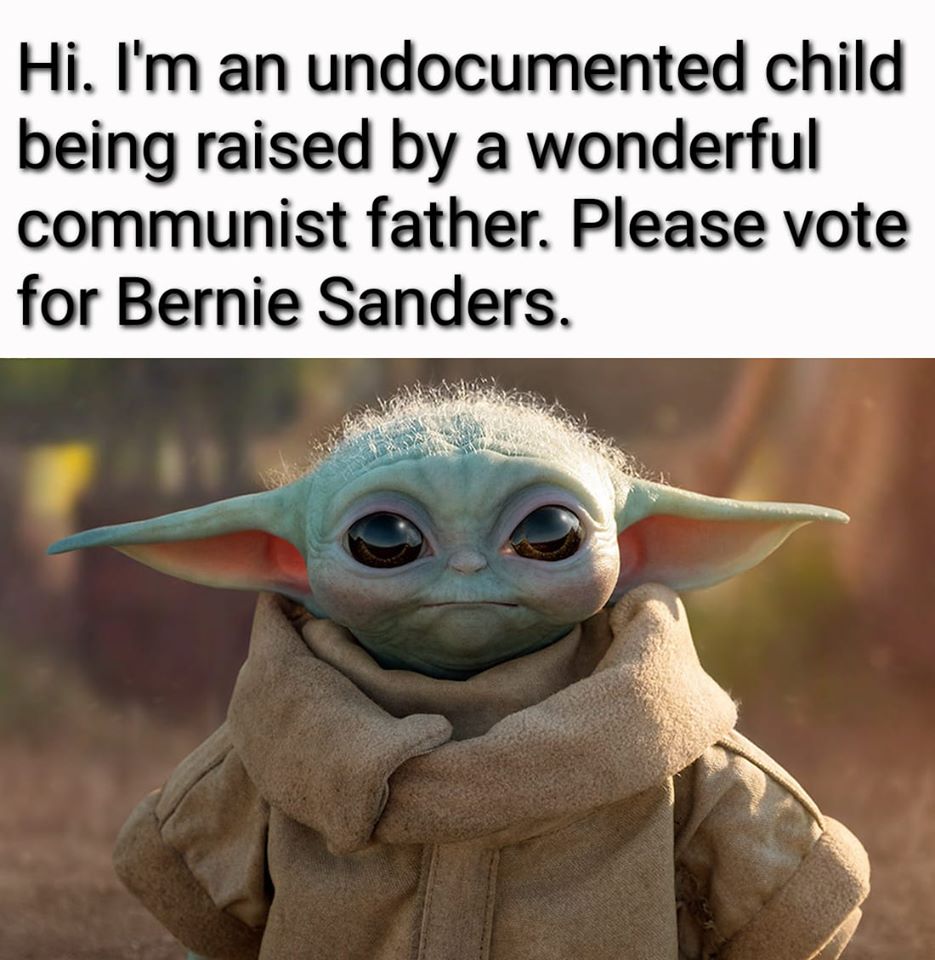
The image features "Grogu" (commonly known as "Baby Yoda"), a character from the Disney+ series The Mandalorian. Grogu is a small, green, humanoid alien infant with large, expressive eyes. He is the focus of the image, presented in a close-up shot against a blurred, natural background. The overall tone is intended to be endearing and sympathetic. Superimposed text reads: "Hi. I'm an undocumented child being raised by a wonderful communist father. Please vote for Bernie Sanders." The meme leverages Grogu's generally innocent and adorable appearance to create a jarring juxtaposition with the explicitly political and loaded text.
Foucauldian Genealogical Discourse Analysis
This meme’s power lies in how it deploys discourse to construct meaning around the categories of "child," "undocumented," "father," "communist," and “Bernie Sanders”. A genealogical approach asks how these categories came to be meaningful, and what power relations they embody.
- "Undocumented" isn’t a neutral descriptor. It emerged as a politically palatable substitute for “illegal,” shifting the focus from a supposed criminal act to an administrative status. This meme directly connects the term to a vulnerable figure (a child) to evoke sympathy and challenge the dehumanizing implications of immigration enforcement.
- "Communist Father" This label has a long and complex history, often demonized in Western discourse. The meme aims to reclaim this label, portraying it within a loving familial context (“wonderful”). This challenges the stereotypical negative portrayal of communists.
- The very framing of the "father" as a political ideology (communist) rather than simply a parent is crucial. It highlights how political beliefs shape (or are seen to shape) parenting and identity.
- The combination of these elements constructs a discourse of political sympathy. By associating a vulnerable child with potentially stigmatized ideologies, the meme attempts to generate empathy for those marginalized by dominant power structures.
Critical Theory
This meme actively engages with the Frankfurt School's critical theory by utilizing a popular culture icon (Grogu) to disrupt normative assumptions and expose power dynamics.
- Culture Industry & Ideology: Grogu, a product of the Disney "culture industry," is subverted. His image, normally used to generate profit and reinforce mainstream values, is repurposed to promote a leftist political agenda. This challenges the idea that culture solely serves to reproduce the status quo.
- Critique of the “Universal” Subject: The meme implicitly challenges the notion of a “universal” subject. By centering the experience of an “undocumented child,” it draws attention to the ways in which social categories (like citizenship) exclude and marginalize certain populations. The very phrasing ("undocumented") suggests a deviation from the presumed norm of documented citizenry.
- Manipulation of Affect: The meme skillfully exploits the emotional appeal of Grogu’s cuteness to bypass rational arguments and appeal directly to the viewer’s empathy. This can be seen as a tactic used to disrupt established power structures.
Marxist Conflict Theory
This meme can be analyzed through the lens of class struggle and the material conditions that shape identity.
- Class and Citizenship: The framing of an "undocumented" child implicitly highlights the ways in which citizenship (and access to resources) are linked to class. The meme suggests that a "wonderful" father (potentially a worker or member of the proletariat) is unable to provide the formal documentation needed for his child to be fully recognized.
- Ideological Struggle: The meme represents an attempt to shift the ideological terrain. By associating a marginalized group (undocumented children) with a progressive political figure (Bernie Sanders), the meme attempts to challenge dominant narratives about immigration and socialism.
- Proletarian Identity: The “communist father” suggests an alignment with proletarian ideology and a potential challenge to the capitalist order. While not explicit, it’s likely intended to imply a rejection of class-based inequalities.
- Exploitation & Labor: Though not directly stated, the fact that the father is “undocumented” hints at the precarious labor conditions and potential exploitation faced by undocumented workers.
Postmodernism
The meme exemplifies several key tenets of postmodern thought.
- Intertextuality: It draws upon multiple cultural texts—The Mandalorian, political discourse about immigration, and socialist ideology. This layering of references creates a complex and ambiguous meaning.
- Deconstruction of Binary Oppositions: The meme challenges simplistic binary oppositions. For example, it subverts the usual association of "communist" with negative imagery by presenting it within a loving familial context. It also attempts to disrupt the opposition between "legal" and "illegal" by focusing on the human cost of immigration enforcement.
- Simulacra and Simulation: Grogu, as a digitally created character, can be seen as a simulacrum – a copy without an original. The meme uses this image to construct a simulated reality, blurring the lines between fantasy and political messaging.
- Fragmentation of Meaning: The meme deliberately creates ambiguity and resists a single, fixed interpretation. The juxtaposition of cute imagery with serious political messaging forces the viewer to grapple with conflicting meanings.
Queer Feminist Intersectional Analysis
While not immediately obvious, an intersectional analysis can reveal some latent implications.
- Vulnerability and Care: The meme centers a vulnerable being (a child) and implicitly highlights the importance of care and protection. This can be connected to feminist ethics of care and the recognition of intersectional vulnerabilities.
- Disrupting Normative Family Structures: While the meme depicts a father-child relationship, the framing of the father as "communist" subtly disrupts normative expectations. This can be interpreted as a challenge to traditional power dynamics within the family and society.
- Marginalization and Solidarity: The meme draws attention to the plight of undocumented children, a particularly vulnerable group. This can be seen as an act of solidarity with marginalized communities and a call for social justice. Intersectionality recognizes that various forms of oppression (such as immigration status, class, political ideology) intersect and compound one another.
- Challenging Dominant Narratives: The meme attempts to challenge dominant narratives about immigration, socialism, and family values. This aligns with queer feminist efforts to deconstruct oppressive systems and create more inclusive narratives.
It's important to note that these analyses are not mutually exclusive. The meme operates on multiple levels, and different theoretical frameworks can illuminate different aspects of its meaning.
simple-description (llama3.2-vision)
This meme is a humorous image of a character from the Star Wars franchise, Baby Yoda, with a caption that juxtaposes the character's innocent and childlike demeanor with a sarcastic and ironic comment about politics. The text reads: "I'm a undocumented child being raised by a communist father. Please vote for Bernie Sanders." The meme uses the character's innocent and childlike voice to make a satirical comment about the 2020 US presidential election.
tesseract-ocr
Hi. I'm an undocumented child being raised by a wonderful communist father. Please vote for Bernie Sanders. SS. i.» yi