First Seen
2023-05-10T21:03:38+00:00
simple-description (llama3.2-vision_11b)
The meme is a humorous comparison between the original 1969 concept design for the United States' lunar exploration program, known as the Apollo Lunar Module, and the actual lunar modules that were used for the Apollo 11 mission. The meme juxtaposes the futuristic, sleek design of the original concept with the actual, more practical and rugged lunar modules that were used for the mission. The text "I can see your house is made of cheese" is not present in the meme, but it is a humorous phrase that could be used to describe the meme's tone.
detailed-analysis (gemma3-27b-vision)
Okay, let's break down this image set of the Venus Project's aspirational design versus its actual manifestation, through the lenses you've requested. Note that some lenses will be more applicable or insightful than others. I'll indicate where a section isn’t as strong or relevant.
Image Overview:
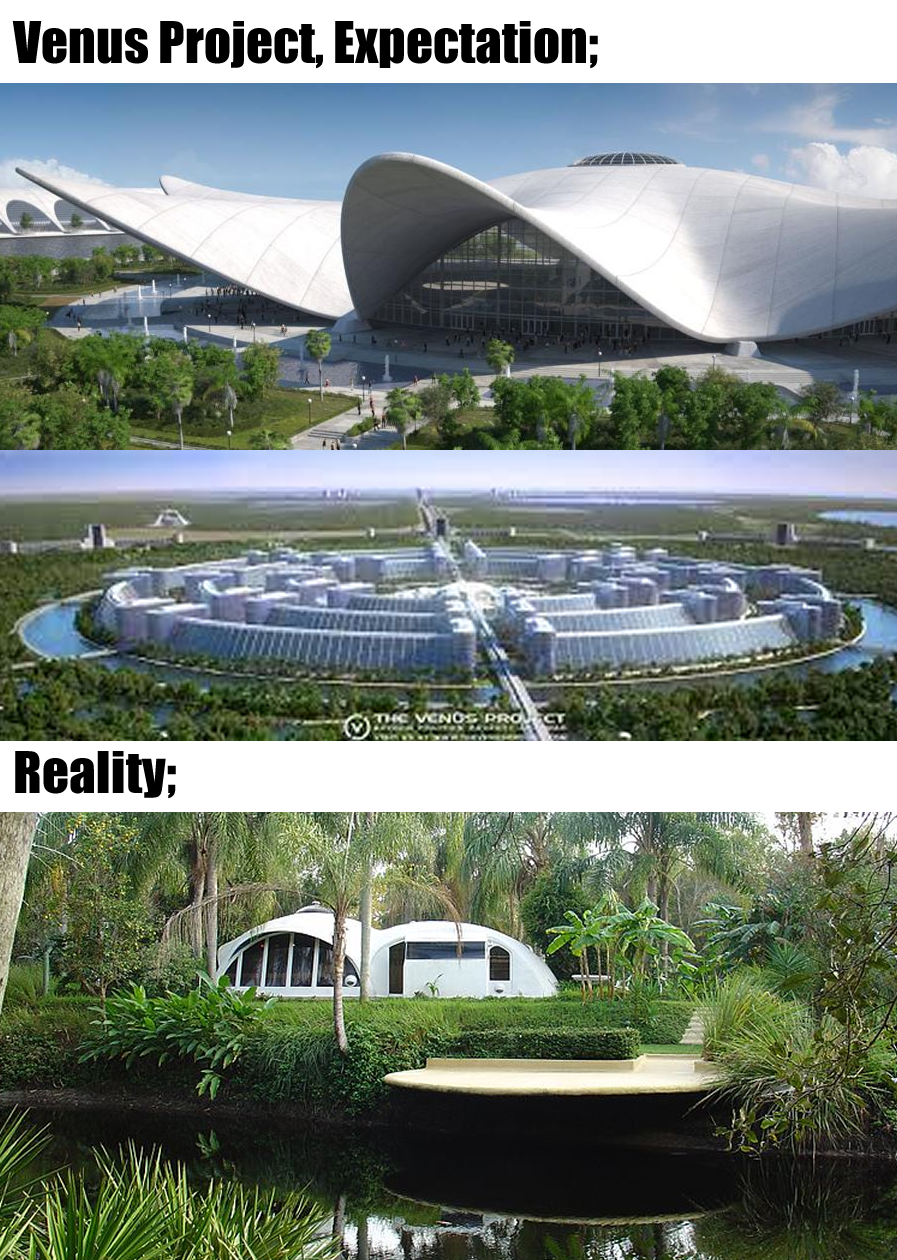
The image juxtaposes two representations of the Venus Project, a socio-economic system proposed by Jacque Fresco and Roxanne Meadows. The top section showcases highly-rendered, futuristic architectural designs—sweeping curves, gleaming white structures, and expansive green spaces. This represents the expectation or projected ideal. The bottom section presents what appears to be a small-scale, eco-friendly habitat (possibly prototype) located within a lush, tropical environment, a stark contrast to the sweeping grandeur of the top images. This is labelled as “Reality.”
1. Visual Description
- “Expectation” Images: Dominated by smooth, biomorphic architecture constructed from materials that appear to be white concrete or a similar composite. The designs are heavily influenced by organic forms, mimicking natural curves and flowing lines. The buildings are expansive, suggesting a focus on communal space and a large population. The landscaping is manicured and pristine, conveying a sense of order and control. There's a sense of utopian futurism and technological advancement. These images depict a large-scale, almost city-like complex.
- “Reality” Image: A much more modest and understated scene. We see a single, rounded, white structure, appearing more like a residential dwelling. It's nestled within a dense, tropical jungle environment, bordering a calm pond. The style is deliberately low-impact and blends into the environment. Materials appear more natural and modest, hinting at sustainable construction. The focus is on integration with nature, rather than domination over it. It is a small structure in a vastly larger environment.
2. Foucauldian Genealogical Discourse Analysis
This lens is useful because it unpacks the power dynamics inherent in how the Venus Project is presented and the discourses it employs.
- Discourse of Progress & Control: The "expectation" images are deeply embedded in the discourse of technological progress. They promise a future where technology will solve societal problems. But they also suggest a desire for total control over the environment and human life, visible in the manicured landscaping and ordered architecture. This is linked to Foucault's ideas about power/knowledge—knowledge is constructed and used to exert power. The rendering itself is a technology of control—it creates a desirable image that obscures potential complexities.
- Genealogy of Utopianism: Tracing the history of utopian thought reveals a recurring pattern of attempts to engineer perfect societies. Foucault would argue that these attempts always involve power dynamics and the imposition of a specific norm. The Venus Project, despite its purported intention of liberating humanity, can be seen as part of this lineage, attempting to construct a new set of norms and a new social order.
- "Reality" as Disruption: The "reality" image disrupts the dominant discourse. It's a humble, grounded counter-narrative. It suggests a different form of progress, one that is focused on sustainability and integration with nature, rather than technological domination. This disrupts the established "regime of truth" associated with the original vision.
3. Critical Theory
- Commodification of Utopia: The initial renderings can be interpreted through the lens of the "culture industry" (Adorno & Horkheimer). The image of the perfect future is sold as a solution to present problems. It functions as a form of distraction and pacification, rather than genuine social change.
- The Illusion of Control: The Venus Project, in its idealized form, suggests a degree of control over society that is both unrealistic and potentially oppressive. Critical Theory would point out that attempting to engineer a perfect society always involves suppressing dissent and imposing a particular ideology.
- The "Reality" Image as Resistance: The simpler "reality" image, situated within a wild environment, can be seen as a form of resistance to the commodification of utopia. It suggests a different path—one that values humility, sustainability, and harmony with nature.
4. Marxist Conflict Theory
- Technological Determinism & Class: The "expectation" images subtly imply that technology will resolve class conflict. A future of abundance and automation is promised, potentially masking the underlying power dynamics of production and distribution. This feeds into the idea of "technological determinism," where technology is seen as the driving force of social change. Marxist analysis would question who controls the technology and who benefits from its implementation.
- Labor & Automation: A key tenet of the Venus Project is automation. Marxist analysis would ask: what happens to the working class in a fully automated society? Are they truly liberated, or simply rendered obsolete? Who owns the means of production (even if that production is automated)?
- "Reality" as Material Conditions: The "reality" image reflects the actual material conditions of the project. It’s a small-scale, likely underfunded, and reliant on the labor and resources of its participants. This starkly contrasts with the utopian vision of automated abundance.
5. Postmodernism
- Deconstruction of Grand Narratives: Postmodernism rejects grand, overarching narratives of progress and utopia. The image set provides a perfect example. The initial renderings represent a grand narrative of technological salvation. The "reality" image disrupts this narrative, exposing its limitations and contradictions.
- Simulacra and Simulation: The glossy renderings can be seen as "simulacra"—copies without originals. They create a hyperreality that is detached from actual lived experience. The "reality" image attempts to ground the project in the concrete world, but it’s dwarfed by the overwhelming power of the simulated vision.
- Fragmentation & Plurality: The juxtaposition of the two images highlights the fragmentation of contemporary experience. We are bombarded with competing visions of the future, and it’s increasingly difficult to discern what is real and what is constructed.
6. Queer Feminist Intersectional Analysis
This lens has the least direct application, but some points can be made.
- The Exclusion of Diverse Experiences: The utopian vision, as depicted in the renderings, often ignores the diverse experiences and needs of different social groups, particularly marginalized communities. A monolithic “perfect” society, even one built on technological progress, can be oppressive if it doesn't account for intersectional identities.
- Gendered Labor & Automation: In a fully automated society, questions arise about the gendered division of labor. Who is responsible for maintaining the technology? Are women and other marginalized groups disproportionately affected by job displacement?
- The “Natural” & the “Artificial”: The contrast between the manufactured environment in the renderings and the natural environment in the “reality” image can be interpreted through a queer feminist lens. The idealized future can be seen as a rejection of the body and the natural world, while the “reality” image embraces them. However, this is a nuanced point, as both can be read in different ways.
I hope this comprehensive analysis helps to unpack the layers of meaning within this seemingly simple image set! Let me know if you'd like me to expand on any specific section or apply a different theoretical framework.
simple-description (llama3.2-vision)
The meme is a humorous comparison between the expected outcome of a project (Venus) and the actual reality. The image shows a futuristic, sleek, and modern cityscape (the "Venus Project") alongside a dilapidated, overgrown, and neglected landscape (the "reality"). The text at the top reads "Venus Project, Expectation" and at the bottom "Reality".
tesseract-ocr
Venus Project, Expectation: ” aM ey \ Ss ee . io rai cei elie ' 2 : } ee S - a A —— Lee Jaa = =o aH * a =) el ot oo v= ‘ i Nae i =< = @ ah a 2. > aay Sere ee —_ Seen cme a * ; ee ans = Reality; sk ae | Bee aa) ae Bo ee oy Wd Se ey | BES See al uy pax eu pee 8 Ap BOC een eae || Be i i SPR IN Fe ene ee en Bid tees i ee es ; RL eae ae NULL Re eet ig S ye PQS 4 He ee yy ee Aes YY Nw eS iS Za) ar JN IN ye IV OLA) VAIALZZ EE ai 4 os renee YANG) ran