First Seen
2023-11-12T08:48:17+00:00
simple-description (qwen3.5_2b-q8_0)
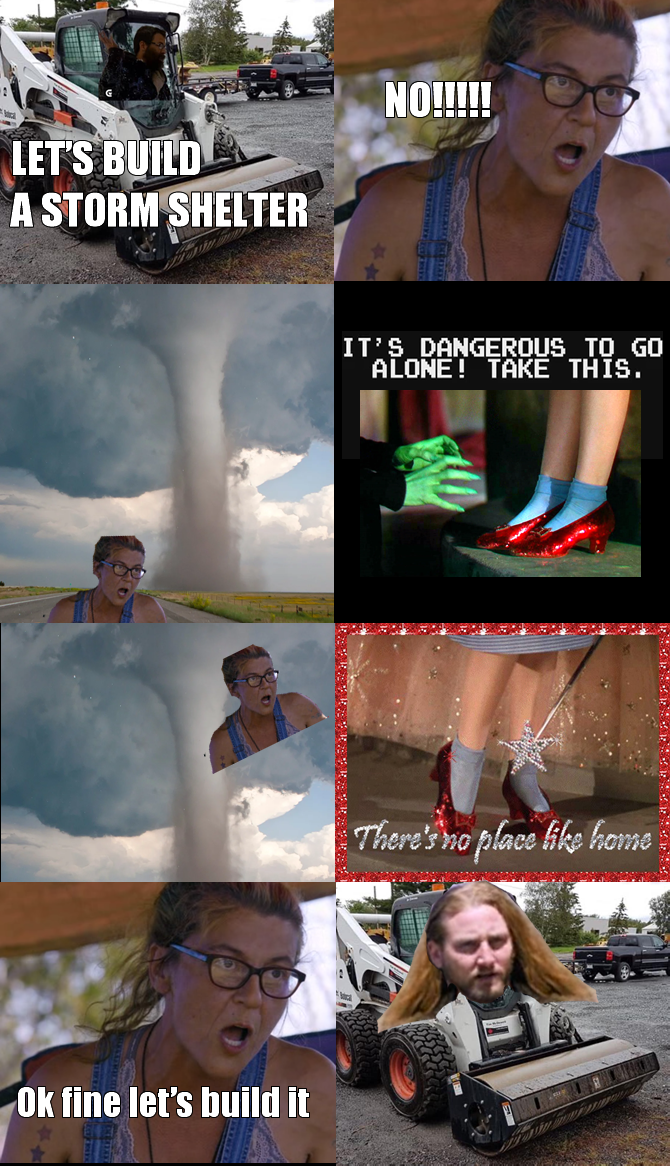
This meme depicts a man with long hair dressed as Dorothy from Gone With the Wind who initially refuses to build a storm shelter, only to eventually agree to proceed after a terrifying tornado appears. The sequence starts with the text "Let's Build a Storm Shelter" and the character screaming "No!!!!", followed by an image of the Wizard of Oz with the line "It's Dangerous to Go Alone! Take This," implying that the weather is too risky to handle. Finally, the man appears resigned and is seen operating a lawnmower with the concluding text "Ok Fine Let's Build It."
simple-description (llama3.2-vision_11b)
The meme is a humorous image of a woman being forced to build a storm shelter, with a caption referencing the classic 1939 film "The Wizard of Oz." The image is a play on words, combining the idea of building a shelter from a storm with the classic phrase "there's no place like home," which is a key line from the movie.
detailed-analysis (gemma3-27b-vision)
Okay, let's break down this meme grid through various theoretical lenses. It's a bit a lot to unpack, so I'll try to be concise and point out where the theories most strongly apply.
I. Visual Description
The image is a 3x3 grid of stills and video frames, creating a meme format. The central figure is a woman with long blonde hair, glasses, and a generally frustrated/weary expression. She is wearing overalls in several of the frames. The background primarily features dramatic weather imagery: a large tornado forming, and images of stormy skies. Interspersed are images of a front loader (tractor) and a pair of ruby red slippers. The meme uses text overlays for comedic effect, with phrases like "Let's build a storm shelter," "NO!!!!," and "Ok fine, let's build it." There's a clear narrative arc of reluctant acceptance playing out across the grid. The composition is dynamic, using the storm imagery to emphasize the urgency or absurdity of the situation.
II. Foucauldian Genealogical Discourse Analysis
This meme lends itself to a Foucauldian reading around the discourse of disaster preparedness and the power dynamics within domestic/household labor. The meme stages a resistance (the initial "NO!!!!") to the expected labor of building a storm shelter (a practical response to a potential disaster). This echoes a broader resistance to the normalized expectations and power imbalances within traditionally gendered roles. The storm shelter itself becomes a symbol of control – a desire to manage the chaotic forces of nature, a deeply Western impulse rooted in a desire for mastery. The power dynamic is reinforced when faced with an implacable outside force (the impending disaster). The woman ultimately concedes ("Ok fine, let's build it") demonstrating the internalization of these norms. We can trace a "genealogy" of this expectation – how societal and cultural forces have constructed the idea of women being expected to shoulder the burden of safety, security and disaster preparedness.
III. Critical Theory
This meme can be analyzed through the lens of Critical Theory as a comment on the construction of the "ideal" domestic space and the labor involved in maintaining it. The storm shelter is not merely a physical structure, but a manifestation of the desire for a safe, controlled environment. This echoes the broader critical theoretical concern with how dominant ideologies (like the “American Dream” and the safety of home) require a significant amount of unacknowledged labor. The woman's initial refusal suggests a rejection of this expectation, while her eventual acquiescence highlights the insidious nature of ideological control. The meme also subtly critiques the societal pressure to be "prepared," implying it is often a burden disproportionately placed on women.
IV. Marxist Conflict Theory
The meme touches upon the theme of labor. The construction of the storm shelter represents unpaid domestic labor, often performed by women, to mitigate the risks of external forces. The initial resistance (“NO!!!!”) can be interpreted as a symbolic rebellion against this labor. The tractor and construction equipment could be seen as representing the tools of production (though in this case, it’s the production of safety and security). The woman’s ultimate compliance suggests a reinforcement of existing power dynamics, where labor is extracted from those who are traditionally marginalized within the household. The potential for conflict arises from the tension between the desire for safety (the “product” of the labor) and the resistance to performing the labor itself.
V. Postmodernism
The meme is a decidedly postmodern pastiche. It juxtaposes disparate elements – dramatic storm imagery, the iconic ruby red slippers from The Wizard of Oz, and a woman’s frustrated reaction – to create a new, ironic meaning. The reference to The Wizard of Oz is especially interesting – "There's no place like home" is meant to be comforting, yet placed next to a tornado and someone needing to build a home, it becomes ironic. The meme actively deconstructs the traditional associations of safety, domesticity, and preparedness, offering a cynical commentary on the absurdity of modern life. The fragmented and playful nature of the meme is typical of postmodern aesthetics.
VI. Queer Feminist Intersectional Analysis
This meme could be read through an intersectional lens, especially concerning the expectations placed upon women in relation to home and safety. The woman’s resistance (and eventual capitulation) represents a challenge to traditional gender roles. Furthermore, the expectation that she’s the one to bear the brunt of this labor could be seen as a manifestation of societal biases. The meme also hints at the emotional labor involved in maintaining a sense of security – the woman's visible exhaustion suggests that this is not simply a physical task. If we read the woman’s expression as representative of a broader societal exhaustion with endless demands, it could connect to queer feminist analyses of burnout and the pressure to be perpetually “strong” or “capable”. The overall meme points towards the ways in which gender, labor, and societal expectations intersect to create a complex web of power dynamics.
Let me know if you'd like me to expand on any particular theoretical lens or aspect of this analysis!
simple-description (llama3.2-vision)
This meme is a humorous take on the classic "It's a good thing" meme, where a person is being threatened with a tornado and is responding with a sarcastic and absurd request to build a storm shelter. The text "Let's build a storm shelter" is written in a bold, playful font, while the person's response "It's a good thing" is written in a smaller, more casual font. The meme is a lighthearted and humorous way to poke fun at the idea of building a storm shelter.
tesseract-ocr
\ ~ J aa ay os = y {gS a = . at ce _. LR) ae tL ——— ~ YT or oy iL SUL hes 7 aR sc ee r ALONE! TAKE THIS. we). Need a ig : Pe in| _ ae ar WN NN ct . eee A oe ; ee ee. “ Sao aes : — 7 \o ae te Go sie A ax, \=Re g + Dp adi M ‘“ i Z <¥ cs 2 2 fine let’s build it — aah Z