First Seen
2023-05-10T21:03:38+00:00
simple-description (llama3.2-vision_11b)
The meme is a playful image of a character from the Star Wars universe, Baby Yoda, holding a grocery cart filled with adult beverages, captioned "I drink your milk, now I drink your beer".
detailed-analysis (gemma3-27b-vision)
Okay, here's a breakdown of the image using the requested theoretical lenses. Not all lenses apply strongly, so those will be shorter or omitted.
Visual Description
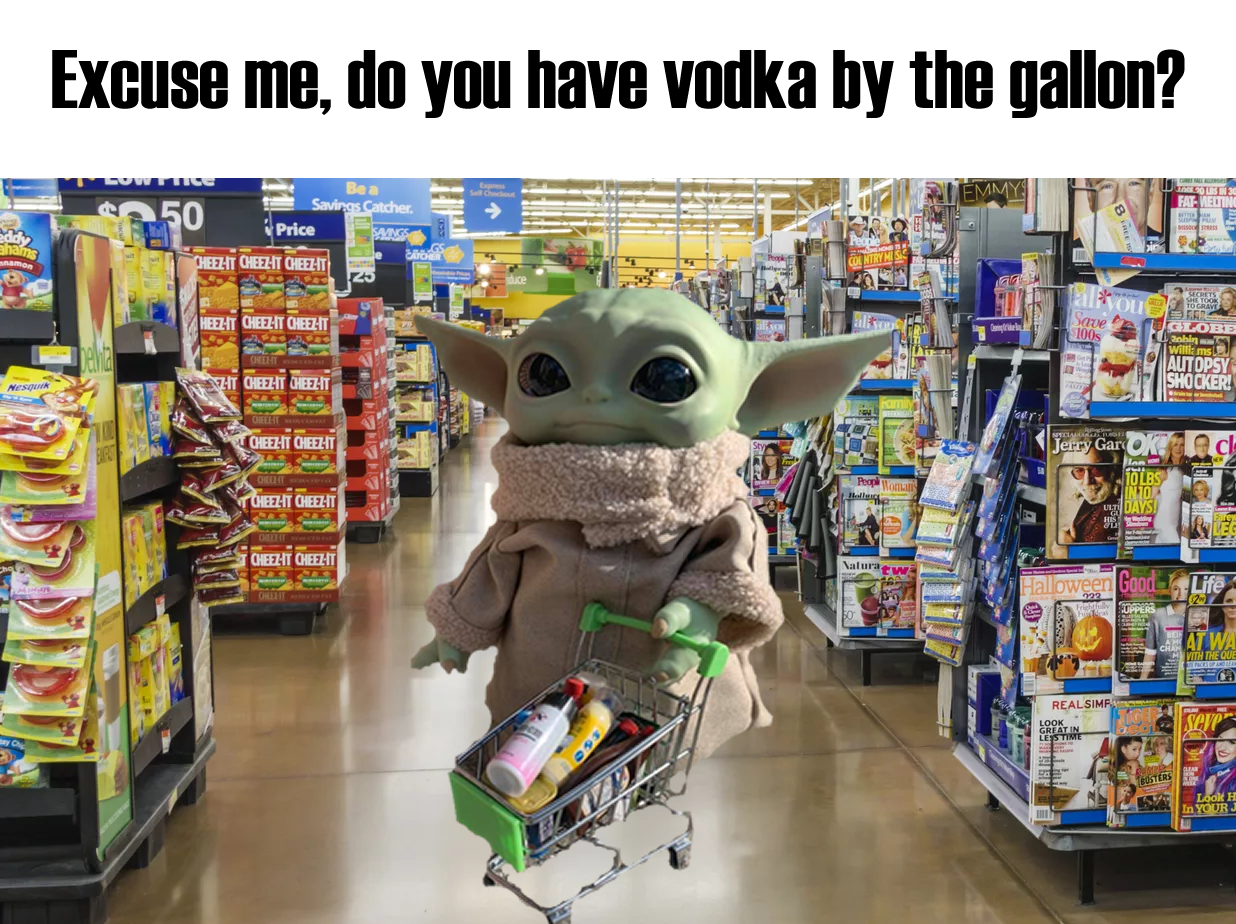
The image is a digitally altered photograph featuring "Baby Yoda" (Grogu) from The Mandalorian superimposed into a brightly lit, seemingly American supermarket aisle. Grogu is dressed in a brown coat and appears to be pushing a small, green shopping cart. He's positioned facing the camera, looking directly at the viewer with a somewhat demanding expression. The aisle is packed with various consumer goods, specifically a massive display of Cheez-Its, and stacks of magazines. The caption at the top of the image reads, "Excuse me, do you have vodka by the gallon?" The image is clearly intended as humorous, playing on the juxtaposition of a beloved fictional character with a decidedly adult request in a mundane setting. The lighting is the standard fluorescent of a large retailer.
Foucauldian Genealogical Discourse Analysis
This image speaks to the discursive formations surrounding childhood, consumerism, and desire. The character of Grogu, as constructed through the Star Wars franchise, is initially presented as a symbol of innocence, vulnerability, and needing protection. This construction is a discourse itself, shaping how we understand 'childhood' – as something requiring safeguarding.
The image subverts this discourse by placing Grogu in a context of adult consumption (a supermarket) and articulating a desire for alcohol. This challenges the pre-established association between childhood and abstinence.
From a genealogical perspective, we can trace the power dynamics embedded in this. The demand for "vodka by the gallon" is presented as casual, almost entitled, for a character culturally positioned as helpless. This suggests a normalization of excessive consumption, an element within capitalist societies. The image isn’t necessarily about alcohol itself, but about the construction of desire and the normalization of seeking gratification within a consumerist framework.
Critical Theory (particularly Frankfurt School)
This image is ripe for a critical analysis in the vein of the Frankfurt School. It exemplifies the culture industry's ability to commodify even the seemingly innocent. Grogu, initially a cultural phenomenon, has been integrated into the spectacle, used for humorous memes and digital alteration, stripped of its original narrative context.
The image functions as a form of false consciousness. It presents a trivial, humorous request ("vodka by the gallon") as normal and relatable, diverting attention from broader societal issues like the pressures of consumerism or the problematic normalization of excessive alcohol consumption.
The image can be seen as a symptom of the erosion of reason and the triumph of spectacle. Humor, in this instance, serves to anesthetize critical thought, replacing meaningful engagement with superficial entertainment. The juxtaposition of Grogu’s ‘innocence’ and the adult request highlights a blurring of boundaries, contributing to the dissolution of values.
Marxist Conflict Theory
The image subtly points to the alienation inherent in capitalist structures. Grogu, despite being a symbol of fantastical wealth within the Star Wars universe, is placed in a space of pure consumerism. The demand for “vodka by the gallon” can be read as a reflection of a desperate need for escape – from the anxieties of modern life, from the pressures of the system.
This isn't necessarily a conscious critique, but a symptom of the commodity fetishism that permeates capitalist society. We imbue objects (like vodka) with the power to solve our problems or fulfill our desires, obscuring the underlying social relations that produce those objects.
The image could also be interpreted through the lens of class (though subtly). The abundance of consumer goods in the supermarket aisle – the sheer volume of choices – is a hallmark of late capitalism. The demand for "vodka by the gallon" suggests a willingness to participate in and even indulge in excessive consumption, a privilege often associated with a particular class position.
Postmodernism
The image embodies several key tenets of postmodernism. It's a pastiche – a blending of disparate elements (a popular fictional character, a supermarket, a humorous caption). This disrupts any sense of originality or authenticity.
The image deconstructs the conventional meaning of childhood and innocence. By placing Grogu in this context, it challenges the pre-established boundaries and expectations associated with that category.
The image is ironic and self-referential. It acknowledges its own constructedness – it’s a digital manipulation, a meme – and plays with the viewer’s expectations.
The image highlights the simulacrum – the copy without an original. Grogu exists as a cultural icon, reproduced endlessly in various forms. This image is just another layer of reproduction, further removed from any 'authentic' source.
Queer Feminist Intersectional Analysis
This analysis is less directly applicable, but worth exploring. The juxtaposition of Grogu and the demand for alcohol can be seen as a subversion of gendered expectations around substance use. Historically, substance use has been coded as masculine, while innocence is often associated with femininity (even in a fictional construct like Grogu). This image disrupts that binary, challenging the idea that only certain genders can desire or consume alcohol.
The image’s humor can be read as a form of camp, a sensibility often associated with queer culture. The exaggeration and subversion of norms are characteristic of camp aesthetics.
However, it is important to note that this interpretation is somewhat tenuous. The image doesn’t explicitly engage with queer or feminist themes, but it does offer a space for reinterpretation through those lenses. This is often a characteristic of postmodern art and meme culture - inviting multiple interpretations.
Hopefully, this provides a comprehensive analysis of the image through various theoretical frameworks! Let me know if you'd like me to elaborate on any particular section.
simple-description (llama3.2-vision)
This meme features a photo of Baby Yoda (also known as "The Child") from the Star Wars franchise, shopping in a grocery store. The image shows Baby Yoda in a shopping cart, holding a carton of eggs, with a caption that reads: "Excuse me, do you have any vodka by the gallon?" The meme is humorous because it takes a character known for being small and innocent, and puts him in a situation where he's asking for a large quantity of a strong drink, which is ironic and unexpected.
tesseract-ocr
Excuse me, do you have vodka by the gallon? =e SS ol! a) He Sy io = on ee SE) pee ae i ea i le A oie =9/ ae - ee Ad £. f am ac) —S a rae ) ee yy So x = con tS a ol ade Wid Ma) ig “ps aes te A a ) So a 5 pA ag eS SA, A ) » PN ea eS | iti steed (1) * 2 = Mak oft. ah he ray im === Se CH) Ne