First Seen
2023-05-10T21:03:38+00:00
simple-description (llama3.2-vision_11b)
The meme is an image of a cartoon character, likely from the animated series "Star Wars: The Clone Wars," with a shocked expression. The text "I can smell the desperation" is overlaid on the image, implying that the character is reacting to someone trying to persuade them with empty or insincere arguments.
detailed-analysis (gemma3-27b-vision)
Okay, here's an analysis of the image as a meme, incorporating the requested theoretical frameworks where applicable. Please note that applying these theories to a simple meme requires some interpretive stretch, but the goal here is to demonstrate how they could be applied.
Visual Description
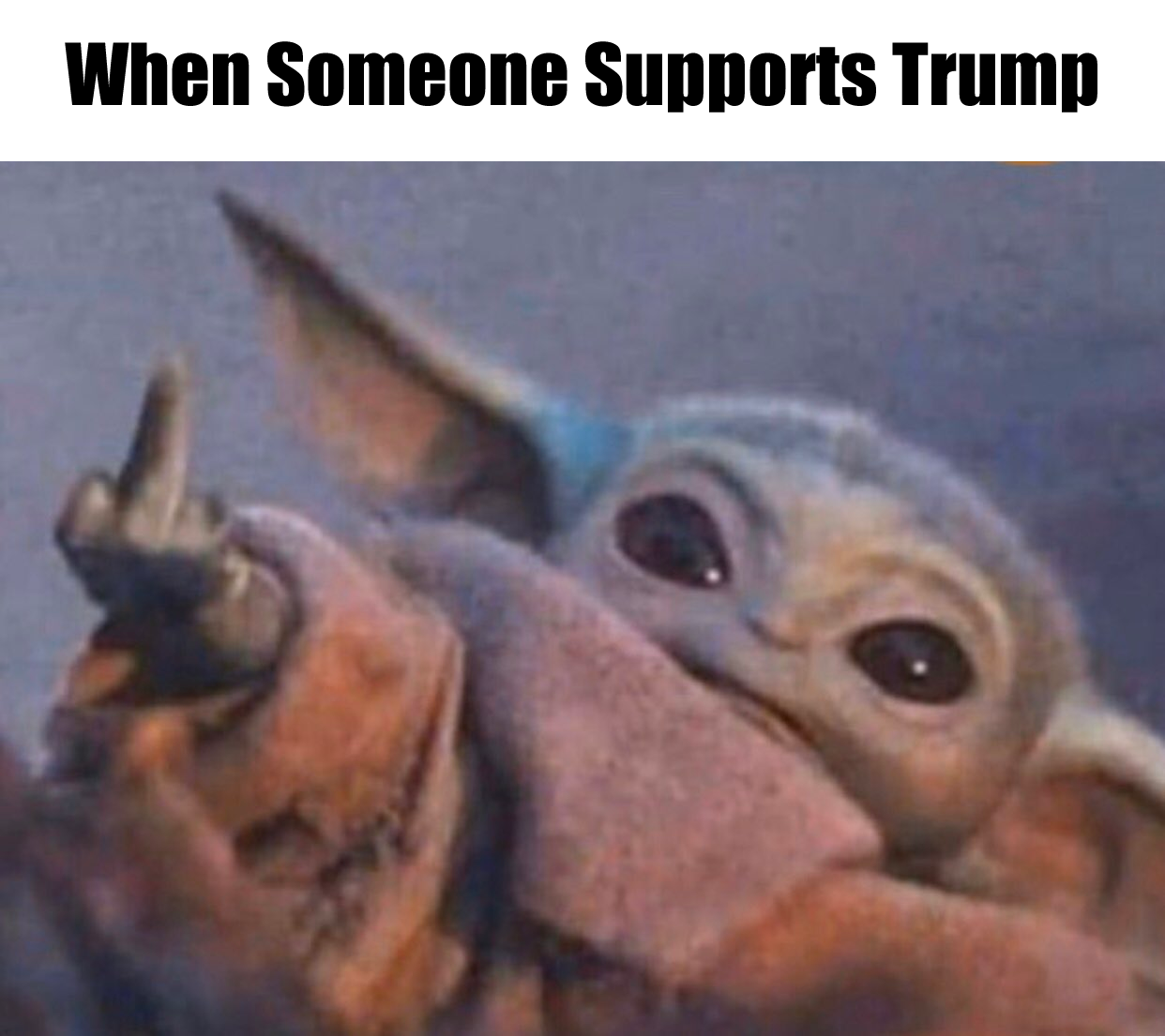
The image is a meme featuring "Baby Yoda" (Grogu) from the Disney+ series The Mandalorian. The image shows a close-up of Grogu making a rude gesture – an extended middle finger. The text overlaid on the image reads "When Someone Supports Trump". The background is blurry and appears to be a scene from the show. The color palette is mostly blue and green, typical of the show's aesthetic. The overall tone is humorous and confrontational, aiming to express disapproval and ridicule.
Foucauldian Genealogical Discourse Analysis
This meme, viewed through a Foucauldian lens, can be seen as a moment within the discourse surrounding political polarization.
- Power/Knowledge: The meme asserts a power dynamic: the creator/sharer positions themselves as knowing the 'correct' political stance and deploying ridicule toward those who disagree. The gesture (the middle finger) becomes a symbol of that judgment, and the image functions to normalize a particular expression of political disdain.
- Genealogy: Tracing the genealogy of this meme would involve looking at the historical evolution of political humor, the use of visual insult, and the rising popularity of "Baby Yoda" as a cultural signifier. The juxtaposition of the cute character with an aggressive gesture creates a surprising and attention-grabbing effect, which is a key element of its spread.
- Discursive Formation: The meme contributes to a specific discursive formation centered around Trump supporters. This formation often relies on demonization or labeling of individuals based on their political beliefs, framing them as 'other' and unworthy of respect. The meme does not engage in reasoned debate but rather contributes to an atmosphere of animosity.
Critical Theory
From a Critical Theory perspective, this meme reflects a broader social critique and the construction of political identity.
- Ideology: The meme functions ideologically by presenting a simplified and negative portrayal of anyone supporting Trump. It does not address complex political motivations or underlying social issues. Instead, it offers a quick, emotionally charged judgment that reinforces a particular worldview.
- Culture Industry: The use of a popular culture icon (Baby Yoda) is significant. The meme relies on the cultural capital of this character, leveraging its widespread appeal to gain attention and disseminate a political message. This is a classic example of how the culture industry appropriates elements for ideological purposes.
- Domination/Resistance: While appearing to be a form of resistance against Trump supporters, the meme's simplistic nature could be seen as a form of domination. By reducing political beliefs to a target of ridicule, it shuts down dialogue and reinforces existing power structures.
Marxist Conflict Theory
Viewing this meme through a Marxist lens reveals the underlying class and power dynamics at play in political polarization.
- Class Struggle: While not explicitly about economic inequality, the meme reflects a cultural struggle between different groups with competing ideologies. The disdain expressed towards Trump supporters can be interpreted as a manifestation of the conflict between those who benefit from or support the existing socio-economic system and those who feel alienated or disenfranchised.
- False Consciousness: The meme could be seen as contributing to "false consciousness" by presenting a distorted and simplistic view of political beliefs. It does not address the root causes of political division, such as economic insecurity or social injustice, and instead focuses on superficial differences.
- Hegemony: The meme reflects a struggle for cultural hegemony—the dominance of one set of ideas and values over others. By ridiculing Trump supporters, the meme attempts to delegitimize their beliefs and establish a dominant narrative that favors a different political perspective.
Postmodernism
A postmodern reading of this meme focuses on its playful and ironic nature, and the blurring of boundaries between high and low culture.
- Simulacra and Simulation: The meme can be seen as a “simulacrum”—a copy without an original. It's not a genuine expression of political analysis but a performative gesture that relies on pre-existing cultural references and emotional associations. The meaning of the image is detached from any objective truth.
- Deconstruction: The meme deconstructs the traditional notion of political discourse by using a silly image to make a political point. It subverts expectations and challenges the authority of traditional forms of political communication.
- Meta-narrative: The meme rejects any grand, overarching “meta-narrative” about politics. It simply offers a fleeting, ironic comment on a specific situation, without attempting to provide a comprehensive explanation or solution.
Queer Feminist Intersectional Analysis
This analysis is the most challenging to apply, given the meme's direct content. However, an intersectional approach might explore how the expression of political disagreement interacts with broader social power dynamics.
- Marginalization and "Othering": The meme contributes to the "othering" of Trump supporters, potentially mirroring the experiences of marginalized groups who are often subjected to similar forms of ridicule and dehumanization. While the intent may be to critique a political position, the tactic itself can reinforce harmful patterns of exclusion.
- Power Dynamics: The meme implicitly asserts the power of the creator/sharer to judge and ridicule, reflecting broader power imbalances in society. This dynamic can be particularly harmful when directed towards those who are already marginalized or vulnerable.
- Intersection of Identities: The meme doesn't explicitly address intersectionality, but it highlights how political beliefs can be intertwined with other aspects of identity, such as class, race, gender, and sexuality. The reaction to the meme itself might vary depending on the social position of the individual viewing it.
Disclaimer: This analysis is interpretive and speculative. The application of these theories to a simple meme requires a degree of abstraction. The purpose is to demonstrate how these theoretical frameworks can be used to examine even seemingly trivial cultural artifacts.
simple-description (llama3.2-vision)
This meme features a still image from the movie "Star Wars: The Force Awakens" of a character named Finn, but it has been Photoshopped to make his face look shocked and horrified. The text "When someone supports Trump" appears above the image, implying that the character's reaction is a humorous way to express disgust or outrage at someone's political views. The meme is a lighthearted way to poke fun at the controversy surrounding Donald Trump's presidency.
tesseract-ocr
When Someone Supports Trump eee, vy ee a ieee | oe ye ~ . be _ , a Oe ee a es a oe oad 4