First Seen
2023-05-10T21:03:38+00:00
simple-description (llama3.2-vision_11b)
The meme is a humorous image of a person wading through a river, but their body is made up of various food items like potatoes, carrots, and bread, implying they are a "human" made of "food". The text overlay reads "when you're a human but also a snack". This meme is a lighthearted way to poke fun at the idea of being a human, but also being made up of food items, often used in a humorous or satirical context.
detailed-analysis (gemma3-27b-vision)
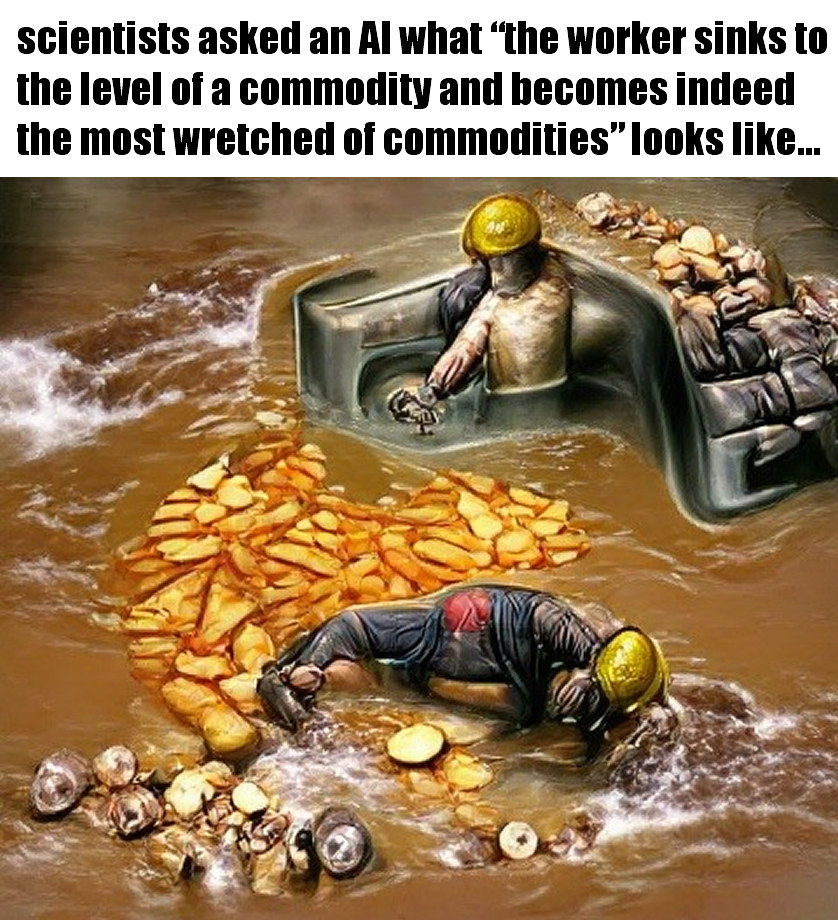
Okay, let's break down this image—generated by AI in response to the prompt "what 'the worker sinks to the level of a commodity and becomes the most wretched of commodities' looks like"—through a series of analytical lenses. It's a potent image, and several theoretical approaches are relevant.
1. Visual Description
The image depicts a scene of industrial disaster and degradation. A large excavator, seemingly abandoned and partially submerged in a thick, muddy, ochre-colored liquid, looms over the scene. The excavator's bucket has spilled a huge pile of what appears to be golden, potato-like objects (likely meant to represent the commodities produced).
Below, two figures, clearly workers, are struggling within the sludge. One is completely submerged, only a hand reaching out visible. The other is partially visible, also clearly in distress. They are dressed in what appears to be old-fashioned mining or industrial workwear, complete with hard hats.
The overall tone is bleak, oppressive, and claustrophobic. The brown/muddy color scheme contributes to a sense of decay and hopelessness. The scene evokes images of mine collapses, industrial accidents, or the consequences of unchecked resource extraction.
2. Marxist Conflict Theory
This image is strongly rooted in Marxist conflict theory. It is a visual manifestation of Marx's critique of capitalism and the alienation of labor. Here's how:
- Commodification of Labor: The prompt explicitly references the "worker sinking to the level of a commodity." Marx argued that under capitalism, labor itself becomes a commodity – something to be bought and sold. This image visually demonstrates that reduction – the worker is consumed by the very commodities they produce.
- Alienation: The workers are immersed in the output of their labor (the golden "potatoes"). They are no longer connected to the product as something meaningful they created, but are rather drowned by it. This represents the alienation of the worker from the product of their labor, a key concept in Marxist thought.
- Exploitation: The scene suggests a profound imbalance of power and exploitation. The excavator (representing the means of production) is in a position of dominance, while the workers are helpless and consumed by the output.
- Dehumanization: The immersion in the sludge, the depiction of bodies struggling, suggests the dehumanization inherent in a system that treats labor solely as a means to profit. The workers are reduced to mere inputs in the production process.
- The golden commodities while visually appealing, are a representation of the wealth created by the workers' labor, which is ultimately not shared with them.
3. Foucauldian Genealogical Discourse Analysis
A Foucauldian approach would examine the discourse around labor, power, and production that this image embodies.
- Power/Knowledge: The image is a product of an AI responding to a specific prompt. This highlights how knowledge is constructed through power relations. The very act of asking the AI to visualize this concept reflects a discourse about labor that is already present within the scientific community.
- Discipline and Biopower: The scene evokes a sense of control and discipline imposed on the workers. The hazardous environment suggests a system that prioritizes production over the well-being of the laborer. The "sludge" can be interpreted as a manifestation of biopower – the power to control and manage life, in this case, through dangerous working conditions.
- Genealogy of Control: Examining the historical genealogy of industrial practices and labor control reveals that this image is not an isolated incident but rather a continuation of a long-standing pattern of exploitation and control.
- Normalization of Risk: The image can be seen as a commentary on the normalization of risk and danger in industrial settings. The acceptance of hazardous working conditions as a necessary part of production is a key aspect of this discourse.
4. Postmodernism
A postmodern reading might focus on the image's deconstruction of grand narratives and its representation of fragmented subjectivity.
- Loss of Meaning: The surreal and somewhat disturbing imagery suggests a loss of traditional meanings associated with labor and production. The golden potatoes are a bizarre, unsettling symbol that challenges conventional interpretations.
- Simulacra and Simulation: The scene could be interpreted as a simulation of exploitation, a hyperreal representation of the dehumanizing effects of capitalism. The image itself is a copy (created by AI) of a concept, further distancing it from any "original" reality.
- Fragmentation of Identity: The submerged and struggling figures suggest a fragmentation of subjectivity. Their identities are lost in the sludge, and they are reduced to mere bodies struggling for survival.
- Rejection of Metanarratives: The image challenges the grand narrative of progress and economic growth, exposing the hidden costs of industrialization and the exploitation of labor.
5. Critical Theory (General)
Critical Theory, broadly, examines the role of ideology in maintaining power structures. This image serves as a potent critique.
- Ideology of Progress: The image challenges the ideology that equates industrial progress with social advancement. The scene of suffering directly contradicts the notion that economic growth automatically benefits all members of society.
- Hidden Costs of Production: The image exposes the hidden costs of production, the human and environmental suffering that are often obscured by the rhetoric of economic efficiency.
- Unmasking Power Relations: The image unmasks the power relations that underpin the capitalist system. It reveals how the owners of capital exert control over the lives of workers and prioritize profit over human well-being.
- Call to Action: By presenting a disturbing and unsettling image, the AI seeks to inspire awareness about the realities of exploitative labor practices and promote social change.
In summary: This image is a layered and complex commentary on the nature of labor, power, and exploitation in the modern world. It draws on a variety of theoretical frameworks to expose the hidden costs of production and challenge the dominant ideologies that sustain the capitalist system. The use of AI to generate the image adds another layer of complexity, as it raises questions about the role of technology in perpetuating or challenging existing power structures.
simple-description (llama3.2-vision)
The meme is an image of a person trapped in a sinkhole of oil, surrounded by oil barrels and oil spills. The text above the image reads: "When you finally understand the concept of 'peak oil' and it's actually just a bunch of people stuck in a giant oil spill."
tesseract-ocr
scientists asked an Al what “the worker sinks to the level of a commodity and becomes indeed the most wretched of commodities” looks like... . ee ee ee ees ee ae Nae iX: a pees 3 a, AE aS lf eR | ‘Gn eel Saha ee ey . ae - scene ee fe - oP es ~ ' [ Z s ~ oP es = > . —s . -s _ 2 - ~ = » t ~ a TN ey J SI SIGE a ™ C6? Ge = wd \= = Ui 4 At i =P ee 7 Paul rs pe eel ae rae ee U5 ng! fe ae a oe oe ae SRR A) on + ko a ~— Se ae 8 Be? rs