First Seen
2023-05-10T21:03:38+00:00
simple-description (llama3.2-vision_11b)
The meme is a screenshot of a TV show where a character is shocked to see someone they thought was a woman is actually a man. The text overlay reads "when you realize someone you thought was a woman is actually a man" and is followed by "but it's a man with a vagina". The meme is poking fun at the idea that some people are shocked to discover that someone they thought was a woman is actually a man, and that this realization is often followed by a sexist or transphobic comment.
detailed-analysis (gemma3-27b-vision)
Here's an analysis of the meme, broken down by the requested theoretical frameworks. It's a complex meme with layers of meaning, so the analysis will be detailed.
Visual Description
The meme is a two-panel image utilizing a popular reaction format.
-
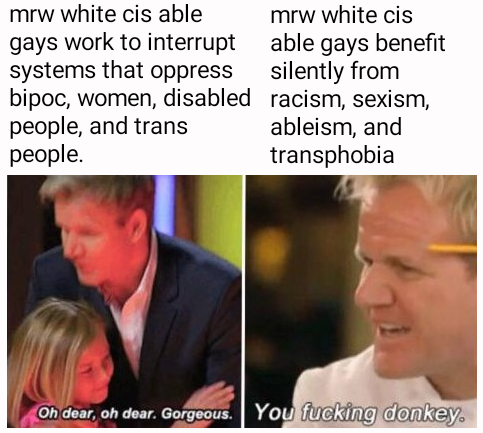
Panel 1: Features a screenshot of actor/comedian, John Mulaney looking with concern and sympathy towards a woman (presumably his partner, Olivia Munn) in a red dress. The caption reads "Oh dear, oh dear. Gorgeous." This conveys a sense of well-meaning, yet ultimately shallow or condescending concern.
-
Panel 2: Features a close-up shot of actor/comedian, Bo Burnham, with a look of frustrated anger. The caption reads "You fucking donkey." This expresses blunt outrage and dismissal.
The meme is structured to create an ironic juxtaposition between a perceived sympathetic gesture and an expressed condemnation.
Queer Feminist Intersectional Analysis
This is where the meme truly shines. It's a commentary on the complexities of privilege within LGBTQ+ communities, specifically focusing on the experiences of white, cisgender, able-bodied gay men.
- Intersectionality: The meme directly invokes the concept of intersectionality (coined by Kimberlé Crenshaw) by listing multiple categories of marginalization – race (BIPOC), gender (women), disability, and transgender status. It argues that while some white, cis, able-bodied gay men perform allyship (often superficially, as suggested by the first panel's caption), they simultaneously benefit from the very systems that oppress those listed. This is a critique of ‘performative allyship’.
- Privilege: The meme highlights the privileges that are inherent to being white, cisgender, and able-bodied, and how these privileges insulate some gay men from the full impact of systemic oppression, even as they advocate for other marginalized groups. It implies they reap benefits from these systems despite claiming to oppose them.
- Critique of Liberal Gay Rights Movements: The meme implicitly critiques the historical focus of mainstream gay rights movements, which have often centered the experiences of white, cisgender gay men, while marginalizing the concerns of LGBTQ+ people of color, transgender individuals, and those with disabilities.
- "Gorgeous" vs. "Donkey": The contrast between "Oh dear, oh dear. Gorgeous" and "You fucking donkey" is key. "Gorgeous" represents the patronizing, superficial sympathy often offered by those with privilege. "Donkey" is a blunt rejection of that performance and a demand for genuine accountability.
Critical Theory
The meme can be analyzed through a lens of Critical Theory, particularly in relation to power dynamics and social critique.
- Ideology and Hegemony: The meme deconstructs the idea that simply advocating for certain social justice causes absolves individuals from benefiting from oppressive systems. It argues that ideology operates on multiple levels, allowing individuals to simultaneously believe in equality while participating in (and benefiting from) inequality.
- Power Dynamics: The meme exposes the ways in which power operates within the LGBTQ+ community, highlighting how certain groups within that community are privileged while others are marginalized.
- Social Critique: The meme is a clear critique of liberal approaches to social justice, which often focus on individual acts of allyship without addressing the underlying systemic issues.
Marxist Conflict Theory
While not the primary framework, Marxist principles can be applied.
- Class Dynamics Within Oppression: The meme subtly implies a class dimension. Those with more privilege (white, cis, able-bodied) have more social capital to leverage even within oppressed groups, gaining access to resources and platforms that are unavailable to others.
- Unequal Benefit: The core argument—benefiting from systems of oppression—aligns with the Marxist focus on how certain groups benefit materially from the exploitation of others. While not strictly about economic exploitation, it suggests a benefit in terms of social capital, access, and status.
- False Consciousness: The "Oh dear, oh dear. Gorgeous" panel hints at a false consciousness – a lack of awareness of the true nature of one’s position within a system of power.
Postmodernism
Postmodernism appears less directly but is relevant due to the meme’s challenging of grand narratives and stable identities.
- Deconstruction of Identity: The meme deconstructs the notion of a unified "gay identity," suggesting that lived experiences are significantly shaped by intersecting identities and privilege.
- Critique of Essentialism: It rejects the idea that there is a single, universal experience of being gay, instead emphasizing the diversity of experiences and the importance of acknowledging privilege.
- Meta-Commentary: The meme itself is a meta-commentary on online discourse and the performance of activism.
Foucauldian Genealogical Discourse Analysis
This framework offers a unique perspective.
- Power/Knowledge: Foucault argues that power and knowledge are intertwined. This meme suggests that those with privilege often produce knowledge about oppression while simultaneously benefiting from it, creating a discourse that maintains the status quo.
- Genealogy of Concepts: Tracing the historical development of concepts like "allyship" and "social justice" reveals how they have been co-opted and depoliticized over time. The meme can be seen as a challenge to these co-opted meanings.
- Discursive Formations: The meme can be analyzed as a disruption of existing discursive formations around LGBTQ+ activism and the discourse of solidarity. It challenges the way we talk about and understand these issues.
In summary, this meme is a complex and nuanced critique of privilege within the LGBTQ+ community. It utilizes irony and a well-known visual format to highlight the ways in which even those who advocate for social justice can benefit from systems of oppression. The meme is rich with theoretical resonance, aligning with multiple frameworks of thought.
simple-description (llama3.2-vision)
This meme is a screenshot from a TV show where a character is responding to a provocative comment. The image shows a man with a shocked expression, and the text overlay says "I'm a 10, I'm a 10, I'm a 10" - a phrase often used to express confidence or arrogance. The meme is captioned "when you're trying to be a 10 but you're actually a 3" and is likely used to poke fun at someone who is being overly confident or arrogant.
tesseract-ocr
mrw white cis able mrw white cis gays work to interrupt able gays benefit systems that oppress __ silently from bipoc, women, disabled racism, sexism, people, and trans ableism, and people. transphobia F - jj : | yy } — ( \_ LP (Oh dear, oh dear. 4 tucking Comsss7.