First Seen
2023-05-10T21:03:39+00:00
simple-description (llama3.2-vision_11b)
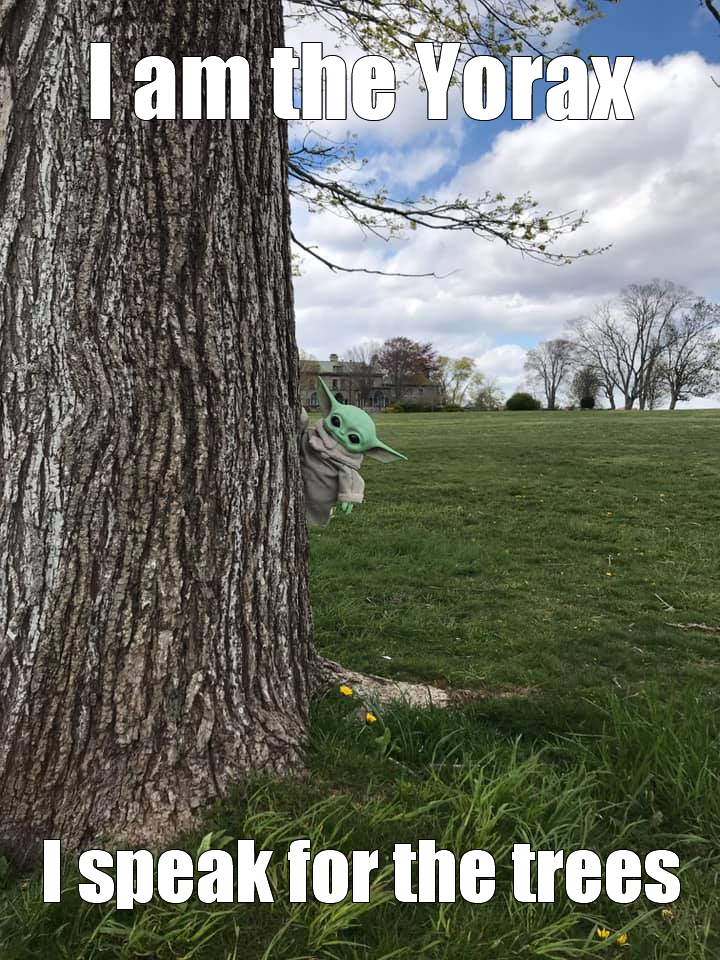
The meme is an image of a character from the Star Wars franchise, Yoda, with a caption that says "I am Yoda, speak for the trees, I do." This is a play on the phrase "I speak for the trees" from a Dr. Seuss book, where the character of the Lorax says he speaks for the trees because they cannot speak for themselves.
detailed-analysis (gemma3-27b-vision)
Okay, let's break down this image with the requested theoretical frameworks. It's a meme, so the interpretations can get quite layered!
Visual Description
The image depicts a close-up of a tree trunk in the foreground, with a small, green Grogu (Baby Yoda) figure partially concealed behind it. The setting appears to be a grassy field under a cloudy sky, with a large building visible in the distance. Text overlays the image: "I am the YORAX" at the top, and "I speak for the trees" at the bottom. The image has a playful, slightly absurd quality due to the juxtaposition of a character from a science fiction franchise and a well-known environmental phrase.
Foucauldian Genealogical Discourse Analysis
This meme engages with the discourse of environmentalism and particularly, the historical construction of “nature” as something needing protection. The phrase "I speak for the trees" originates from the Dr. Seuss book The Lorax, a narrative specifically about industrial exploitation and environmental devastation.
A genealogical approach (as developed by Michel Foucault) would examine how the idea of "speaking for" nature came to be. Initially, it's an anthropocentric assertion (humans deciding what nature needs). The meme, by placing Grogu – a creature inherently “other” to humans – in the position of the speaker, slightly disrupts this power dynamic. Grogu isn’t a human conservationist; he is a non-human, potentially giving him a more legitimate claim to represent nature’s interests.
The "YORAX" (a deliberate misspelling of “Lorax”) functions as a point of disruption. It isn't merely a mistake, it creates distance. The misspelling could also be seen as a commentary on the co-option of environmental movements by capitalist interests, diluting the original message. The entire meme can be seen as a challenge to the established power structures that define and control our relationship with the natural world.
Critical Theory
From a critical theory perspective (drawing from the Frankfurt School), this image can be understood as a commentary on the commodification of environmentalism. The Lorax narrative (and by extension, the meme) presents a critique of capitalist exploitation of natural resources. However, the image itself becomes a commodity—a meme spread through online platforms driven by capitalist advertising.
This creates an ironic tension: the meme is a criticism of the system, yet is distributed through that very same system. The image implicitly asks us to consider the way environmental messages are packaged, disseminated, and potentially neutralized within consumer culture. It challenges us to examine the ways in which environmental concern can become a form of branding or marketing, obscuring the underlying systemic problems.
Marxist Conflict Theory
A Marxist reading focuses on the inherent conflict between the forces of production (capitalism) and the natural world. The Lorax is a direct allegory for industrial exploitation and the prioritization of profit over ecological sustainability. The image reiterates this conflict.
Grogu, hidden behind the tree, can be seen as representing a force resisting this exploitation. He embodies the ecological, while the implicit ‘other side’ is the capitalist system that threatens the trees. The meme frames the situation as a class struggle – not between human classes, but between the interests of capital and the needs of the natural world.
Postmodernism
The image embodies several core tenets of postmodern thought. Firstly, it’s an intertextual work, combining elements from Star Wars and Dr. Seuss—two vastly different cultural sources. This blurring of boundaries is characteristic of postmodernism.
Secondly, the deliberate misspelling of “Lorax” and the overall playful nature of the meme subvert traditional notions of meaning and authority. It rejects a singular, ‘correct’ interpretation and embraces ambiguity. The image is a remix, a playful deconstruction of pre-existing narratives. It celebrates surface over depth, and embraces irony and pastiche.
Queer Feminist Intersectional Analysis
This is where it gets trickier, but still possible. A queer feminist perspective would look at the representation of agency and voice. The original Lorax has been criticized for its paternalistic framing - the Lorax speaks for the trees, implying they are unable to speak for themselves.
By placing Grogu – a creature historically marginalized in human narratives – in the role of speaker, the meme slightly disrupts this dynamic. However, it’s important to note that Grogu's agency is still mediated through the image’s creator and the meme’s circulation.
From an intersectional point of view, the meme could be read as a broader commentary on the need to amplify marginalized voices in environmental movements. While Grogu is a non-human creature, the image can be used to metaphorically represent the importance of centering the voices of Indigenous peoples, people of color, and other communities disproportionately impacted by environmental injustice.
I hope this breakdown offers a comprehensive analysis of the image from these different theoretical frameworks! Let me know if you'd like me to explore any of these points further.
simple-description (llama3.2-vision)
This meme features a photo of a Star Wars character, Grogu (also known as Baby Yoda), sitting on a tree branch and looking at the camera. The image is captioned with the phrase "I am the Yorax" and "I speak for the trees". The meme is a play on a famous line from a 1971 song by the band Led Zeppelin, "I am the Walrus", but with a Star Wars twist.
tesseract-ocr
ett Sek aR eke A RS DO . . La ee \ AY PS we tN Wey ll evn Y i ea il i “ | HN Wt }y\ \ TE TEER CBS Rec =~ a PY eee Pees We Leeann int ie Ee aa Mm Noes Ce eae eal Beg ae tatay es ‘ = AV ss RRR ROE EN AEE a Paes 5 oe : ‘\ oy Wa AeA EAaE ' whip ¢ SUNGARD il. ee WR PLD ey Sok VC rn Mi" 4 ie WF aie Wie ; bt ae pg yaRy Pee Wi dee Bp eee a a ee aaa dr ae Nee Py ta 3 s i ee VA ean eo (eet ee ETT EA yg a rea aL es. Aa eeu atin : Mas Ma BRE DAR n= PEO TRCN tiie i PAT CTT MSR! fea ese a 3 TEA CLLRS f Be x 4 4 ° I speak forthe trees d ; nae iva 4 ( ™ ; } , A hs 2 Lf i