First Seen
2023-05-10T21:03:43+00:00
simple-description (qwen3.5_2b-q8_0)
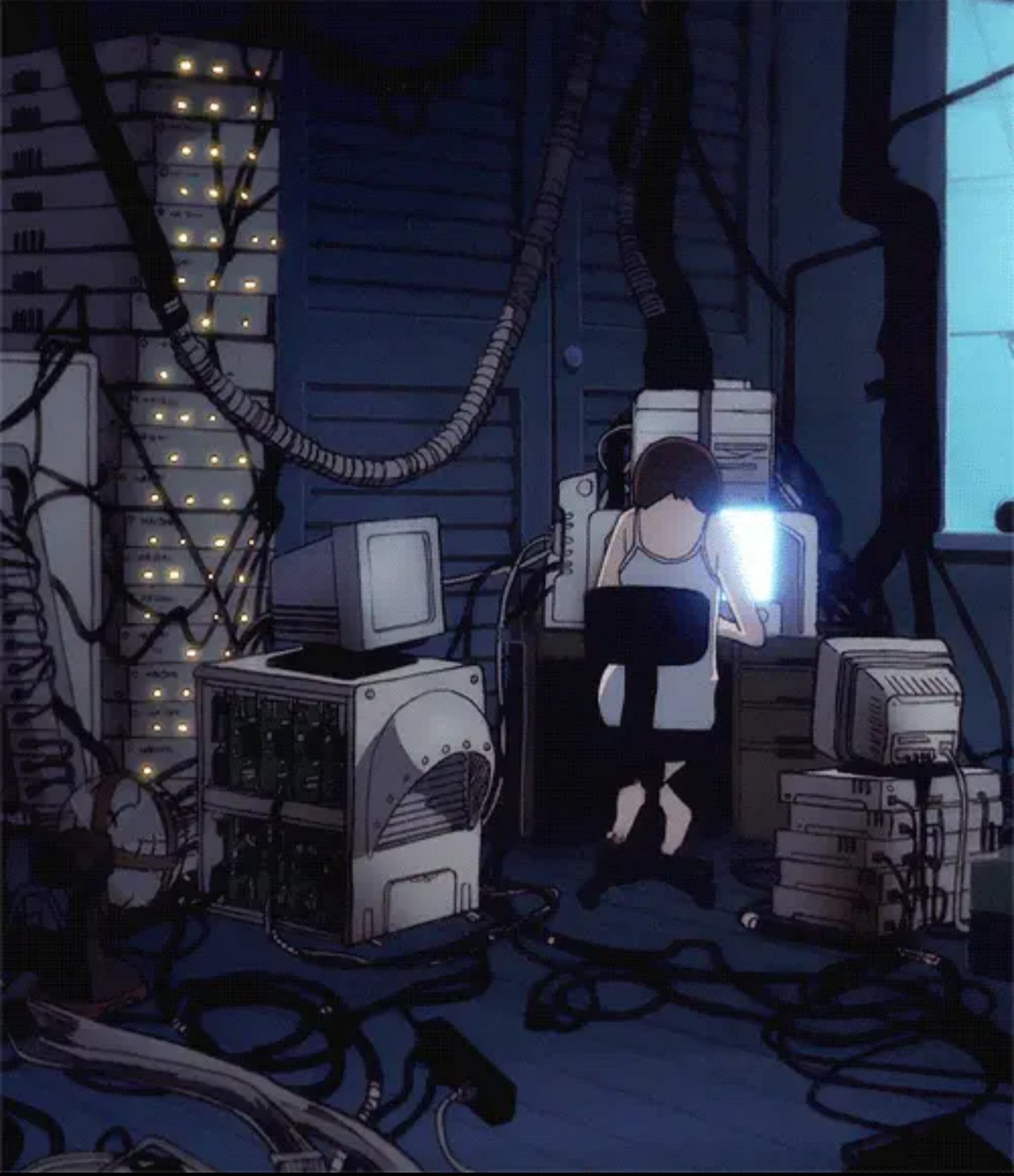
This meme fits the "Papes - Dark" category perfectly because it captures the essence of the "I'm blind but I can still hear it!" joke, but visualized through darkness. The image shows the girl sitting in a room filled with a dark, chaotic array of computer equipment, which would be visually overwhelming to see in real life. However, the screen in front of her is glowing brightly, illuminating her face while the rest of the room remains in shadow. This creates a contrast where the darkness makes it hard to see the environment, yet she is clearly focused on the data. You can see white lettering on the screens and back of the computer towers, adding to the busy, technology-heavy environment.
The text on the monitors and computer towers serves as visual noise, much like the chaos in the room, further emphasizing the difficulty of seeing amidst the digital clutter. This visual metaphor effectively conveys the feeling of being surrounded by information that feels overwhelming to process while in a dark, shadowy space.
simple-description (llama3.2-vision_11b)
The meme appears to be a screenshot from the anime "Paprika" where the main character, Paprika, is shown in a dark room surrounded by computer screens and wires. The text "I'm not a hacker, I'm a Paprika" is likely written above or below the image, implying that Paprika is not a hacker, but rather a person who is somehow connected to the dark and mysterious world of hacking. The meme is likely used to express a sense of being overwhelmed or confused by complex technology, and is often used humorously to describe a situation where someone is struggling to understand or keep up with something.
detailed-analysis (gemma3-27b-vision)
Okay, here's a breakdown of the image using the requested theoretical lenses. Because some of these frameworks don’t directly apply in a strong or necessary way, I’ve indicated that, and I'll adjust the depth of each section accordingly.
Visual Description
The image is a stylized illustration, reminiscent of anime or graphic novel artwork, utilizing a limited color palette of primarily dark blues, blacks, and highlighted with the glow of computer screens. A solitary figure, silhouetted, is depicted sitting before a stack of older computer equipment – monitors, CPU towers, printers, and a tangle of wires and cables covering the floor. The equipment is arranged in a cramped, chaotic space that suggests a basement, storage area, or abandoned office. A window is visible on the right, offering a glimpse of light, but the overall mood is dark, isolating, and claustrophobic. The figure is illuminated by the screen's glow, emphasizing their face and the focused activity of interacting with the technology. The style is somewhat nostalgic, evoking the early days of personal computing. The use of strong lines and limited details contribute to a sense of unease and disconnect.
Foucauldian Genealogical Discourse Analysis
This image lends itself well to a Foucauldian analysis. The overwhelming accumulation of outdated technology represents a discourse of control and surveillance, even in its obsolescence. Consider:
- Panopticism: The figure, while seemingly alone, is immersed in a system that embodies the logic of the Panopticon. Even though there isn’t a literal “guard” watching, the networked and data-driven nature of this technology implies a constant potential for observation, tracking, and control.
- Power/Knowledge: The technology itself embodies the power/knowledge nexus. The computer isn't just a tool, but a vehicle for producing and disseminating knowledge, and therefore, power. The obsolescence of this equipment doesn't negate this power; it just shifts it. The cables and equipment are historical markers of these power dynamics.
- Genealogy of Control: Tracing the "genealogy" of this technology reveals a historical development of systems of control – from early forms of data processing to the ubiquitous surveillance technologies of today. The image captures a transitional moment – a relic of past control mechanisms, but one that informs the present. The figure, engaging with this older technology, is potentially either resisting, perpetuating, or uncovering aspects of this historical trajectory.
Critical Theory
The image can be interpreted through the lens of Critical Theory, particularly focusing on alienation and the technological rationality of modernity.
- Alienation: The figure's isolation within this dense technological landscape speaks to a kind of alienation characteristic of modern life. The technology, intended to connect, ironically creates a sense of disconnection and isolation. They are not with technology, but surrounded by it, trapped in its shadow.
- Instrumental Rationality: The focus on the function of technology, the accumulation of hardware, and the absence of human connection demonstrate the dominance of instrumental rationality – a worldview where everything is judged by its usefulness or efficiency, and where human values are often disregarded. The cluttered space is not designed for human comfort or aesthetic pleasure; it is purely functional.
- The Culture Industry: One can also see echoes of the Culture Industry – the mass production of standardized goods and experiences. The repetition of similar technology pieces suggests a lack of individuality or creativity.
Marxist Conflict Theory
While the image isn't overtly depicting class struggle, a Marxist reading can identify underlying tensions related to labor and ownership.
- Means of Production: The computer equipment represents the “means of production” – the tools used to create value. The accumulation of obsolete technology suggests the cyclical nature of capitalism – the constant drive for innovation and the inevitable discarding of older tools.
- Alienation of Labor: The figure could be seen as a worker alienated from the fruits of their labor, trapped in a cycle of technological obsolescence. They are engaged in maintaining or repurposing old technology, perhaps as a form of resistance or survival, but potentially also as a means of perpetuating the system.
- Digital Divide: Depending on the context, this image could also hint at the digital divide – the gap between those who have access to technology and those who do not. The figure might represent someone struggling to access or maintain technology in a world increasingly dominated by digital innovation.
Postmodernism
The image embodies several characteristics of postmodernism:
- Nostalgia & Pastiche: The retro technology evokes a sense of nostalgia, but it's not a simple longing for the past. It's a re-appropriation of outdated forms, blended with the present. This creates a sense of “pastiche” – an imitation of styles without a clear sense of originality.
- Fragmentation & Deconstruction: The chaotic arrangement of equipment, the tangled wires, and the fragmented space represent a breakdown of traditional order and a rejection of grand narratives. It challenges the idea of a unified, coherent technological landscape.
- Simulation & Hyperreality: The image can be seen as a “simulation” of a technological environment – a representation that obscures the real. The emphasis on the surface of things – the glow of the screens, the texture of the equipment – overshadows any deeper meaning or purpose.
- Blurring of Boundaries: The image could suggest a blurring of boundaries between the physical and virtual worlds, between the past and the present, and between technology and the human subject.
Queer Feminist Intersectional Analysis
This is the lens that applies the least directly, but an analysis is still possible if a specific narrative is applied.
- Tech Bro Culture: The image can be read, metaphorically, as a critique of the “tech bro” culture and its historical exclusion of marginalized groups. The outdated, cluttered space could represent the legacy of a patriarchal system that prioritized certain voices and perspectives.
- Labor of Care & Maintenance: The figure’s engagement with outdated technology could be interpreted as a metaphor for the often-invisible labor of care and maintenance that is disproportionately performed by women and marginalized groups. This labor is essential for keeping systems running but is often undervalued or overlooked.
- Reclaiming & Repurposing: If the figure is actively repairing or repurposing the technology, it can be seen as an act of resistance – a reclaiming of space and resources from a dominant system. This could be interpreted as a metaphor for feminist and queer efforts to reclaim and redefine technology on their own terms.
Let me know if you’d like me to elaborate on any of these points or explore other theoretical frameworks!
simple-description (llama3.2-vision)
The meme is an image of a person sitting in a dark, cluttered room filled with old computers and wires. The text "I can smell the desperation in the air" is overlaid on the image, implying that the person is struggling to cope with their situation. The image is a humorous commentary on the struggles of being a computer enthusiast or gamer.
tesseract-ocr
ee. 2 er ed = ¥. F 4 2 f : o f § * A . i 4 OO Py - a > au “\ — =| > i i — i | rt ~3 (/ : =a 4 o) * = : mo | . rr aaa a ~ f : , , nl 4 *~ | d . a) i in et éf’ > ° i 4 a “a So ~~ “a . —_ : i" Wet ey Z ——_ = a a H 4 jet f “te, ps x hy _ 1 Mn A s Pe ie pr el ~ oS < We