First Seen
2023-05-10T21:03:43+00:00
simple-description (qwen3.5_2b-q8_0)
This image is a stylized cityscape from the popular "Papes in the Dark" meme format. To someone who cannot see it, it looks like a pixelated or embroidered skyline where tall buildings are black blocks lit only by small dots of blue and white light. If you look closely at the blue-lit structure in the upper right, you can see the text "123." This version of the meme humorously depicts a quiet, dark city at night, often accompanied by text like "No light" to suggest that the urban environment is solitary and mostly empty after the usual hours.
simple-description (llama3.2-vision_11b)
The meme appears to be a screenshot of a video game, specifically the game "Papers, Please", which is known for its dark and satirical take on bureaucratic systems. The image likely shows a character's "passport" being rejected, with a message stating "I'm sorry, Dave. I'm afraid I can't let you do that." This is a reference to the 1983 movie "WarGames", where a character says this line to a hacker.
detailed-analysis (gemma3-27b-vision)
Okay, let's break down this image through the lenses of the requested theoretical frameworks. It's a fascinating piece that lends itself to several interpretations.
Visual Description
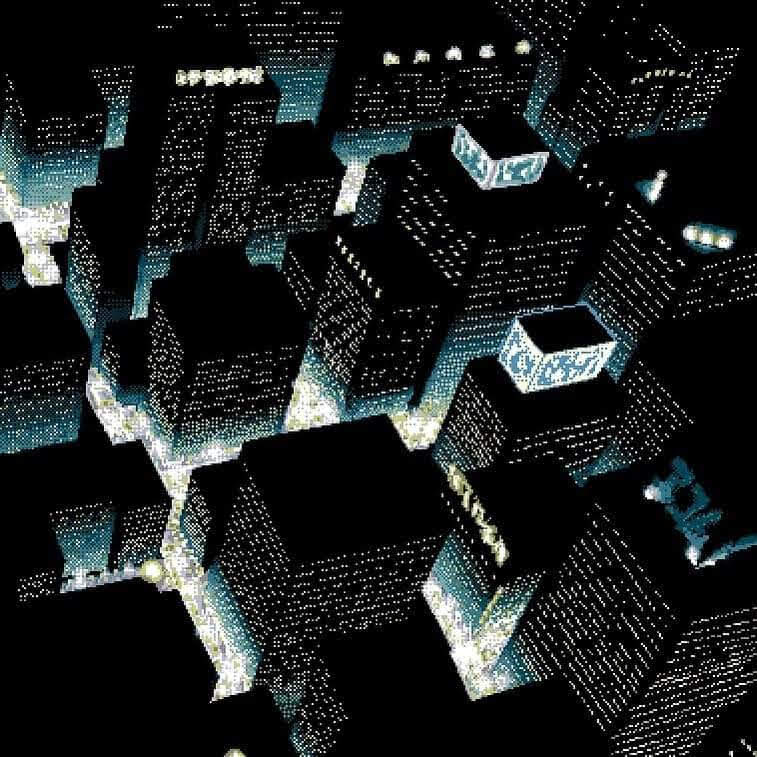
The image presents a highly fragmented and abstract cityscape. It appears to be a digital rendering or a pixelated representation of towering buildings, rendered in shades of teal, white, and black. The perspective is dramatically angled, creating a disorienting and unstable view.
Key features:
- Fragmentation: The structures are not whole, but broken into strips or shards. This contributes to a sense of deconstruction or decay.
- Repetition: There's a strong sense of repetition of lines and angles, evoking the monotony and regimentation of urban architecture.
- High Contrast: The stark contrast between the bright white/teal and deep black exacerbates the sense of unease and highlights the fragmented elements.
- Pixelation: The image is heavily pixelated, giving it a low-resolution, almost glitchy appearance. This could be seen as an intentional stylistic choice or a commentary on the digital nature of modern life.
- Disorientation: The extreme angle and fragmented forms make it difficult to establish a clear sense of space or orientation.
Foucauldian Genealogical Discourse Analysis
This image can be analyzed through Foucault's concept of discourse and genealogy. The cityscape doesn't represent a "neutral" depiction of a city, but a discursive formation. The image “speaks” to the historical power dynamics embedded within urban planning and architecture.
- Power/Knowledge: The rigid, repetitive architecture reveals a power structure. The buildings aren't designed for organic human experience, but for control and efficiency. The repetitive lines suggest a disciplinary architecture, reminiscent of Bentham’s panopticon, enforcing norms and regulating behavior.
- Genealogical tracing: By "digging" into the history of urban planning, we can see how concepts of order, control, and visibility have shaped the built environment. This image can be seen as a trace of those historical power relationships.
- Disciplinary Spaces: The fragmentation and instability could represent the breakdown of these disciplinary structures, or the anxieties generated by them.
Critical Theory
From a Critical Theory perspective, this image is a critique of the alienation inherent in modern urban life and the rationalization of society.
- Alienation: The fragmented structures and lack of human scale reflect the alienation of individuals within the modern city. The cityscape is dehumanizing, a product of instrumental rationality rather than human needs.
- Commodification: The buildings can be viewed as commodities, mere objects in a capitalist system. Their purpose is not to house and nurture people but to generate profit.
- Loss of Authenticity: The image can be interpreted as a commentary on the loss of authenticity in a mass-produced, artificial environment.
Marxist Conflict Theory
From a Marxist viewpoint, the image represents the inherent conflicts within capitalist society.
- Class Struggle: The towering, impersonal structures symbolize the dominance of the ruling class and the subjugation of the working class. The buildings are monuments to wealth and power, while the human element is obscured.
- Reification: The structures are "reified," meaning they have taken on a life of their own, separate from the human beings who created them. This symbolizes the alienation of labor and the dominance of capital.
- Control and Surveillance: The rigid lines and structures suggest a system of control and surveillance, reflecting the power dynamics of a capitalist society.
Postmodernism
This image strongly aligns with postmodern aesthetics.
- Fragmentation and Deconstruction: The fragmentation of the buildings is a key characteristic of postmodernism, representing the breakdown of grand narratives and fixed meanings. The image resists a single, coherent interpretation.
- Simulacra and Simulation: The pixelated, artificial appearance suggests a world of simulacra, where copies have become more real than the original. The city is not a genuine place but a constructed representation.
- Loss of Meaning: The image challenges the idea of a fixed, stable meaning. It invites multiple interpretations and celebrates ambiguity.
Queer Feminist Intersectional Analysis
While not immediately obvious, this image can be approached through a queer feminist intersectional lens, though it requires more interpretive work.
- Disrupting Heteronormative Space: The fragmented, disorienting nature of the cityscape can be seen as a disruption of the traditionally ordered, masculine space of the city. The image challenges the idea of the city as a stable, predictable environment, opening up possibilities for alternative ways of being and inhabiting space.
- Invisible Bodies: The lack of human presence can also be interpreted as a reflection of the ways in which marginalized bodies (queer, feminist, people of color) are often rendered invisible or excluded from urban space.
- Power Dynamics & Spatial Exclusion: The stark architecture can mirror power structures that exclude or marginalize certain groups. Intersectional analysis focuses on how various forms of oppression intersect and reinforce one another, and this image can be seen as a visual representation of those complex dynamics.
Let me know if you'd like me to elaborate on any of these points or explore other theoretical frameworks!
simple-description (llama3.2-vision)
The meme is an image of a dark, empty cityscape with a single, tiny figure in the distance. The figure is a small, pixelated character, and the text "I'm not arguing, I'm just explaining why I'm right" appears in a small, white font at the top of the image.
tesseract-ocr
“EAST gma ew ere s i vite ei fo Dig t Sage cca Me ne ee mee Po en ee Bei Y ame & a Sent Re em a Bay oon ce PE SO a lle ore ee abe ae eae ee ae. Pun a ade RNS eet og Se Se OM Tk mL 4 DES g emmy “SR ner Res 4 S Bes Sem eter eee Sanat Ma oa pene en oo as ae er ee my ca Mean, eee fe can ok nee nT A oot seus eprereaceen SO ee OR a ety Reena I pe ea gee” ty paramere? (meee ‘ a og SCRE oo er om a bg 7 FRR ESR? COMICS OREO Le he Soe. = re UR - Sones | 7. ili teil SSS a mporiicens aoe ENO eee ae SONS I eo Brean se . ae PASC Eur ceesioht eg Een We eee oe cet a ee