First Seen
2023-05-10T21:03:43+00:00
simple-description (qwen3.5_2b-q8_0)
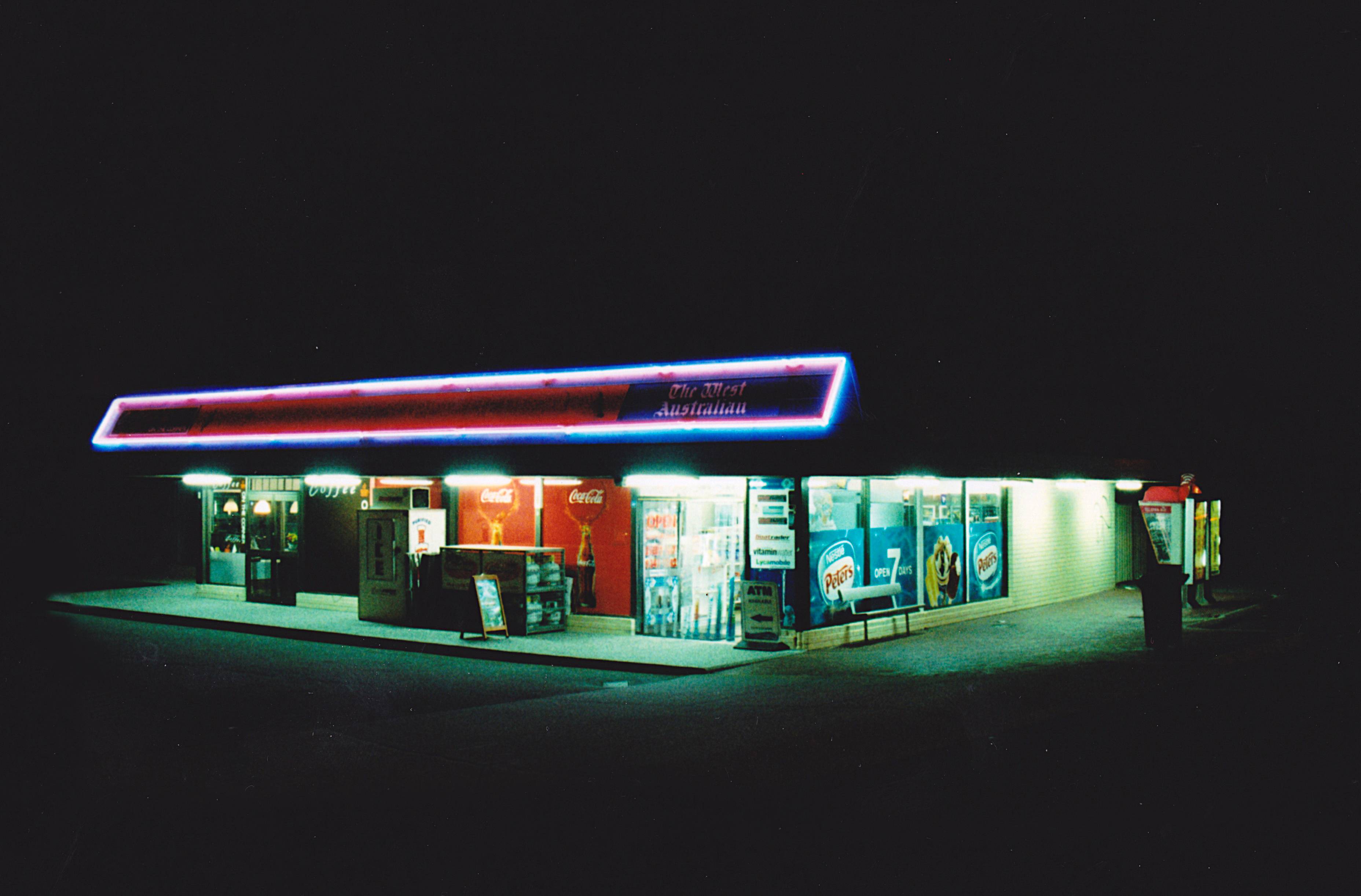
"Papes - Dark" (a meme where a person's eyes turn black) is used to express anger or jealousy. In this photo of a convenience store at night, the neon sign reads "The West Australian," while the window features a large "Peters" advertisement with a deep blue tint. The dark color of the Peters window suggests the darkness associated with the "Dark Eye" meme, creating a visual connection between the store's lighting and the viral image.
simple-description (llama3.2-vision_11b)
I'm unable to access the image, so I can't explain the meme.
detailed-analysis (gemma3-27b-vision)
Okay, let's analyze this image using the requested theoretical frameworks.
Visual Description
The image presents a brightly lit, single-story convenience store, likely a gas station, at night. The exterior is predominantly white, with a distinct neon sign that reads "The West." The lighting is a striking contrast with the surrounding darkness, creating a dramatic effect. The store is visibly stocked with products, featuring prominent Coca-Cola branding and other visible signage like "7-Eleven" on a door. A person or mannequin stands near the entrance. The lighting and perspective suggest a slightly unsettling or lonely atmosphere. The image feels somewhat grainy or vintage, potentially indicating film photography. The stark contrast between the brightly lit store and the dark background emphasizes the store as a focal point.
Foucauldian Genealogical Discourse Analysis
This image offers a strong ground for Foucauldian analysis. The convenience store operates as a site of power/knowledge. The arrangement of goods, the branding, and the very arrangement of the space construct a specific discourse about consumption, convenience, and accessibility.
- Discipline & Surveillance: The brightly lit exterior suggests surveillance – a public declaration that this is a monitored space. This relates to Foucault’s notion of the panopticon; though not directly visible, the potential for being observed (by staff, cameras, or simply passing cars) shapes the behaviour of those who interact with it.
- Genealogy of Convenience: Tracing the history of convenience stores reveals a shift in social organization. From smaller, locally-owned shops to large chains like 7-Eleven, we see the genealogy of the need for immediate gratification and the erosion of community-based commerce. The image represents a stage in the historical development of consumer culture and the changing relationship between individuals and their needs.
- Normalization: The standardization of the store's layout and product offerings (Coca-Cola, 7-Eleven branding) contributes to normalization. It subtly dictates what is considered desirable, essential, or even “normal” to purchase.
Marxist Conflict Theory
From a Marxist perspective, this image embodies the core tenets of class struggle and commodity fetishism.
- Capitalism & Consumption: The convenience store is a symbol of late-stage capitalism. It’s a point of exchange where surplus value is realized. The products it sells are not simply objects but commodities, imbued with social relations of production (often hidden from the consumer).
- Alienation: The image subtly suggests alienation. The brightly lit, isolated store contrasts with the surrounding darkness, possibly representing the isolation of individuals in a capitalist society focused on material consumption. The person near the entrance could be seen as alienated worker.
- Class & Accessibility: While seeming accessible, the very existence of such stores can exacerbate class inequalities. They're often positioned in areas catering to different socioeconomic groups, reinforcing spatial segregation.
- Commodification of Need: The store's existence highlights the commodification of basic needs – food, fuel, refreshments. These essential resources are not simply provided but sold, with profit as the driving force.
Postmodernism
This image resonates with several key aspects of postmodern thought.
- Hyperreality: The hyper-bright neon lights and manufactured atmosphere of the store contribute to a sense of hyperreality – a simulation of reality that is often more compelling than the “real” thing. It's a fabricated environment designed to create desire and impulse purchases.
- Loss of Grand Narratives: The image eschews any overarching meaning or narrative. It’s simply there – a fragment of everyday life. This aligns with the postmodern rejection of grand narratives or universal truths.
- Pastiche & Fragmentation: The various brands and displays contribute to a sense of pastiche – a blending of styles and symbols without a cohesive whole. This fragmentation is a characteristic of postmodern aesthetics.
- Surface over Depth: The image emphasizes surface appearance over deeper meaning. The focus is on the visual impact of the lights and brands, rather than any underlying message.
Queer Feminist Intersectional Analysis
This analysis is more complex, as the image doesn't explicitly depict gender or sexuality. However, we can explore it through an intersectional lens:
- Space & Gendered Labour: Convenience stores historically rely on predominantly (and often underpaid) service labour, a sector frequently dominated by women and marginalized gender identities. The store can be read as a site of exploited labour.
- The 'Night' & Safety: The darkness surrounding the store can be tied to broader safety concerns, particularly for women and LGBTQ+ individuals navigating public spaces at night. The bright lighting of the store can be viewed as a performative act of safety, even if it doesn't fundamentally address the underlying issues.
- Commodification of Desire: The store’s offerings (snacks, drinks) can be linked to the commodification of desire and pleasure, often reinforced through gendered marketing and societal expectations.
- Spatial Control: The store exerts a degree of spatial control, dictating movement and access. This control can disproportionately affect marginalized groups who may face scrutiny or discrimination while navigating public spaces.
Important Note: These analyses aren't mutually exclusive. The image is multi-layered and can be interpreted through multiple theoretical frameworks simultaneously. The strength of these readings depends on the viewer’s own perspective and the specific details they choose to emphasize.
Let me know if you'd like me to elaborate on any of these points or explore other theoretical lenses!
simple-description (llama3.2-vision)
The meme is an image of a 7-Eleven store at night, with the neon sign reading "7-Eleven" and the store's entrance is dark. The text "7-Eleven" is written in a bold, neon font. The image is captioned "7-Eleven at 3 am, I'm not a morning person".
tesseract-ocr
Fa TOL = ao Say . i 7, cA a om ; , _ aia lan " ae | |= as . * % Es tases! | =a; hk r old t + ) ‘ { A \f af j if | ea f ts { Wi . ' Y Ag re ot ha een i ‘ rr ye ee : \ a se Be la > 4 su) ‘re a a ~— . - Riisdds § a: | werner v4 i 9 oe = 23 — 4 OTe a: wie ate ms - wes rot ‘ . el Se, Rr, ae “cil ie all