First Seen
2023-05-10T21:03:43+00:00
simple-description (qwen3.5_2b-q8_0)
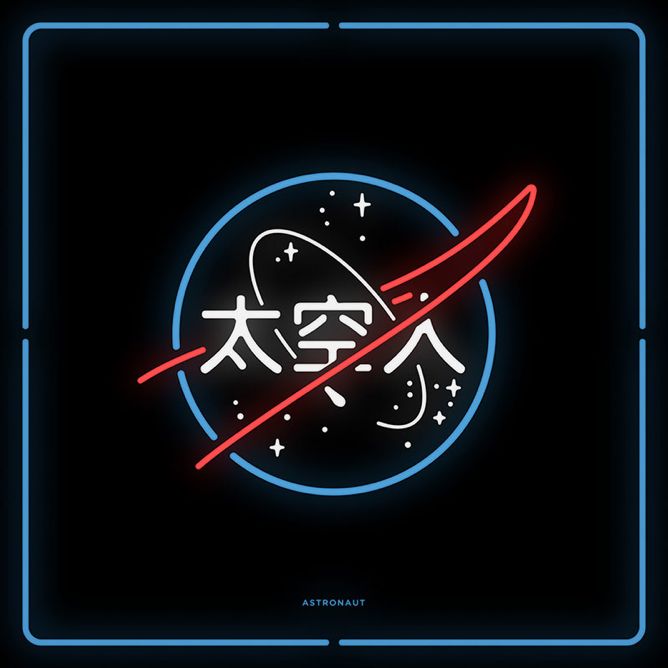
This is a stylized neon sign design featuring the Chinese characters "太空人" (which translates to "Astronaut") and the English word "ASTRONAUT" at the bottom. The logo is depicted with a bright blue glowing circle and a red slash cutting across it, set against a dark background to give it a sci-fi, nighttime aesthetic.
simple-description (llama3.2-vision_11b)
The meme is a picture of a cat with a caption "Papes - Dark". The image is likely a reference to a popular internet meme or a joke about cats being associated with darkness or being "dark" in some way.
detailed-analysis (gemma3-27b-vision)
Okay, let's break down this image through the lenses you've requested. It's a fascinating piece that lends itself to several theoretical frameworks.
1. Visual Description
The image is a striking graphic design piece. It is a circular logo mimicking the NASA (National Aeronautics and Space Administration) logo, but with key modifications. The background is deep black. Within a bright blue circular border, there are scattered white sparkles reminiscent of stars. The NASA logo's typical wording ("National Aeronautics and Space Administration") is replaced by Chinese characters, potentially meaning "Astronaut". A bright, neon-red line cuts diagonally across the circle, partially obscuring the Chinese text, and forming a dynamic, slightly disruptive element. Below the circle, in simple white lettering, is the English word "ASTRONAUT". The entire graphic is surrounded by a bright blue square border. The overall aesthetic is modern, neon-infused, and feels like a mashup of space exploration, graphic design, and Eastern culture.
2. Foucauldian Genealogical Discourse Analysis
This image is ripe for a Foucauldian analysis. Foucault's genealogy focuses on the history of ideas and their relationship to power. Here's how it applies:
- Discourse of Space Exploration: The NASA logo is itself a discourse – a system of thought, language, and practice – that establishes authority and narrative around space exploration. It carries the history of American scientific progress, Cold War competition, and national pride. By appropriating this logo, the artist disrupts its established meaning.
- Orientalism & Representation: The replacement of English text with Chinese characters immediately introduces a discourse of "otherness." Historically, Western discourse has often constructed the "Orient" (a broad, often inaccurate term) as exotic, mysterious, and often in need of "civilizing." Even the use of Chinese characters, in a context dominated by Western space exploration, can be read as a form of exoticization.
- Power/Knowledge: The red line, aggressively crossing the text, can be interpreted as a disruption of this discourse. It’s a gesture of resistance – a visual “no” to the traditional narrative. It implies a challenge to the power structures embedded in the NASA logo, the scientific establishment, and the historical representation of space exploration. It's an assertion of another perspective, a different "knowledge" system.
- Genealogical Trace: Tracing the genealogy of the NASA logo, we find its roots in military design, Cold War anxieties, and a specific American vision of the future. This image doesn't erase that history, but it re-writes it by layering in a non-Western perspective.
3. Critical Theory
From a Critical Theory perspective (drawing on thinkers like Adorno and Horkheimer), this image can be read as a commentary on the cultural industry and the commodification of ideas.
- Reification: The NASA logo has become a symbol disconnected from its original context, easily reproduced on merchandise and popular culture. This image takes that reified symbol and further layers it with new meanings.
- Culture Industry: The design itself, with its neon aesthetic, is indicative of the commodified nature of visual culture. It's an easily marketable design that borrows from existing cultural symbols.
- Critique of Modernity: The juxtaposition of the futuristic NASA logo with the ancient writing system can be seen as a critique of modernity’s claims to universality and progress. It suggests that progress isn't linear or unidirectional, and that non-Western cultures have their own histories and perspectives to offer.
4. Marxist Conflict Theory
From a Marxist perspective, the image can be seen as a reflection of the power dynamics at play in scientific and technological development.
- Hegemony: The NASA logo represents American cultural and technological hegemony. The artist's substitution of English with Chinese characters is a challenge to this dominance, proposing alternative knowledge systems.
- Ideology: The NASA logo embodies a particular ideology – a belief in progress through technology and a specific vision of the future. The artist is subverting that ideology by introducing a different worldview.
- Class & Access: Historically, space exploration has been dominated by powerful nations and elite groups. By incorporating a non-Western element, the image hints at the exclusion of other cultures from this realm.
5. Postmodernism
This image embodies many key tenets of Postmodernism:
- Intertextuality: The image is deeply intertextual – it borrows from, and references, the NASA logo, Chinese calligraphy, and neon design aesthetics.
- Pastiche: It's a pastiche – a stylistic blend of different elements, creating a new, hybrid form.
- Deconstruction: The artist is "deconstructing" the original meaning of the NASA logo by disrupting its visual and textual elements.
- Rejection of Grand Narratives: It challenges the idea that there's one universal path to progress or a single dominant narrative of space exploration.
- Simulacra & Simulation: The image can be seen as a "simulacrum" – a copy without an original – suggesting that our understanding of reality is increasingly mediated by signs and symbols.
6. Queer Feminist Intersectional Analysis
This lens is more subtle but possible.
- Challenging Dominant Narratives: Like the other lenses, this piece disrupts the traditionally masculine, Western-centric narrative of space exploration.
- Intersectionality: The juxtaposition of Western and Eastern symbolism suggests a broader questioning of power dynamics and the exclusion of marginalized voices. It’s a visual “what if?” that opens up space for other perspectives.
- Hybridity & Fluidity: The blending of design elements embodies the idea of hybridity – a rejection of rigid categories and a celebration of fluidity. This can be seen as a metaphor for challenging gender norms and embracing diverse identities.
- Reclaiming Space: Historically, STEM fields (including space exploration) have been dominated by men. The act of “re-writing” the NASA logo with a non-Western symbol can be seen as a metaphorical reclaiming of space for marginalized communities.
In conclusion, this is a rich and complex image that invites multiple interpretations. It’s not simply a visually appealing design; it's a statement that challenges established power structures, questions dominant narratives, and opens up space for alternative perspectives. The theoretical frameworks above provide a starting point for understanding the layers of meaning embedded within this striking graphic.
simple-description (llama3.2-vision)
The meme is a image of a simple, hand-drawn picture of a face with a neutral expression. The text "In space, no one can hear you scream" appears below the face. The image is a humorous take on the classic horror movie "Alien" and is likely referencing the idea that in space, there is no sound to carry screams, making it a clever and darkly comedic meme.
tesseract-ocr
hea