First Seen
2023-05-10T21:03:43+00:00
simple-description (qwen3.5_2b-q8_0)
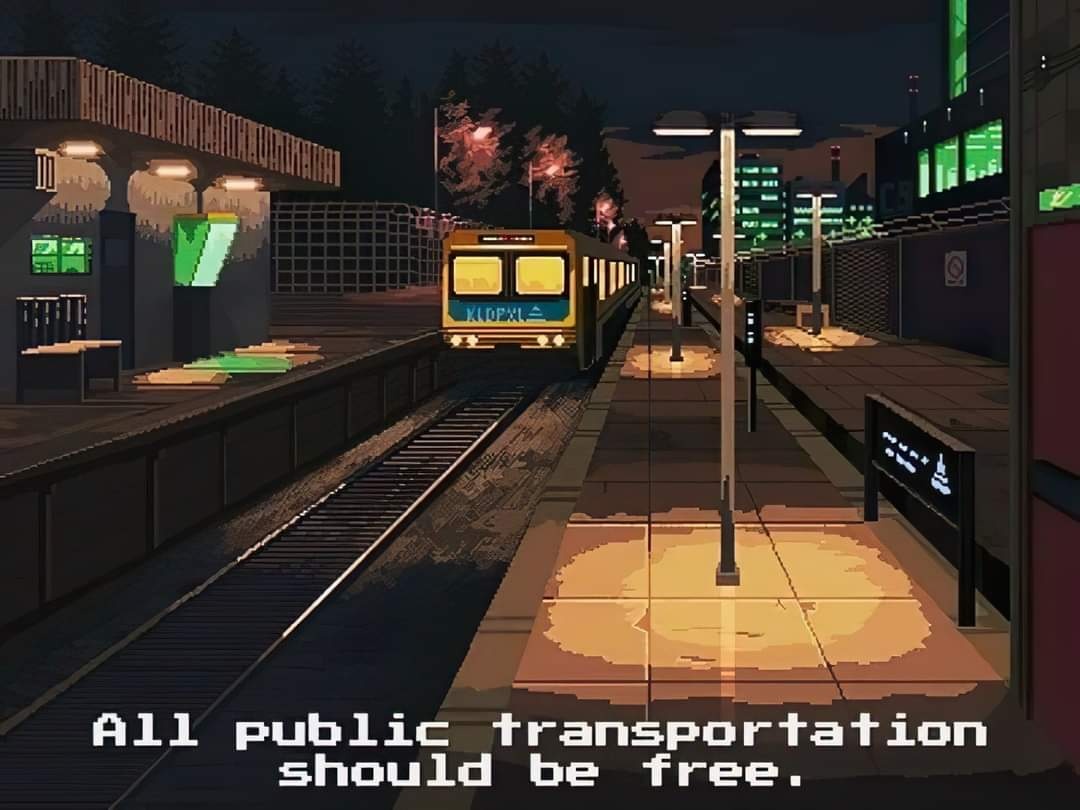
This image features a dark, atmospheric train station at night, with a yellow train approaching empty platforms lit by warm streetlights. The text at the bottom reads "All public transportation should be free," a sarcastic meme statement often associated with the "Dark" humor subculture. This quote is used to satirize the inefficiency and absurdity of public transit systems, implying that the chaos of commuting should be free for everyone.
simple-description (llama3.2-vision_11b)
The meme is a screenshot from the video game "Papers, Please," where the main character, a border control officer, is asked to deny a man's request to enter the country. The text "ALL PAPERS MUST BE IN ORDER. ALL PAPERS MUST BE IN ORDER. ALL PAPERS MUST BE IN ORDER." is displayed on the screen, with the man's papers being rejected. The meme is a humorous take on the game's strict and bureaucratic nature, with the repetition of the phrase "ALL PAPERS MUST BE IN ORDER" becoming a darkly comedic commentary on the absurdity of the game's world.
detailed-analysis (gemma3-27b-vision)
Okay, let's break down this image using the theoretical frameworks you've requested. Given the image's focus on public transportation and the text overlay, certain frameworks will be more relevant than others.
Visual Description
The image presents a low-resolution, pixelated rendering of a train platform at night. The scene is dimly lit by artificial lights casting long shadows. A yellow train is approaching/present on the tracks. The platform itself is tiled, suggesting a public space designed for functional movement. There are benches and some basic signage. The background is dominated by a high, imposing wall/structure, likely part of the train infrastructure, and hints of buildings in the distance. The color palette is muted, consisting primarily of blacks, grays, and yellows. The aesthetic evokes a retro video game or early 3D rendering style. The image feels somewhat isolating and impersonal, despite being a place designed for connection. The text "All public transportation should be free" is digitally overlaid at the bottom of the image in a stark, blocky font.
Foucauldian Genealogical Discourse Analysis
This image can be interpreted through a Foucauldian lens by examining the discourse surrounding public transportation. The image performs a statement – the call for free public transportation.
- Power/Knowledge: Public transportation is not simply a logistical system. It's deeply intertwined with power dynamics. The very need for public transportation is often a result of power imbalances, limiting access to resources and employment for certain groups. The act of paying for access reinforces this power structure. The image's text is a direct challenge to this established power/knowledge system. It attempts to disrupt the accepted "truth" that access to mobility is a commodity.
- Discipline & Normalization: The structure of paid public transportation can be seen as a form of discipline. It regulates movement, imposes costs, and excludes those who cannot afford it. This normalizes a system where mobility is not a universal right, but a privilege.
- Genealogy: A genealogical investigation into the history of public transport reveals how pricing structures were established, and who benefitted. Examining the historical justifications for fares – the rationale that user fees contribute to the sustainability of the system – and the impact of those structures on vulnerable populations is essential.
- Statement/Enunciation: The statement "All public transportation should be free" is a significant one, as it is an attempt to reconfigure the discourse around this crucial part of modern society.
Critical Theory
This image lends itself strongly to a Critical Theory analysis.
- Ideology: The image challenges the dominant ideology that equates access to mobility with a market transaction. It reveals how our perceptions of public transportation are shaped by capitalist values—that everything has a price, including basic needs like getting to work or school.
- Emancipation: The text advocates for a form of emancipation – freeing people from the financial constraints that limit their access to opportunities. It suggests a vision of a society where mobility is a right, not a privilege.
- Hegemony: The current system of paid public transport represents a form of cultural hegemony. It is presented as 'natural' and 'necessary', but it serves to maintain existing power structures. The image attempts to disrupt this hegemony by presenting an alternative vision.
- Alienation: The impersonal, somewhat bleak atmosphere of the image could be interpreted as symbolic of the alienation that often accompanies life in a capitalist society. Even in a space designed for connection, there's a sense of isolation.
Marxist Conflict Theory
From a Marxist perspective, the image embodies a clear class conflict.
- Means of Production & Access: The train and the infrastructure represent the "means of transportation," which are controlled by capital (whether public or private). The need to pay for access to these means perpetuates class inequality.
- Exploitation: The lack of free transportation can be seen as a form of exploitation. Workers, for example, are compelled to pay for transportation to get to their jobs, effectively reducing their wages.
- Proletariat & Bourgeoisie: The image implicitly positions those advocating for free transportation as allies of the proletariat (the working class), fighting against a system that benefits the bourgeoisie (those who own and control the means of transportation).
- Revolution: The call for free transportation can be interpreted as a small-scale revolutionary demand—a step towards a more equitable distribution of resources and a challenge to the capitalist system.
Postmodernism
A postmodern interpretation might focus on the image’s fragmented and mediated nature.
- Simulacra & Simulation: The pixelated, retro aesthetic of the image is a kind of simulacrum – a copy of a copy. It isn't a "real" representation of a train platform, but a digital construction that references reality.
- Deconstruction of Meaning: Postmodernism questions the idea of fixed meanings. The image's simplicity and the directness of the text invite multiple interpretations.
- Challenge to Grand Narratives: The image can be seen as a rejection of the "grand narrative" of economic progress, which often justifies inequality. It proposes a different vision—one where social needs are prioritized over profit.
Queer Feminist Intersectional Analysis
While not immediately obvious, a queer feminist intersectional analysis can be applied:
- Accessibility & Disadvantage: Considering who is most impacted by the cost of transportation reveals intersectional vulnerabilities. Women, people of color, disabled individuals, LGBTQ+ people, and those living in poverty are disproportionately affected by transportation costs, limiting their access to employment, healthcare, and social services.
- Gendered Labor & Mobility: The image prompts questions about the gendered nature of both transportation labor and the need for mobility. Who performs the work to maintain the transportation system? Who relies most on public transport for caregiving responsibilities?
- Spatial Justice: The image can be linked to issues of spatial justice—the idea that everyone has the right to access resources and opportunities regardless of their location. Free transportation is a step towards creating a more equitable spatial environment.
- Disrupting Norms: The call for free transportation challenges the capitalist norm of commodifying essential services, potentially creating a more inclusive and empowering environment for marginalized groups.
I hope this detailed breakdown is helpful! Let me know if you'd like me to focus on any particular theory in more depth.
simple-description (llama3.2-vision)
The meme is a screenshot from the video game "Papers, Please" where a character's line of dialogue is displayed on the screen. The text reads: "All public transportation should be free." The image is likely a satirical commentary on the idea that public transportation should be a free service, rather than a paid one.
tesseract-ocr
TT ‘ A ae md Tote aie nu Make : cigs A, . | Cy - Me “Fae bis P All public. transportation Should be free.