First Seen
2023-05-10T21:03:43+00:00
simple-description (qwen3.5_2b-q8_0)
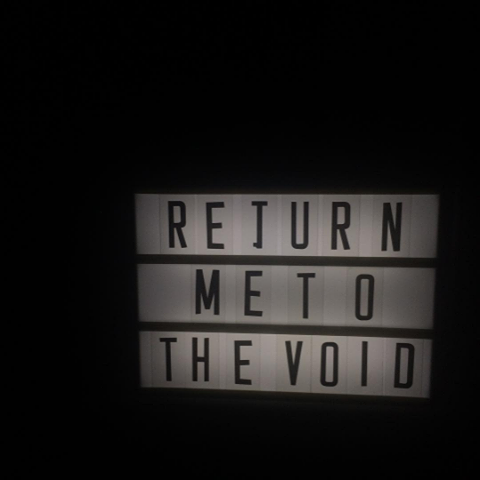
This image displays a lightbox with the text RETURN METO THE VOID.
This meme refers to the chaotic indie game Papes & Papillon (often tagged as "Papes"). The "meme" logic is ironic because in the game, players are literally tasked with "returning" a character to the Void to save them, which creates a humorous contradiction because the phrase usually implies letting them die.
simple-description (llama3.2-vision_11b)
The meme appears to be a screenshot of a video game or a computer interface, with a dark and ominous background. The text "RETURN TO PAPES" is displayed prominently, with the word "PAPES" highlighted in a bold, red font. The meme is likely a reference to the video game "Papers, Please", a game where the player takes on the role of a border control officer in a fictional communist state, and the "RETURN TO PAPES" text is a nod to the game's satirical take on the communist regime's propaganda efforts.
detailed-analysis (gemma3-27b-vision)
Here's an analysis of the image, broken down into the requested sections. Given the image’s strong philosophical suggestion, some of these analyses will be more prominent than others.
Visual Description
The image is a stark, high-contrast photograph featuring three illuminated rectangular panels displaying the phrase "RETURN TO THE VOID" in capital letters. The text appears to be rendered in a stark, blocky font. The panels are embedded in deep shadow, and only the illuminated text and a small halo around each panel are visible. The overall effect is dramatic and somewhat unsettling. The background is completely black, emphasizing the sense of emptiness and the void referenced in the text. The framing is tight, drawing attention specifically to the message.
Postmodernism
The image and its message strongly resonate with key tenets of postmodern thought. The phrase "Return to the Void" suggests a rejection of grand narratives, meaning, and stable truths. Postmodernism emphasizes the deconstruction of established systems of thought and a celebration of fragmentation and uncertainty.
- Loss of Meaning: The "Void" implies a lack of inherent meaning. In postmodernism, meaning is not fixed, but rather constructed through language and social context.
- Rejection of Metanarratives: The imperative to "Return" suggests a deliberate disengagement from overarching narratives (religious, political, scientific) that attempt to explain existence.
- Simulacra and Simulation: The illuminated panels themselves could be interpreted as simulacra – copies without originals – mirroring the postmodern fascination with the blurring of reality and representation. The message is a representation of a state (the Void) that is itself unrepresentable.
- Emphasis on Absence: The prominence of black/shadow and the “void” itself underscores a focus on what isn’t there, what’s lacking, a hallmark of much postmodern art and thought.
Critical Theory
The image evokes a sense of alienation and a critique of the structures that define individual identity.
- Alienation: The “Void” can be seen as a metaphor for the experience of modern alienation, a sense of disconnection from oneself, society, and meaningful purpose. This ties into themes of the loss of authenticity in a mass society.
- Power Structures & Control: While subtle, the image can suggest a critique of systems that attempt to fill the “void” with ideologies, consumerism, or false promises. The return to the void can be read as a rejection of these controlling forces.
- Critique of Enlightenment Reason: The image may hint at a rejection of Enlightenment ideals of progress and rationalism. The "void" suggests a space beyond reason, a return to something primal or pre-rational.
Foucauldian Genealogical Discourse Analysis
Applying a Foucauldian lens reveals how the concept of the "Void" has been historically constructed through discourse.
- Genealogy of "The Void": Tracing the historical usage of "Void" reveals its associations with ideas like nothingness, emptiness, and even religious/philosophical concepts like sunyata (Buddhist emptiness). Foucault would be interested in how the concept of the Void has been defined, categorized, and used in various power structures.
- Power/Knowledge: The image can be seen as challenging dominant discourses about meaning and purpose. By advocating a "Return" to the Void, it disrupts the accepted frameworks through which we understand existence. The message doesn’t create the void, but draws attention to its already existing potential as a way to subvert expectations.
- Disrupting Norms: The imperative "Return" suggests an act of resistance. It challenges the "normal" expectation that we should constantly strive to fill the emptiness of our lives with something.
Marxist Conflict Theory
This connection is the weakest, but possible.
- Alienation from Labor: The “Void” could metaphorically represent the alienation of the worker from the products of their labor under capitalism. The feeling of emptiness and meaninglessness that can result from repetitive, dehumanizing work.
- Rejection of Consumerism: “Returning to the Void” can be interpreted as a rejection of consumer culture's attempt to fill emotional and existential voids with material possessions.
Queer Feminist Intersectional Analysis
This analysis would focus on how the "Void" can be a space of liberation or a site of further marginalization, particularly for those who exist outside normative categories.
- Rejection of Normative Identity: For queer and gender non-conforming individuals, the “Void” can represent a liberation from the constraints of binary gender and heteronormative expectations. It’s a space beyond categorization, a rejection of being defined by dominant societal structures.
- Intersectionality and the Void: The experience of the "Void" is not universal. For marginalized individuals, the "Void" can be a product of systemic oppression and exclusion. However, reclaiming the "Void" can be an act of resistance and a way to forge new forms of identity and community.
- Deconstruction of Meaning: Queer theory emphasizes the instability of meaning and the constructed nature of identity. The "Void" can be seen as an affirmation of this fluidity and a rejection of fixed categories.
Overall
The image is rich in symbolic meaning and invites multiple interpretations. It’s a powerful statement about alienation, meaning, and the search for authenticity. The strongest readings lean towards postmodernism, critical theory, and Foucauldian analysis. The image seems to be a philosophical provocation that challenges viewers to question the foundations of their beliefs and consider the possibility of embracing emptiness as a path to freedom.
simple-description (llama3.2-vision)
The meme is an image of a "Dead" button from a old-style movie theater, but with the word "Dead" changed to "Return".
tesseract-ocr
RETURN MET O iT)