First Seen
2023-05-10T21:03:43+00:00
simple-description (qwen3.5_2b-q8_0)
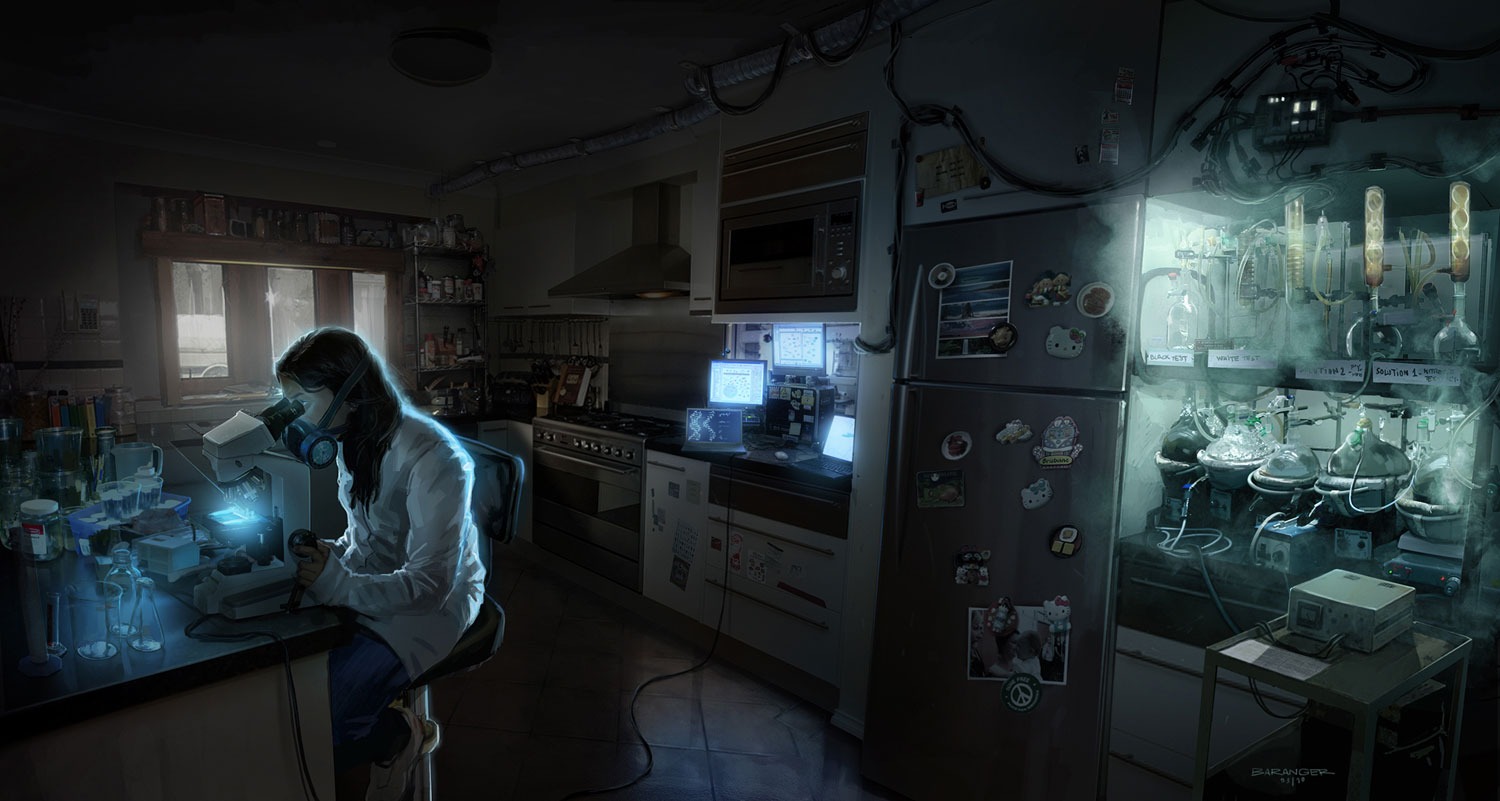
The 'Papes - Dark' meme plays on the contrast between reality and expectation. It presents a gloomy, low-light laboratory scene that tricks the viewer into thinking the entire picture is pitch black or impossibly dark. This visual trick is enhanced by the text "BARANGER" visible in the bottom right, which serves as the artist's watermark and confirms the image's source context.
simple-description (llama3.2-vision_11b)
The meme is an image of a woman in a dark lab setting, surrounded by various scientific equipment and papers. The image is captioned "Papes - Dark" and features a woman in a lab coat, looking at a microscope with a serious expression. The image is meant to be humorous, implying that the woman is so focused on her work that she's forgotten about the world outside the lab.
detailed-analysis (gemma3-27b-vision)
Okay, here's an analysis of the image, broken down into sections addressing the requested theoretical frameworks. I'll assess if each framework is applicable before diving into the analysis for that section. I'll prioritize the most relevant approaches given the visual content.
Please note: These are interpretations based on a single image. A more thorough analysis would require more context (the artist, the original source of the image, etc.).
1. Visual Description
The image depicts a dimly lit, cluttered kitchen space that has been transformed into a makeshift laboratory. The lighting is a cool blue, emanating from computer screens, glowing vials, and what appears to be a refrigerated cabinet. The central figure is a person wearing a respirator, their back to the viewer, bent over a workbench cluttered with laboratory equipment (beakers, test tubes, flasks, etc.). The kitchen elements (cabinets, a stove, a sink) are visible but obscured by the scientific equipment and a general sense of disarray.
A prominent feature is a large, illuminated refrigerator or cabinet filled with preserved animal specimens (brains, eyes, and other organs). The refrigerator is covered in photographs, stickers and drawings - seemingly personal in nature. The space appears worn, aged and abandoned. There is a clear juxtaposition of the domestic (kitchen) and the scientific/macabre.
The overall mood is unsettling, hinting at a secretive and potentially disturbing operation being conducted within the confines of a normal home. The style leans towards a digital painting or illustration with a strong emphasis on atmospheric lighting and texture.
2. Foucauldian Genealogical Discourse Analysis
Applicable: Yes, strongly. The image powerfully evokes themes of power, knowledge, and surveillance that are central to Foucault's work.
This image can be read through the lens of Foucault’s concept of biopower – the way modern states regulate life and populations through control over bodies and biology. The makeshift laboratory in the domestic sphere suggests a decentralization of this power, a “grassroots” bio-experimentation outside of official institutions.
The respirator-wearing figure represents a subject caught within a network of power/knowledge. The need for the respirator implies a hazardous environment, and the laboratory setup suggests an attempt to know and control biological processes – but at a potential cost.
A genealogical approach allows us to trace the historical emergence of these practices. The combination of domesticity (kitchen) and scientific rigor suggests a disruption of established categories. We might ask: What social conditions led to this blending of the private and the scientific? What anxieties or desires are being expressed through this unconventional research?
The refrigerator filled with specimens becomes a discursive formation – a way of organizing knowledge about the body and its parts. The personal touches (photos, stickers) on the refrigerator complicate this, suggesting a subjective relationship to the objective data within. It’s as though the objective becomes personalized, the body becomes a thing of ownership.
3. Critical Theory
Applicable: Yes, but with focus. The image resonates with themes of alienation, rationality, and the social construction of reality, particularly as explored by the Frankfurt School.
The scene exhibits a sense of instrumental rationality – the application of logic and efficiency to achieve specific goals (scientific experimentation). However, the setting (a dilapidated kitchen) and the disturbing nature of the experiments suggest a critique of this rationality. Has the pursuit of knowledge become detached from ethical considerations or human needs?
The image could be seen as an embodiment of alienation. The figure, obscured and masked, is distanced from their own body and from the broader social world. The laboratory itself is a fragmented, isolating space. This fragmentation is also present in the juxtaposition of the scientific and domestic spheres.
The refrigerated specimens represent the objectification of life – the reduction of living beings to mere objects of study. This ties into critical theory's concern with the ways in which power structures create and maintain systems of domination.
4. Postmodernism
Applicable: Yes, to a degree. The image exhibits elements of fragmentation, ambiguity, and the blurring of boundaries characteristic of postmodern thought.
The juxtaposition of the domestic and the scientific creates a sense of pastiche – a blending of styles and categories that challenges traditional hierarchies. The scene lacks a clear narrative or purpose, inviting multiple interpretations.
The fragmented nature of the space and the obscured identity of the figure contribute to a sense of decenteredness – a rejection of grand narratives or overarching truths. The image suggests that knowledge is always situated, subjective, and contingent.
However, the image doesn’t necessarily fully embrace the playful irony and self-reflexivity often associated with postmodernism. The atmosphere is more unsettling than whimsical.
5. Marxist Conflict Theory
Applicable: Limited. While a Marxist reading could be attempted, it is not the most dominant theme.
One could argue that the makeshift lab represents an attempt to circumvent established scientific institutions – a rebellion against the “means of production” of knowledge. The figure may be a “rogue scientist” operating outside of the control of corporations or governments.
However, the image doesn’t explicitly depict class struggle or economic exploitation. The focus is more on the individual's internal struggle and the ethical implications of their research. The image primarily reflects a conflict between the individual and the inherent dangers of the pursuit of knowledge rather than a focus on class or economic disparity.
6. Queer Feminist Intersectional Analysis
Applicable: Potentially, but requires speculation.
Without additional context, a Queer Feminist reading is less direct. The image does suggest a transgression of boundaries – the blurring of the domestic and the scientific, the challenge to established norms of knowledge production. One might interpret the figure's obscured identity as a rejection of traditional gender roles or an exploration of non-normative subjectivities.
The body, particularly the dismembered organs, could be seen as a site of power and control, mirroring feminist critiques of patriarchal structures that objectify and control women's bodies. The figure’s potential isolation and secrecy could be interpreted as a response to societal oppression. The disruption of a traditionally safe/domestic sphere, like a kitchen, could be viewed as a form of resistance.
However, these readings are speculative and require further contextual information. The absence of explicit gender markers makes it difficult to apply these frameworks with certainty.
In conclusion: The image is most compellingly analyzed through the lenses of Foucauldian discourse and Critical Theory, as it powerfully evokes themes of power, knowledge, alienation, and the ethical implications of scientific inquiry. Postmodernism and Queer Feminist Intersectionality offer interesting possibilities, but rely on greater speculation given the limited visual information. The Marxist reading, while not impossible, is the least directly supported by the image's content.
simple-description (llama3.2-vision)
The meme depicts a person in a dimly lit, cluttered room surrounded by computer screens and wires. The text "I can smell the desperation" appears in the image, implying that the person is struggling to complete a task or meet a deadline. The overall tone is one of frustration and exhaustion.
tesseract-ocr
eNO ( =." ae orl jab caged (a = oy | bt ae uty a ae ee” be _ on) = uf ~ ' DS epee | B : : j [e) psy = i! Se le al 7 i pei _” i . va ee i i ) ij] a ee ae f ah