First Seen
2023-05-10T21:03:43+00:00
simple-description (qwen3.5_2b-q8_0)
This image features a complex machine with the text 'Papes - Dark' and 'THE DARK MODE' visible on the device. This text is a self-deprecating joke that translates to 'Please Apologies - Dark.' The humor implies that the person is apologizing so deeply that they are in such profound darkness that they can't even see the words they are writing down, referencing the 'Papers, Please' meme.
simple-description (llama3.2-vision_11b)
I'm unable to locate the meme you're referring to.
detailed-analysis (gemma3-27b-vision)
Okay, here's an analysis of the image of the quantum computer, broken down into the requested theoretical frameworks. I'll only address sections where the frameworks meaningfully apply. Given the nature of the image, certain frameworks (like Queer Feminist Intersectional Analysis) aren't a direct fit, but I'll indicate where possible connections could be drawn.
1. Visual Description
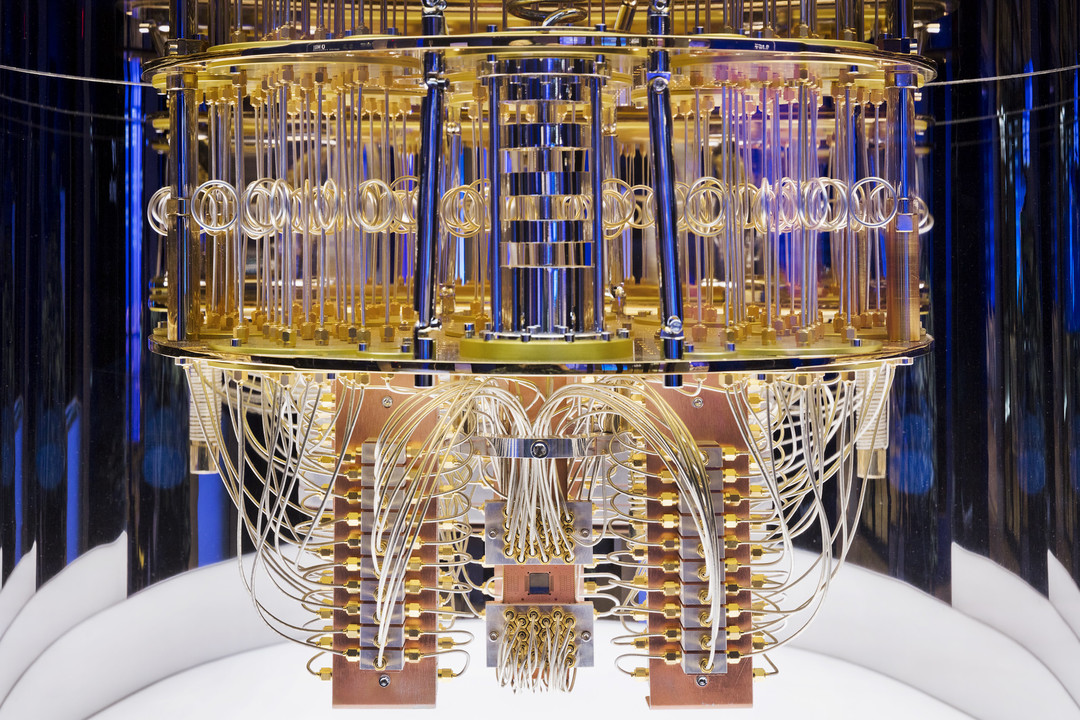
The image depicts the internal components of a quantum computer. It’s a visually striking and complex assemblage of technology. Key features include:
- Central Structure: A large, cylindrical structure forms the core of the image. This appears to be a cryogenic dilution refrigerator, likely housing the qubits. It is metallic, appearing golden/brass in tone.
- Wiring/Cabling: A dense tangle of multicolored wiring (gold, copper, blue, white) hangs downwards from the central structure. These are likely control lines, connecting the qubits to the control electronics. The sheer volume of wiring emphasizes the complexity of operating a quantum computer.
- Stacked Layers: The internal structure is organized into stacked layers, suggesting a modular design.
- Circular Components: The uppermost layer contains several metallic, circular objects, perhaps shielding or other critical hardware.
- Cryogenic Environment: The image is taken in what appears to be a controlled, cooled environment, likely due to the extreme temperature requirements of quantum computing (near absolute zero). This is supported by the use of a white, rounded backdrop.
- Scale: The device is clearly large-scale, implying significant resource investment and infrastructure.
- Aesthetic: The image evokes a sense of advanced technology, precision engineering, and intricate complexity. It has a futuristic, almost baroque quality due to the density and visual texture.
2. Foucauldian Genealogical Discourse Analysis
A Foucauldian approach would examine the discourse surrounding quantum computing – how it is talked about, the power relations it embodies, and the knowledge/power systems it creates.
- Episteme and Power/Knowledge: Quantum computing represents a shift in our “episteme” (a historical a priori of knowledge) - how we understand computation, information, and reality itself. The very pursuit of this technology is tied to power—national security, economic dominance, technological leadership. The knowledge produced through quantum computing isn't neutral; it’s shaped by (and reinforces) existing power structures.
- Disciplinary Practices: The development of quantum computing demands highly specialized skills and knowledge. This creates a disciplinary regime - it controls who can participate in the creation and utilization of this technology, enforcing boundaries of expertise. Those who hold this knowledge wield considerable power.
- Genealogy of Control: We can trace a "genealogy" of the desire for increasingly complex computation – from early mechanical calculating devices to ENIAC, to modern silicon chips, and now to quantum computing. Each iteration represents a drive towards greater control over information and a deepening of our ability to model and manipulate reality.
- Panoptic Potential: The power of quantum computing to break existing encryption algorithms raises the specter of a "panoptic" surveillance state – a society where everything can be monitored and controlled. (This is, of course, a potential, not a certainty.)
3. Critical Theory (Frankfurt School)
Critical Theory, especially drawing on figures like Adorno and Horkheimer, would focus on how quantum computing exemplifies the instrumental rationality of modern technology and its potential for domination.
- Instrumental Reason: Quantum computing is primarily driven by instrumental reason – a focus on how to achieve goals (faster computation, breaking encryption) rather than why those goals are desirable. This can lead to a loss of ethical considerations.
- The Culture Industry: While not directly a product of the "culture industry", the hype around quantum computing (often driven by corporate and governmental interests) can be seen as a form of ideological control, masking the potential downsides and justifying massive investment.
- Domination of Nature: Quantum computing seeks to harness the fundamental laws of nature (quantum mechanics) for human purposes. This represents a continuation of the Enlightenment project of dominating nature – potentially with unforeseen consequences.
- Loss of Autonomy: The immense power of quantum computing, if used for control and surveillance, could diminish human autonomy and freedom.
4. Marxist Conflict Theory
A Marxist analysis would focus on the material conditions underlying the development of quantum computing and the class relations it reinforces.
- Means of Production: Quantum computers are incredibly expensive to build and maintain, requiring massive capital investment and highly skilled labor. This means that access to this technology will be concentrated in the hands of powerful corporations and nation-states.
- Class Struggle: The benefits of quantum computing (e.g., breakthroughs in medicine, materials science) are unlikely to be equally distributed. The ruling class will likely exploit this technology to further consolidate their power and wealth, widening the gap between the rich and the poor.
- Capital Accumulation: Quantum computing represents a new frontier for capital accumulation. Companies that dominate this technology will gain a significant competitive advantage, leading to further concentration of wealth.
- Technological Unemployment: While offering potential benefits, quantum computing could also lead to technological unemployment, as it automates tasks previously performed by human workers.
5. Postmodernism
A postmodern approach would challenge the notion of a singular, objective truth associated with quantum computing and emphasize the role of language, representation, and social construction.
- Deconstruction of "Progress": Postmodern thought would question the uncritical acceptance of quantum computing as "progress." What does "progress" even mean? Whose interests does it serve?
- Simulation and Hyperreality: Quantum computing relies on complex simulations and models of reality. This blurs the line between what is "real" and what is "simulated," contributing to a state of "hyperreality."
- Fragmentation of Knowledge: Quantum computing requires expertise from multiple disciplines (physics, computer science, engineering). This leads to a fragmentation of knowledge and a loss of holistic understanding.
- Relativism: Postmodernism would emphasize that there are multiple interpretations of quantum mechanics and its implications. There is no single, objective "truth" about this technology.
Note on Queer Feminist Intersectional Analysis: While not a primary lens for analyzing the image, it's possible to connect it in the following ways:
- Access and Inclusion: Who is involved in the development of quantum computing? Are marginalized groups (women, people of color, LGBTQ+ individuals) adequately represented? If not, this perpetuates existing inequalities.
- Bias in Algorithms: Algorithms used in quantum computing (or developed using its insights) could be biased, reinforcing discriminatory practices.
- Power Dynamics: The concentration of power in the hands of a few corporations and governments who control this technology can exacerbate existing power imbalances based on gender, race, and other social categories.
I hope this detailed analysis is helpful! Let me know if you’d like me to elaborate on any particular section.
simple-description (llama3.2-vision)
The meme is an image of a computer model of a human brain, specifically a neural network called "DALL-E". The text overlay on the image says "I can generate entire books, documentaries, and even entire universes... but I still can't figure out how to make a decent cup of tea".
tesseract-ocr
ae eS tla lee ee IN a ein ! Wah) will! ob aes a ed ab a5 se | OG CP a ian et een hls oat it i i il Ae eis Fim ae ae