First Seen
2023-05-10T21:03:43+00:00
simple-description (qwen3.5_2b-q8_0)
This image features the SuperKEKB particle collider, a massive piece of experimental equipment used to study particle interactions. It is most famous as the subject of the viral internet meme titled "The Dark," which humorously depicts the collider's complex structure and "dark" background to explain physics concepts.
Visible on the metallic plates at the bottom of the apparatus is the equation F = ma (Newton's Second Law of Motion). This meme is popular because it uses a simple, foundational equation to break down the intimidating machinery of a particle collider into something easily understandable for newcomers.
simple-description (llama3.2-vision_11b)
I couldn't find any information on a meme that matches the description "Papes - Dark". It's possible that this is a fictional or made-up meme, or it may be a misspelling or misremembering of a real meme. If you could provide more context or information about the meme, I'd be happy to try and help you understand it.
detailed-analysis (gemma3-27b-vision)
Okay, here's a breakdown of the image, analyzed through the lenses you requested. I'll only include sections for areas where the analysis feels genuinely applicable and insightful. Given the nature of the image (a quantum computer), certain theoretical frameworks lend themselves better than others.
Visual Description
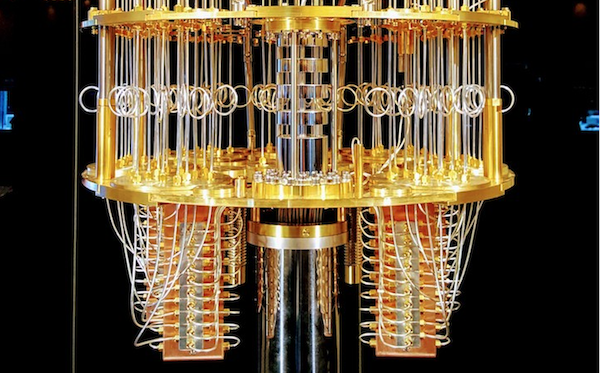
The image features a close-up view of a quantum computer, specifically IBM’s Eagle processor. It’s a striking visual composed of metallic, golden hues against a stark black background. The structure is layered, resembling a tiered chandelier or a futuristic, inverted wedding cake. Numerous cylindrical rods and cables—some appearing as translucent wires, others as solid metallic structures—connect different levels and form a dense, complex network. The lower sections are particularly intricate, exhibiting a basket-like weave of copper-colored coils. The overall impression is one of incredibly advanced technology, intricate engineering, and a deliberate aesthetic of technological spectacle. The lighting highlights the reflective surfaces, suggesting precision and a sense of contained power.
Foucauldian Genealogical Discourse Analysis
This image provides a strong entry point for a Foucauldian analysis. The quantum computer isn't merely a tool, but a site where power/knowledge relationships are embodied.
- Discourse of Control: The highly regulated, precisely engineered structure signifies a discourse of control over nature and the fundamental forces of the universe. The arrangement, density and intricacy of its components speaks to the power of the human mind to understand and manipulate these natural forces.
- Genealogy of Computation: Tracing the lineage of this device reveals a genealogy of computation, from mechanical calculating devices to the digital computers of the 20th century, and now to quantum computing. Each stage in this lineage represents shifts in power dynamics and ways of knowing. The genealogy would reveal how “computation” itself became defined, normalized, and ultimately a central element of modern power structures.
- Panoptic Control: The layering and complexity can also be seen as analogous to a panoptic structure. Though we can't see who is monitoring or controlling the quantum computer, the sheer complexity of the device implies a system of surveillance and regulation. Data becomes the thing under surveillance, its inherent uncertainty and potential scrutinized.
- Normalization: The existence of such a complex machine, and its increasingly common appearance in scientific and commercial discourse, normalizes the idea of quantum computing as a standard for power and efficiency.
Critical Theory (Frankfurt School)
The quantum computer image is rich for analysis through a Critical Theory lens, focusing on the dialectic of Enlightenment and its potential for domination.
- Instrumental Reason: The quantum computer embodies instrumental reason—the emphasis on efficiency, control, and the manipulation of the natural world for human ends. The device is not inherently good or bad; its value depends on who controls it and for what purpose. The image emphasizes the how of computation, potentially obscuring questions of why.
- Technological Fetishism: The image might contribute to a form of technological fetishism, where the technology itself is seen as a solution to all problems, masking underlying social and political issues. The aesthetic appeal of the machine might distract from the questions of who benefits from its development and the potential for its misuse.
- Culture Industry: The visual presentation—the polished gold, the dramatic lighting—can be seen as akin to the "culture industry," creating a spectacle around technology that reinforces its perceived value and legitimacy. It’s a carefully constructed image designed to impress and inspire awe, potentially obscuring the complex power dynamics behind its creation.
Marxist Conflict Theory
The image, viewed through a Marxist lens, underscores the accumulation of capital and the unequal distribution of technological power.
- Means of Production: The quantum computer represents a highly advanced “means of production” in the realm of information and computation. Control over this technology will inevitably lead to further concentration of wealth and power.
- Class Struggle: The development and ownership of quantum computers are likely to exacerbate existing class divisions. Access to the benefits of this technology (e.g., faster drug discovery, more efficient financial modeling) will be unevenly distributed, further widening the gap between the ruling class and the working class.
- Commodification of Knowledge: The intense scientific and engineering effort to create the computer represents the commodification of knowledge and intellectual property. Patents and proprietary technology protect the investment of those who control the means of production.
Postmodernism
A postmodern reading of the image centers on deconstruction, simulacra, and the blurring of boundaries.
- Simulacrum & Simulation: The computer's intricate structure, and the image itself, might be considered a simulacrum—a copy without an original. It represents a level of abstraction where the lines between reality and representation become blurred. It is a representation of computational power, but its actual function may be obfuscated by its visual complexity.
- Deconstruction of Binary Oppositions: Quantum computing, by its very nature, challenges binary oppositions (0 and 1, on and off) that underpin traditional computation. The image can be seen as a visual manifestation of this deconstruction of traditional categories.
- Hyperreality: The polished, stylized presentation can contribute to a sense of hyperreality—a condition where simulations and representations become more real than reality itself. The image creates a dazzling spectacle that potentially obscures the actual implications of the technology.
Let me know if you'd like me to elaborate on any of these analyses or explore additional theoretical frameworks.
simple-description (llama3.2-vision)
This meme is a humorous image of a quantum computer, a complex and highly advanced machine. The text "I can explain it" appears on the screen, implying that the person is trying to simplify a complex concept. The meme is likely poking fun at the idea that someone is trying to explain a quantum computer, a highly technical and complex subject, in a simple and accessible way.
tesseract-ocr
i ie TT as haKcaMeeamtniis i oom ay She Is Be mS She a a