First Seen
2023-05-10T21:03:43+00:00
simple-description (qwen3.5_2b-q8_0)
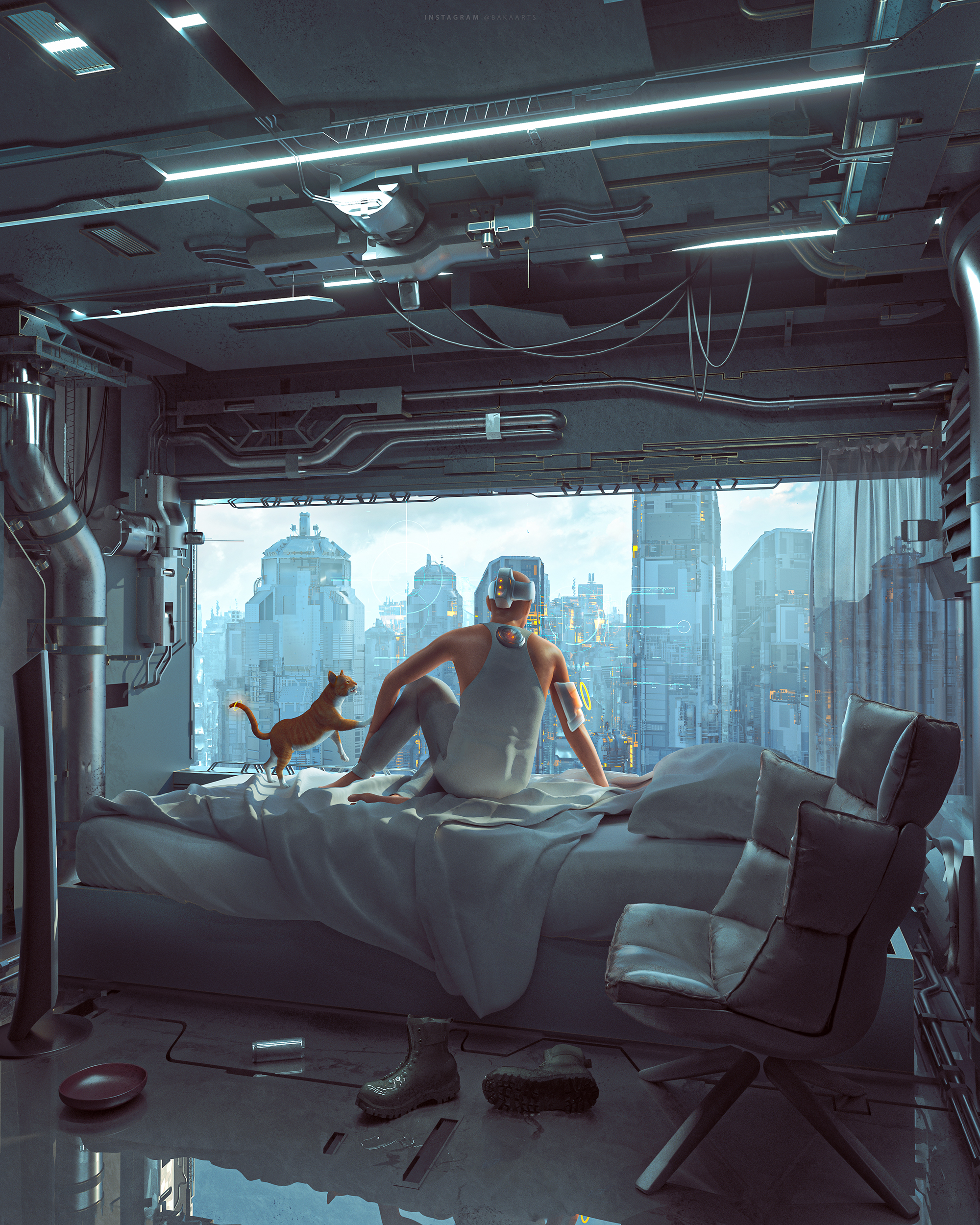
This image captures the essence of the "Papes" meme, a dark internet video format that famously features people sitting alone in cold, depressing, and often surreal apartments to evoke feelings of hopelessness and isolation. Even though this scene is set in a futuristic bedroom with a view of a city, the cool blue lighting and the solitary figure sitting on the bed maintain the "Papas" atmosphere of being trapped in a dark, void-like space. The text "INSTAGRAM @BAKAARTS" at the top suggests this is a user sharing this type of dark, surreal, and often AI-generated humor on social media.
simple-description (llama3.2-vision_11b)
The meme is an image of a person in a dark, futuristic city, surrounded by wires and screens. The text "Papes" is written in a bold, graffiti-style font at the top of the image, and the caption reads "Dark". The meme is likely referencing a fictional or sci-fi setting, and the use of the word "Papes" suggests a connection to a specific genre or theme.
detailed-analysis (gemma3-27b-vision)
Okay, let's break down this fascinating image through the lens of various critical theories.
Visual Description
The image depicts a futuristic, slightly claustrophobic interior dominated by cool blues and grays. A person, appearing androgynous, is seated on a bed in what seems to be a high-rise apartment, gazing out a massive window at a sprawling, technologically advanced cityscape. The interior is heavily industrial with exposed pipes, ducts, and mechanical elements. The bed itself appears streamlined and somewhat monolithic, almost like a molded structure within the space. A small orange cat is on the bed beside the person. Scattered on the floor are various discarded items – empty medicine vials, a discarded face mask, and what appear to be disposable containers – adding to a sense of lived-in, but potentially desolate, reality. Lighting is provided by bright, almost sterile, fluorescent bars. The overall impression is one of technologically advanced living coupled with a distinct sense of isolation and potentially, a degree of disrepair.
Foucauldian Genealogical Discourse Analysis
This image lends itself strongly to a Foucauldian interpretation. The scene suggests a powerful disciplinary apparatus at play.
- Panopticism: The vast cityscape viewed through the window can be seen as a metaphorical panopticon – the many “eyes” of the city (surveillance technology, constant connectivity) watching and influencing the inhabitant’s behavior. The person on the bed is simultaneously observing the city and being observed by it.
- Biopower: The discarded medical vials and mask hint at concerns about health, control of the body, and the normalization of medical intervention. The emphasis on medical technology suggests an attempt to regulate and control life itself. The person in the scene exists within and is defined by these regulatory systems.
- Genealogy of Control: Looking at the historical emergence of the technologies and systems represented (high-tech urban life, constant surveillance, bio-medical regulation), we can trace the evolution of power relationships that have shaped this environment. The image suggests that power is not a top-down imposition but a network of dispersed relationships that permeate everyday life.
- Discourse & Subjectivity: The environment itself produces a certain kind of subjectivity. The person within is not necessarily ‘free’ but is constructed by the discourses of technology, health, and urban living.
Critical Theory
The image resonates with many tenants of Critical Theory, particularly those exploring alienation and reification.
- Alienation: The scene evokes a deep sense of alienation. The sleek, impersonal environment, coupled with the vast, overwhelming cityscape, suggests a disconnect between the individual and their surroundings. The person seems detached, almost lost within the technological landscape.
- Reification: The depiction of a fully technologically advanced society invites consideration of how the tools that humans create end up controlling them. The person within is not the master of the technology, but a subject of it.
- The Culture Industry: The scene could be interpreted as a product of the "culture industry," where mass-produced standardized environments and experiences replace authentic connection. The sterile, industrial aesthetic reflects the standardization and commodification of modern life.
- Loss of Authenticity: The highly stylized, futuristic nature of the image prompts questions about the loss of genuine experience and the dominance of artificiality.
Marxist Conflict Theory
From a Marxist perspective, the image reveals the contradictions inherent in advanced capitalism.
- Class Division: The view of the city suggests a stark contrast between the occupant's relatively isolated, technologically advanced existence and the presumably vast underclass inhabiting the city below.
- Commodification of Space: The entire room can be seen as a commodified space – a product to be bought and sold. The occupant's isolation is a direct result of their economic position and the alienating nature of capitalist production.
- Technological Control: Technology, while appearing progressive, is ultimately a tool of control used by the ruling class to maintain their power. The surveillance implied by the cityscape is a form of social control.
- Exploitation (implied): The opulence of the technologically advanced living space is likely built upon the exploitation of labor elsewhere – a hidden undercurrent beneath the glossy surface.
Postmodernism
The image embraces several postmodern themes.
- Simulacra & Simulation: The cityscape viewed through the window could be seen as a hyperreality – a simulation of a city that is more real than the actual city itself. The occupant is interacting with representations rather than authentic experiences.
- Fragmentation: The image is fragmented – the juxtaposition of industrial elements, technological devices, and discarded objects creates a sense of disjointedness. This reflects the postmodern emphasis on the breakdown of grand narratives and the embrace of multiplicity.
- Loss of Meaning: The sterile, impersonal environment suggests a loss of traditional values and meaning. The occupant is adrift in a world of signs and symbols, without a clear sense of purpose.
- Irony & Parody: The futuristic setting may be viewed as a parody of utopian visions of the future. The dystopian undertones suggest that technological progress is not necessarily synonymous with human liberation.
Queer Feminist Intersectional Analysis
This analysis requires some extrapolation as it's not explicitly foregrounded, but connections can be made.
- Androgyny & Challenging Gender Norms: The androgynous appearance of the figure is significant. The blurring of gender lines challenges traditional binary understandings of identity.
- Isolation & Marginalization: The figure's isolation, combined with the sterile environment, could be read as a metaphor for the marginalization experienced by queer and feminist subjects.
- Technology & Control of the Body: The medical vials and other technological elements relate to debates around reproductive rights and the control of women's bodies, as well as broader issues of body modification and surveillance.
- Intersectionality (implied): Though not explicitly shown, the scene lends itself to exploration of how power structures intersect. The figure may be simultaneously navigating gender, class, or racial/ethnic dynamics within this futuristic setting.
I hope this detailed analysis provides a multifaceted interpretation of the image, drawing on various critical lenses. Let me know if you'd like me to elaborate on any particular aspect.
simple-description (llama3.2-vision)
The meme is an image of a person sitting on a couch, staring out the window at a cityscape. The person is wearing a futuristic-looking headset and has a robotic arm on their side. The text "I'm not lazy, I'm just on energy-saving mode" appears on the screen of their headset.
tesseract-ocr
os we S } ’ a Nee =a — wath ee > a — | a = ; pa a S 4 wi — <a | ws eee : f > Kw = —____— - | a i SSS Se ” ~ Di fos = —— , 4 .\ ie Se ERE = ee MA ec ry fae Tt Se Ee [| i % \ { ~ , I \ Kf: ) ‘we ea) ie vn pen | & ta - (= ove : Eth : % ee 3 ge ea P : | he = 9 4 ; E 7, ee a Aj PN ee wee eo | | i pe ad fe nd _ LS = wail & ; a ij le Se aah it —— mm aa a ee 4 | 4 vo — e. 4 5 Sy . ne ATs. 3 oe ¢ a 2 Cc SE ; \ | =F j PT A if y y a pd Baim ey oe 4)